Showing posts with label Azerbaijan. Show all posts

9.6.15

The musician is a tool...

 
Davod Azad
Nabil Yousof Sharidavi
Give Wine Unto Those That Be Of Mystics
2013

Tracks:

01 - Unless you come
02 - O'epherma
03 - Avaz-e Bayat Turk
04 - What is beyond Adoration?
05 - You are all in my Essence
06 - O' Eternity Realm
07 - Avaz-e Afshari
08 - Ecstatic
09 - Salute to Saints salute to Ecstatics
10 - Avaz-e Homayoun
11 - Be aware

Musicians:

Davoud Azad, 
Javid Ebrahimpour, 
Amin Heydari, 
Nabil Yousef, 
Ghazi Aska.

♫☆`*♥¸¸.•*¨*•♫☆`*♥¸¸.•*¨*•☆♫

.ღ•:*´♥`*:•ღ. 

♫☆`*♥¸¸.•*¨*•☆♫`*♥¸¸.•*¨*•☆♫
  
 His official website [http://www.Davoodazad.com/en] tells us that his “music speaks the universal language of Love and Unity for all mankind.”


Davod Azad is a prominent master of Iranian music who is based in Tehran , Iran . A vocalist , composer & instrumental musician, he is a virtuoso in playing Tar, Setar, Tanbour, Oud, Daf & Robab. Davod was born in Orumieh , Iran in 1963. He began playing music at the age of 19 & began performing & teaching at 21 . His first CD was released when was 25 years old & this CD called "Maktab e Tar e Tabriz" became a classic & a standard for Tar playing.

His musical source is the classical Iranian model system ( Dastgah ) & the Tradition (regional ) Maqam musical form . He is  admired for his unique singing style , which integrates classical & modern spiritual elements, and for his improvisation , which brings a contemporary sensibility to a traditional musical format. For the last 30 years Davod has performed in sufi gatherings around the world , and his compositions to the poems of Rumi are known for their healing & uplifting effect.

Few musicians form Iran have traveled & played before such diverse audiences as Davod. he has performed extensively over the last two decades in Europe,North America the Caribbean,Australia, India,Japan & recently in Bhutan,as well as throughout Iran whit over 300 performances worldwide .He has performed at international festivals ,including the Istanbul international Music festival ,BBc Proms ,Music village (Sacred Voices ) ,Sir John Taverners festival ,the folk festival of Hungary , World in Nord festival in Norway ,Art In Action festival in Oxford England , The Edinburg Spiritual festival Scotland and the institute de Monde Arabe festival in France . Davod is the first Iranian lecturer invited to Oxford University to lecture about Iranian music & its forms. His " The Divan of Rumi & Bach " albums is the first Iranian fusion with Western classical music. The music was performed at many international venues & was played on many Radio stations in Europe Kulture House in Vienna Austria . Davod has also performed for BBC television & for TV network in India & Bhutan.

Davod adds his contemporary vision to the classic Persian musical format to spread a message of human unity. Harmony & peace among nations. His music is universal & appeals people of all religions & backgrounds. 


***


Ancient Sufi love poems inspire these sacred Islamic sounds

Bruce Elder writes:
   
Davod Azad is a physically striking person and a remarkable musician.

In live performance he sits on beautiful Persian carpets accompanied by Shahram Gholami (oud) and Pezhham Akhavass (tambour and daf) and weaves a special kind of Sufi musical magic. Azad's grey-flecked, long hair and wispy beard seem perfectly in tune with the ancient Sufi love poems which he sings in a warm tenor voice accompanying himself on the intricate tar (a Persian stringed instrument) and daf (a frame drum).

Like many Sufi musicians Azad is committed to performing around the world, as he explains in near-perfect English.

"I was born in Tabriz in the Iranian part of Azerbaijan," he says. "I came to Tehran when I was 28. For the last three years I have lived in London and Austria. I have been performing internationally since 1991. I have performed around 200 concerts outside Iran in that time."

His first concert tour of Australia offers local audiences an important extra dimension to their understanding of Sufi music. Until now the only contact Australian audiences have had with this style of mystic music has been through the performances of the Pakistani qawwali singers, the late Nusrat Fateh Ali Khan (who performed at WOMADelaide and in Sydney) and The Sabri Brothers.

Pakistan is only a very small part of the vast Sufi community. Sufism, a deeply spiritual-mystical branch of Islam, which emphasises the divine love of God and the unity of all things, started in the eighth century in Basra (at the time part of Persia), found its spiritual centre in Mesopotamia and Persia, and slowly spread south and west, so that by the 11th century it was well established in the Indian subcontinent and as far west as Morocco.

For Sufis, music and poetry are absolutely integral to worship and, not surprisingly, Sufi music varies according to the culture in which it is created. Thus Nusrat and the Sabris play in a distinctive Pakistani style.

The sacred texts they sing may be shared but their modes of expression are dramatically different from Davod Azad's, which are steeped in a mixture of Iranian classical music, Azeri folk music and an ancient style of Persian Sufi music which has been neither modified nor diluted by Western influences.

In simple terms Pakistani qawwali singers rely on droning harmoniums, dramatic singing and rich harmonies, while Azad's Iranian musical emphasis is more on the intricate plucked interplay between oud and tar, the exuberant complexity of the daf, and quietly beautiful renditions of spiritual poetry.

"I was initiated into Sufism when I was 19 years old," says Azad. "I was not born into a Sufi family. I was really interested in Sufism and mysticism since my childhood. So my music has developed in Sufi sessions."

"I haven't had a teacher in Iranian music. I have learnt by myself. This was the way the music was learnt in ancient times. It was learnt from the masters. I have researched Iranian music and learnt a specific way of playing and singing."

"I have seen all the masters but I have not had them as teachers. I have tried to copy their way of playing. Mostly I have researched old Iranian music."


So is Sufi music essentially religious music?

"We can't say religious," says Azad. "The texts that we sing are about love and truth. All the melodies I compose are based on traditional music because Iranian traditional music is Sufi music. All arts in Iran have been influenced by the philosophy of mysticism. We can't separate them. We need knowledge of traditional music to be able to play Sufi music."

"But that is not enough. After acquiring this musical knowledge the musician needs to be a real Sufi. You must not make a show of yourself on stage. You must not show yourself as: 'I am playing. I am a musician.' "


"The aim is to transfer the feeling to the audience. You should lose yourself inside the music. Otherwise your music will leave people cold."

"The musician is a tool."


source

*♥* 

3.2.15

While my tar gently weeps...

  
Ostad Ali Salimi, Tar
Azerbaijan Music
2001

Tracks:

01. Segah, Zabol 15:40
02. Shur 7:30
03. Tasnif Segah 3:06
04. Reng Chargah 1:37    
05. Tasnif Segah 2:52
06. Tasnif Bayat-E-Shiraz 4:19
07. Fantasy No. 2 2:02
08. Qaitaqi 1:35
09. Bayat-E-Shiraz 19:30
10. Reng-E-Segah 2:03
11. Segah-E-Yatim 11:37

♫☆`*♥¸¸.•*¨*•♫☆`*♥¸¸.•*¨*•☆♫

.ღ•:*´♥`*:•ღ. 

♫☆`*♥¸¸.•*¨*•☆♫`*♥¸¸.•*¨*•☆♫
  
Ostad Ali Salimi was born in 1922 in Baku. Poverty of the family was the major obstacle for him to enter the field of music. His parents encouraged their son to study in science and technics in the hope of overcoming the unpleasant situation. But his fervent adoration for music worked at last, and he persuaded his mother to buy him and instrument. The father objected him, but in vain, and one of his relatives bought a tar for him. Finally his father abandoned his first attitude and accepted the condition. Music lessons began in Salimis' house, with only a single room to live. At the age of 11, he registered as a student in Music School of Ship-manufacturing Factory, where his father worked. The weak quality of teaching caused father to seek for another tutor. He was found, the prominent tar master of Azerbaijan Ahmad Bakikhanof, with whom he developed a rare kind of friendship and intimacy. In those years Stalin government forced Iranians either to accept Soviet citizenship or to leave for Iran. Father was prisoned for 2 months and Salimi abandoned his studies and hid himself until 1938, when all of the family left USSR for Iran. The family settled in Mazandaran and Salimi left there for Tehran. The poverty continued but there was hopeful news which informed Salimi that an Azerbaijani Orchestra had been founded in National Radio. The Council of Music (Moshir Homayun, Ruhollah Khaleqi, Abolhasan Saba, Hoseyn-Ali Mallah) tested the young artist. Salimi had studied composition, counterpoint and harmony before and was regarded as a brilliant artist and at last was appointed as the conductor of the newly-founded orchestra.

Salimi married in 1959 with one of his co-workers. His wife was a symbol of fidelity and sacrifice. Several of Salimi's works were premiered by the voice of his wife. In 1963 the orchestra was disbanded and all of the economic pressure of the family was put on the shoulder of his wife, who worked with sincerity as a dressmaker.


When the "Orchestra of Culture and Art" was founded, Salimi was invited again. The first program was held in Rudaki Hall in the presence of late Ostad Shahriar. It was based on Heydar Baba epic poem by Shahriar and some other works all composed by Salimi, and fortunately it was well received. Then the orchestra toured Iran with great success. Afterwards Salimi went to Tabriz and collaborated with some other masters such as late Qolam-Hosyn Bigje-Khani and late Ostad Dadestanpur. After the revolution, Ostad Salimi worked permanently with Tabriz radio and Television fund and composed many pieces.

In 1962, Rashid Behbudof - the famous tenor of Azerbaijan Opera Company - came to Tehran to give concerts. He was deeply moved by hearing the famous composition of Salimi, Ayrilig and with kind permission of the master, he managed to record this beautiful song performed by himself.

In addition to Airliq - which has been performed in countless versions and arrangements - Ostad Salimi composed many other instrumental and vocal pieces. Of these works Heydar Baba, Siza Salam Gatir Misham, Gejalar are performed and recorded. Some of his compositions have not been published yet, for example a piece for voice and orchestra, based upon the translation of Rubaiyats of Omar-Khayyam. His course book on Azari Tar known as "Tar-e Maktabi" (Scholar Tar Playing) is a precious work in this field.

Ostad Ali Salimi passed away in 1997 in Tabriz. 

May his cherishing memory last forever and ever.

♥

Ayrilig
(Separation)

Azerbaijani lyrics by Farhad Ibrahimi
Music composed by Ali Salimi
 
I cannot sleep at nights, thinking of you.
I cannot get these thoughts out of my mind;
What am I to do since I cannot reach you?
Oh, separation, separation, painful separation.
It's harsher than any pain-separation.
The dark nights are so long in your absence.
I don't know where to go in the dark distance.
The nights have injured my heart so much.
Oh, separation, separation, painful separation.
When I remember your hazel eyes,
I ask the stars of your whereabouts.
Have you forgotten me, now that we are apart?
Oh, separation, separation, painful separation.


♥


"Beloved tar player, composer and music instructor Ali Salimi died in Tabriz in April 1997. Salimi was born in Baku in 1922. In 1938, at the beginning of World War II, Stalin ousted all non-citizens from the Soviet Union. Salimi's mother did not want to be separated from her husband, an Iranian, so she lied claiming that she was a native of Ardabil (Iran) and, thereby, succeeded in getting herself and her children eligible to join the crowds of refugees heading south to Iran. Salimi, a youth at the time, fled with the refugees carrying only his tar across the border.

In the 1940s and 50s, performing music in Iran was associated with drug addicts and smoking opium, but Salimi's music was so dearly loved that officials invited him to start playing everyday on Tehran Radio. He later went on to create a string ensemble for the radio which continued until a few years before the Islamic Revolution (1979).

Salimi is most remembered for the hauntingly mournful melody of "Ayrilig" (Separation), a song set to lyrics written by Farhad Ibrahimi which was an immensely popular hit in the late 1960s both among Azerbaijanis living in the North (Soviet Azerbaijan) and the South (Iran). Both Baku's Rashid Behbudov and Tehran's "Googoosh", a famous Iranian female singer of Azerbaijani descent, popularized it. The song also played a symbolic role in Baku's quest for independence in the late 1980s."


"I had a great love for music from very early childhood. My parents, however, were not musical at all. They thought music would prevent me from doing well in my studies. They were both very religious; that's another reason why they were against my love of music.

But whenever I heard the tar strings vibrate, it used to tug at my heart so deeply. Eventually, my aunt bought me a tar. She told my parents, "Don't you see? This kid is dying for music! Why don't you let him play it?"

And that tar became my life. I used to practice it everyday. I really took care of it, I would varnish it, make it shine. When my father understood how deeply I loved this instrument, he arranged for a music teacher to instruct me at home. A year later, my teacher told my father, "I can no longer teach your son; he already plays better than I do." I was about 11 at the time."

read the whole interviev
  
  
¡♥¡


24.1.15

Fire On The Mountain

 
Dast-i Afshān
Improvisation on garmon, naqara & tombak
2005

Tracks:

01. Ipak (12:19)
02. Araram sani (29:30)
03. Daghlar (11:01)
04. Tombak & Naqara (15:49)
♥

♫☆`*♥¸¸.•*¨*•♫☆`*♥¸¸.•*¨*•☆♫

.ღ•:*´♥`*:•ღ. 

♫☆`*♥¸¸.•*¨*•☆♫`*♥¸¸.•*¨*•☆♫
  
Garmon: Khan Nar Jafarov
  
Naqara: Vahid Asadollahi
  
Tombak: Kambiz Ganjei
 
Khan-Nar Jafarov
Born in 1956 in Baku, he began learning the garmon at the age 16 through listening to performances of the contemporary masters of his time. Then, he developed his understanding of the Azeri maqams repertory under master Mirza Ebrahimov. Nowadays, he is regarded as one of the most prestigious master players on the garmon in the Republic of Azerbaijan and widely performs inside as well as outside the country. There have been published a couple of his recordings in Baku. The present collection is the result of his collaboration with two Iranian percussionists. He is currently the conductor of the Oil Company of Baku Orchestra.

Vahid Asadillahi
Born in 1960 in Tehran, he learned the qaval under his brother while being 11. Then, he switched to naqqare owing to its wider range and studied it with Hushang Zive. Being a player for over 18 years, he made a trip to the Republic of Azerbaijan and extended his technical faculty under Almas Qoliev. Along with the master Safar-Ali Javid he experienced an orchestral performance and his learning there assisted him in his journey to Baku in 1998 a lot. He has so far had various tours to Canada, the United States, Germany, Italy, and France. He has achieved the first rank at Fajr Music Festival twice and appeared in the jury of Regional Music Festival in 2001.

Kambiz Ganjei
The son of Davud Ganjei, the renowned kamanche player. He was born in 1968 in Shahr-e Rey near Tehran. In basic principle of music his first teacher was his father. Then he went for learning tombak with Mahmud Farahmand. He has played in many concerts in Iran and abroad with ensembles Sama` and Mowlana. He began his teaching courses in the Center for Preservation and propagation of Music from 1987. He has attended the class of many Iranian masters such as Naser Farhangfar and Bahman Rajabi to perfect and improve his musical knowledge.

♥♥♥


20.9.11

Jazziza

  
Aziza Mustafa Zadeh
Aziza
1991/93

Tracks:

01. Chargah
02. My Ballad
03. Exprompt
04. Quiet Alone
05. Inspiritation
06. I Cannot Sleep
07. Oriental Fantasy
08. Moment [Short Variation, Based on a Theme by Michal Urbani]
09. Blue Day
10. Character
11. Tea on the Carpet
12. Cemetery
13. Reflection
14. Aziza's Dream
15. Two Candles

Aziza Mustafa Zadeh - Grand Piano / Vocal
 
♫☆`*♥¸¸.•*¨*•♫☆`*♥¸¸.•*¨*•♫
        
        
♫☆`*♥¸¸.•*¨*•☆♫`*♥¸¸.•*¨*•♫
 
   
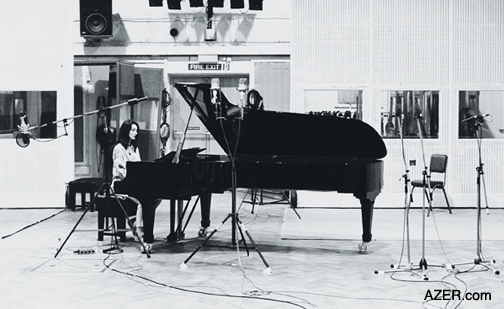
Aziza was born on December 19, 1969, in Baku, the capital of Azerbaijan, into an immensely musical family: Her father, Vagif Mustafa Zadeh, an established Jazz legend throughout the former USSR, of whom BB. King said "people call me the king of the blues, but if I could play the piano like you do, I would call myself God," was a pioneer in as much as he was the first musician to incorporate the traditional music of his homeland, known as "mugam" into popular Western Jazz music. Mugam, itself a highly improvisational style, refers to a modal system of music of which there exist over 70 types, all defined by their specific pattern of intervals, range, as well as direction of melodic movement and rhythm. With her father as architect of the Azerbaijani Mugam Jazz Movement, and her mother Eliza Mustafa Zadeh (in Soviet times known as Eliza Khanom), herself a professional singer and one of the first women to sing in the new Mugam Jazz style, it was only a question of when and how Aziza would express her musical heritage, never an if...
   
Still, she came a long way from the headstrong child fascinated by any kind of art-form (be it music, dance or painting, but bored and annoyed by her early musical teachers, who demanded more commitment to her practicing) to the disciplined professional pianist/singer/composer. Not that she would have lost any of her self-determination. She always liked to have things her way, a philosophy that did not necessarily go down well with her teachers at Baku conservatory where she received classical piano training. While her all to obvious talent was never under dispute, her handling of musical icons was: neither Aziza's trangressive "additions" to Beethoven Sonatas, nor her improvisations on Bach fugues were very much appreciated. "I'm sure Bach would have agreed with it," she said with a smirk at an interview. It was in this same self-confident fashion that she would later on recruit Jazz celebrities such as Al Di Meola, Stanley Clarke, Omar Hakim or Bill Evans as supporting guests on her CD Dance of Fire. The fact that they all came to play her music is not a small achievement for a then 25 year old, not exactly well-known musician. Asked whether she was in the least intimidated by the famous lot she replies: "No. Not at all. In fact, I think I intimidated them a little. It took a lot of time to record and the music was very different. We had to stay up long hours and even then we recorded for the best part of a month."

    Aziza started playing the piano when she was 3 years old, gave her first concerts with 14, and won her first international prizes with 17."It would have been a sin not to use this god-given gift," she muses. Next to God her parents are Aziza's most important musical leaders, especially her father. He tragically died at the early age of 39 of a heart attack after a performance in Uzbekistan, an event both devastating and strangely motivating for the ten-year old girl: With Vagif's death she not only lost her father but a source of inspiration and a gifted mentor for whose unceasing creativity Aziza continues to have the highest appreciation. "He was a genius. A true genius." Vagif continued to influence his daughter beyond his death it seems. Commenting on his death she muses: "For me, my father has never died. He simply has left this earth. I still feel his energy surrounding me. Sometimes, it's like his soul is flying around me, you know. There are times when I give concerts that I feel his presence so strongly, it's almost tangible. It's like I could reach out and touch him." Little surprise that her father is omnipresent in Aziza's work, be it in the form of one of his compositions or in a song dedicated to him.

After her husband's death Eliza Zadeh gave up her own career as a singer and invested her talent and professional knowledge into her daughter's musical education. In so doing she continued a tradition of musical collaboration that had formerly existed between herself and her husband. Eliza not only directed her daughter's vocal training but would later on become her manager, co-producer and confidante in all things regarding Aziza's own career.
In 1989 Aziza left her home Azerbaijan for Germany. At present she lives in Mainz...
 
   
The first CD bears as its title the name of the artist, as simple as that. Aziza presents 15 compositions of her own, where she distinguishes herself primarily as a pianist. These are 15 pearls on a string that need to be cherished one at a time. Although the tracks display an astonishing diversity of character and three of them incorporate her singing voice, the fact that these are all solo piano pieces, and not a small number at that, brings with it the danger of surfeit. The same thing happens if you listen to the entire Goldberg Variations in one go. One needs to give those tracks enough room to expand and display their nature.
Those are not easy-pleasy compositions: clearly, this CD is the most demanding for the listener, since we have become unaccustomed to listen to music that is not technically enhanced or digitally remastered, all the more if it is not "conventional" music.

But if we give it some time there is much to be discovered on this CD, and the more I listen to these tunes the better they get! The track called Inspiration for example shows us how Aziza uses her voice and how she "thinks" musically: her scat-like singing takes up the melody her right hand plays, which is--so typically for mugam--forever moving it seems. To every note there is attached a little trill, an ornament, so as to never let a note just be "plain". And she sings as fast as she plays! Her astonishing vocal abilities are amply displayed in the "Short variation," based on a theme by Jazz violinist Michal Urbaniak, Moment. (Given her singing technique I bet she would be a brilliant wind instrument player). The track Oriental Fantasy shows how Aziza plays with the cliché of Western conceptions of "oriental" music: well aware of the strangeness of some of her harmonies to Western ears and her Azerbaijani origins that make her prone to become the "exotic other," the "Oriental Princess of Jazz" as she has been called, she quickly lets go of supposedly typical oriental harmonies and takes us on a much more idiosyncratic and unconventional musical journey.
       

On the whole, one can say that the amount of "traditional" musical matter is much less prominent than in later productions, and that her compositions are much more avant-garde and jazz-induced. In fact, Aziza draws from the entire texture that the world of music provides for her, and her comment on the initial track Quiet Alone must be understood as a general practice for Aziza's musical understanding. She writes: "This piece was written by my father, interpreted through the prism of my soul. This is a dedication..." In this sense musical allusions are present everywhere and her play is as much a dedication as an exploration of her own personal universe. Tea on the Carpet and Exprompt bear Brackeenesque traits, pieces such as Aziza's Dream are reminiscent of Latin-American harmonies and rhythms, while Character seems to echo Bach, and in what has become the epitome of the art of Jazz improvisation, its variation on a simple, straightforward theme--in superior style--combines modernity with its classical musical heritage. On My Ballad, Aziza for the first time sings in Azeri, exhibiting the mysterious, enchanting beauty of her mother-tongue.


Aziza Mustafa Zadeh is certainly an impressive first work, giving us a pretty clear idea where the immense talent and creativity is going to take this young artist, versed in both technical and expressive skills, acting as composer, pianist as well as singer: straight to the top of the Mount Olympus of Jazz music!


☆
  
♥
listen,
listen,
listen.
  
  
♫

2.8.11

Ashiq


Aşıq Hüseyn Saraçlı
Ruhani

2004

Tracks:

01. Agir Shekili
02. Bagdad Dubeyti(2)
03. Bash Saritel
04. Dagida Bilmez
05. Behrani
06. Dol Hicrani
07. Bagdad Dubeyti(1)
08. Etrafli Dubeyti
09. Qehramani
10. Mechul
11. Ruhani
12. Terif
  
♫☆`*♥¸¸.•*¨*•♫☆`*♥¸¸.•*¨*•♫
        
        
♫☆`*♥¸¸.•*¨*•☆♫`*♥¸¸.•*¨*•♫


Ashiq Hussein Saraclı In 1916, the Republic of Georgia in the Bolnisi district officials sacrifice the well-known person in the family Borcalının Saraclı was born in the village. In 1931, the establishment of collective farms during the period of his father, shot dead by Russian bolsevikləri.

Incomplete secondary education at the school's Saraclı it removes the peak of fame in the real sense, the name of the entire Caucasus, Turkey and Central Asia is still very young age the art of languages ​​əzbəri to the ankle. Saz Ismail learned tutmagı Saraclıda Here, Here and Sarvan Ibrahim Quscunun puxtələsib next holiday. Masters of the famous words of poet Fakhrali Borcalının Nəbinin and other talent bəhrələnib Agacanın yogrulmus with The Gift of God.

Ashiq Hussein Saraclı size-buxunu, sits, posture, speech, along with the conversation, but also the moral - with a high morality was a minstrel. Ashiq, yetisdirib possible Sadaxlı catdırdıgı səyirdləri Ahmad, Muhammad Sadaxlı, Sadi Ulaslı, Nureddin Gasimli and others on the horse, together with the major-lowlander Borcalını dolasar land-land, was invited to the near countries is heavily weddings, meetings would leave.

Ashiq Ashiq Hussein Saraclı was also creative. Languages ​​əzbəri seirlərin were a few epic, "Qurbəti-Karam", "Baghdad dubeyti as" good havalarının Ashiq Hussain was the author of many fiction and documentary film Saraclının speeches, television programs were yarasıgı. "Pipe sound" film caldıgı "spiritual" atmosphere of the great works of art as an example of the eternal life won tamasacını əfsunlayan.

Hussein Saraclı ashigs II and III of convention, held in Moscow in 1959, was an active participant in the art ongunluyunun.

Many of his poems, written articles, short film. Ozan wrote about the great national poet Bakhtiyar Vahabzade: "... He listened eposes Saraclının said. The visit of the master of the literary and figurative Alesker Here's the situation in front of the eyes, such as Performance canlanır. I could watch a beautiful opera. The opera he is the director, conductor and performer, and accompanied by the recipient. At the same time, he is the author of the liberetto, as well as a composer. "

Ashiq Hussein Saraclı Georgian Soviet Socialist Republic in 1980 and was awarded the title of the Honored worker of culture, the art collection of the works in 1992, "Writer" was published. People's poet of his life and works of art related to the activity Zelimkhan James "Hussein Saraclı epos" created account.

Ustad Ashiq died in 1987. Qəbristanlıgındadır Saraclı grave.  

Asıg bust in his native village.
  
  
Hasanov Hussein was born in 1916 in the village Saraclı. From his early years nurtured a love for art ashug, dastans and playing saz. The first teacher of a young Hussein was Ashyg Ismail. He later went to another prominent ashug his time Gushchu Ibrahim. Continued to study the poets and Nabi Sarwan Bayram (both from the village Fahralo). Ashyg Hussein Sarachly played on saz, wrote poetry and read epics.

The funds of the Azerbaijani and Georgian radio and TV recordings are stored Sarachly Hussein. They are used in the classroom on the acting faculty of the Azerbaijan Institute of Art. On the 60-year anniversary, he was awarded the name of "Honored culture" of Georgia.

Hussein died in 1987 Saraclı at age 71.

  
- confusion as usual by google :( - 
  
♥

One in love


Ashik

From Wikipedia, the free encyclopedia

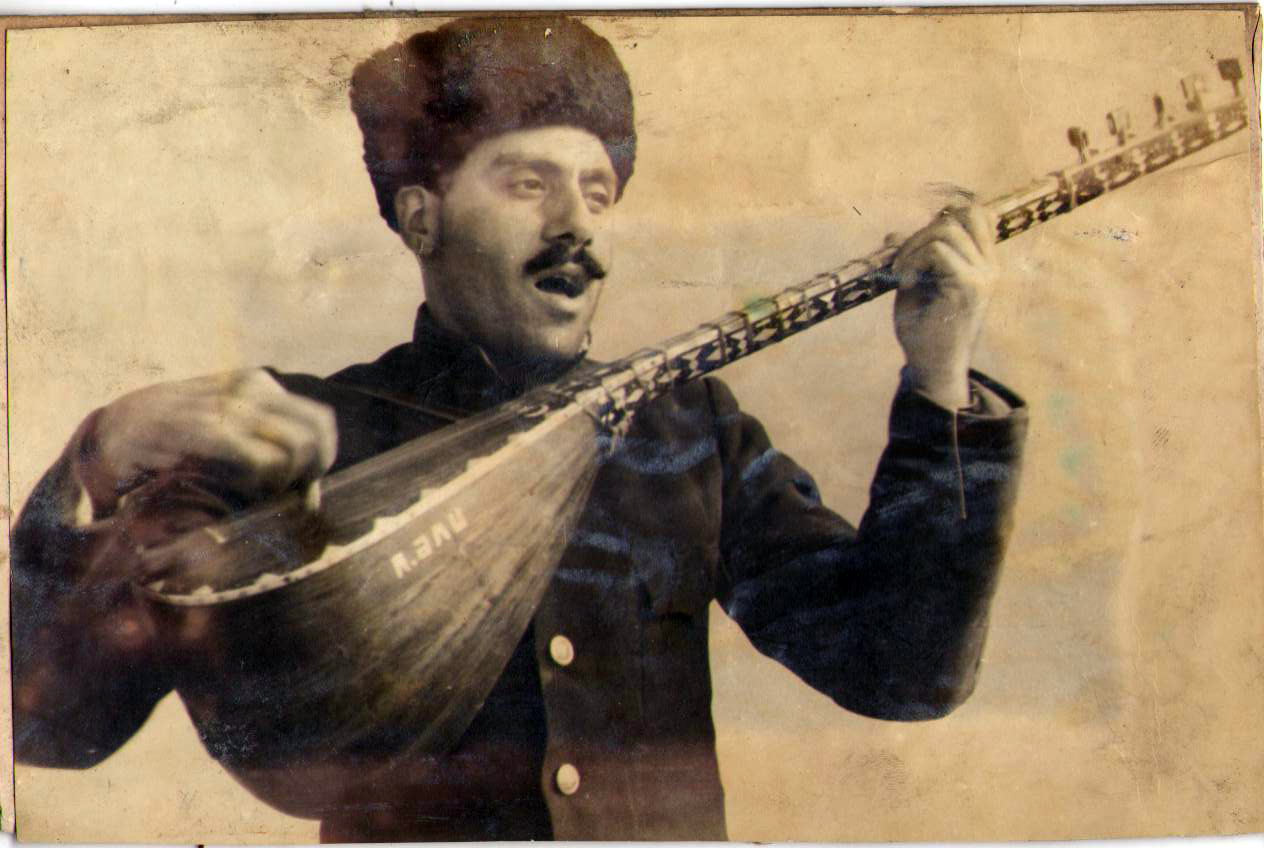
An Ashik (Azerbaijani: Aşıq,Turkish: Aşık}, Persian: عاشیق, Armenian: Աշուղ, ashugh, Georgian: აშუღი, ashughi) is a mystic troubadour or traveling bard, in Turkey, Azerbaijan, Georgia, Armenia, and Iran who sings and plays the saz, a form of lute. Ashiks' songs are semi-improvised around common bases.
The Ashik tradition in Turkic cultures of Anatolia, Azerbaijan and Iran has its origin in the Shamanistic beliefs of ancient Turkic peoples.[1] The ancient ashiks were called by various names such as bakhshi (Baxşı), dede (dədə), and uzan or ozan. Among their various roles, they played a major part in perpetuation of oral tradition, promotion of communal value system and traditional culture of their people. These wandering bards or troubadours are part of current rural and folk culture of Azerbaijan, and Iranian Azerbaijan, Turkey, the Turkmen Sahra (Iran) and Turkmenistan, where they are called bakshy.

Etymology

The word Ashik, derives from Arabic word Asheq (عاشق), and means the "one who is in love (Ishq, Turkish: Aşk),Azerbaijani: Aşiq,Eşq)".
  

1.8.11

Wire in the city of saz...

  
Aşıq Ədalət
Telli sazın sehrində

Tracks:

01 - Yanıq Kərəmi
02 - Naxçıvani
03 - Ruhani
04 - Shəmkiri
05 - Bolu muxəmməsi
06 - Misri
07 - Divani
  
♫☆`*♥¸¸.•*¨*•♫☆`*♥¸¸.•*¨*•♫
        
        
♫☆`*♥¸¸.•*¨*•☆♫`*♥¸¸.•*¨*•♫
  
Among many kinds of the Azerbaijan musical traditions the Ashig performing was always the most popular in all regions of Azerbaijan. They use to name it "the art of Saz-n-Word". Just like today guitar or piano at the West, Saz is often the «family instrument» for Azerbaijan inhabitants, even if in the home there are no professional musicians.

Saz is the conventional pinching instrument of the Turkish people. The Ashig performing with Saz accompaniment is the sequence of the extremely emotional singing, poetically rhythmic speech and short phrases of contrasting simplicity. Saz – is a good fellow traveler of Ashig, wherever he is going to: to love date, cheerful holidays, severe fight with an enemy... This factor also determines the variety of the theme range of the Ashig performance.

Frequently young Ashig (literally: "One in love") beats on strings of the Saz and improvises, poetically praising his love. Most successful from these eastern serenades are saved in memory of the nation and are repeated by other Ashigs. This basic element of the Ashig's repertoire makes them related to such characters of western culture as minstrels.

But probably even more popular kind of Ashig performing is a dastan performance – traditional poetry of long ballads, love stories and legends which public performance transforms into multi hour performance and sometimes is carried on for several days. The most known dastans are Ashig Garib, Koroghlu, Asli and Karam, Gachag Nabi, Abbas and Gulgez etc.

Ashig music is perfectly perceived both in solo performance, and in performance by ensemble. It can be heard both in male, and in female performance.
© azerbaijan.aznet.org 
   
Nəsibov Ədalət Məhəmmədəli oğlu (Ashiq Adalat) - Ashiq, Honored Art Worker.
Ashiq Adalat was born in 1939, in the Kazakh region.
His father learned to play good. Innate talent of the young age of the face, was invited to məclislərə.
Calgısının love with his talent has been the national poet.
The "Qaytarma", "Baş sarıtel", "Ruhani", "Yanıq Kərəm" and other good havalarının unique performer.
 
Aşıq Əli was his master.
 Aşıq Əli
google got to try harder :)

Thanks to Ramin/Shark for introducing me, quite some years ago, to this music, which I love ever since I listened to it for the first time...
♥

11.8.10

Azerbaijan 6

 
Azerbayjan
Musique Traditionnelle
1989
  
Tracks:
01. Zabiollâh Kuliev & Hâbil Aliev - Karabâgh Shekastesi
02. Elkhân Mansurov - Esfahân  
03. Elkhân Mansurov - Mâhur-e Hindi
04. Elmân Badalov - Dilkash-Kurdi
05. Habib Bayramov - Râst
06. Alem Kâsimov, Bahrâm Mansurov & Elmân Badalov - Arazbâre
07. Zabiollâh Kuliev & Hâbil Aliev - Mansuri
08. Hâbil Aliev - Dilkash
09. Bahrâm Mansurov - Shushtar
10. Alem Kâsimov, Bahrâm Mansurov & Elmân Badalov - Osmanli
11. Alem Kâsimov, Bahrâm Mansurov & Elmân Badalov - Ovshar
    
♫☆`*♥¸¸.•*¨*•♫☆`*♥¸¸.•*¨*•♫
        
        
♫☆`*♥¸¸.•*¨*•♫☆`*♥¸¸.•*¨*•♫
  
This record was made by Jean During during a mission of the Centre National de la Recherche Scientifique undertaken in 1985.
1, 2, 3 & 7 were recorded in Baku.
5 & 8 were recorded in Strasbourg, 1984.
4, 6, 9, 10 & 11 were provided by the courtesy of Eldar Mansurov from the Azerbaijan Radio.
  
A Brief History of Azerbaijani Music…
      
Among the “traditions savantes“ from the middle to the Far East, the music of Azerbaijan is one of the least known. Articles written about this musical style are restricted to short encyclopaedic entries or accompanying notes on the back of a record. Nevertheless, the music of Azerbaijan has a firm place among the most elaborate musical traditions of this region, stimulated by the ancient art of modes or “maqāms”, a tradition practised from the Mashrek to the confines of the desert of Gobi. Furthermore, its music has influenced the whole of Trans-Caucasus.

Few peoples have used music with as much fervour, worship and joy as the Azeris. They are profoundly passionate about music, and have time and again, brought forth excellent musicians, even in as remote a place as the mountainous Karabakh.

 One of the reasons of why this tradition is so little know in Europe is to be found in the political and cultural isolation of the Trans-Caucasus. Culturally, the Azeris have remained for a long time in a position of retreat; they have never been interested in founding a reputation of their music abroad. They were content to have a number of academics among their composers, some “people’s artists” a handful of musicologists and ethnologists in order to assure acknowledgment by the central authorities, as well as to converse with sister nations. Something very similar can be said about Turkmenistan, Uzbekistan, and Tajikistan, whose musical traditions share the same fate as that of Azerbaijan. This isolation, however, also had its benefits, since Azerbaijan was able, more than other oriental countries, to preserve its musical authenticity. This doesn’t mean that Azerbaijan and its musicians would have refused to integrate foreign concepts into their own, or that it remained closed towards the outside. A famous example is Bül Bül (1897-1961), the traditional singer who studied bel canto at Milan, and eventually would sing the works of his compatriot Hâijbeyov, who in turn introduced the “Mugam” (the art of Azeri musical modes) into western opera. But despite a very active environment and numerous attempts to fuse traditions, Azerbaijan has been able to preserve its cultural and ethnic identity.

Art Music and Popular Music

The traditional music of Azerbaijan can be divided into two main parts: a “professional” part, in other words, one reserved to highly qualified and trained musicians, and a popular part, whose use does not necessitate a particular qualification. The first domain is that of the art of Mugam, as well as that of the bards (´âshuqs), whereas the second comprises the so-called folk music. A third domain can be assigned to urbane centres and their entertainment music, which includes elements of all domains, as well as western influences.

The “musique savante” or professional music can be divvied up roughly into two zones: the north of the country and a part of Karabagh with a special preference for the art of Mugam, while the south is famous for the cultivation of the art of the bards.

Both traditions have close ties, of course. However, there are certain differences: Contrary to the music of the bards, Mugam music can also be purely instrumental. An instrumental solo, a very important part of Mugam music is very rare in the art of the ´âshuqs, reserved for a few exceptional virtuosos. The art of the bards therefore consists almost exclusively of song, whose leeway for interpretation is rather narrow. Its tradition is purely oral, while Mugam is often based on ancient texts. To work out the specificities of all Azeri musical traditions is, however, extremely complicated, since they all follow a very dense structure that is sometimes hard to comprehend with western concepts of music in mind.
 
Geographical History

Azerbaijan covers most of the region known as Caucasus, as well as the northwest of the Iranian plateau. In 1828 the land was divided up into two parts, one part constituting a province of Iran, while the other was annexed to the empire of the czars, right up to the birth of the USSR in 1920. This whole region was under Turkish influence for several centuries, so that a large majority of the population spoke one of the Turkish dialects.

Azerbaijan is an old home of Iranian culture, with its worship of Zarastrus and the practice of the “religion of fire;” its name ”atra pajân” (the land of the living fire) evokes the spontaneous flames emerging from its petrol fields. The region withstood the conquests of Alexander the Great, as well as the initial Arabic hordes. The Turks only entered the region in the 10th and 12th century, with the vogue of nomadic seldjuqs, who dispersed themselves in the whole of northwest Iran. Long after the Turkish administration was established (middle of 11th century) its regions remained for a long time under Iranian culture, until the Persian language became the official language of the Seljukian court.

After the invasion of Genghis Khan’s hordes in 1220, which culminated in the fall of Baghdad in 1258, the Mongolian dynasty of the Ilkhan established its capital in Marâghe, and afterwards in Tabriz, in the south. Under this rule Azerbaijan lived a prosperous existence.

To cut this long and complicated story short: the Azeris are the result of a mixture of Turks and Iranians (disregarding Caucasian and Armenian elements for the moment), and although the Turkish language has established itself, there remained the refined Persian culture in the cultivated and aristocratic cycles. The relation between these two nations was forged because of the Turkish origin of the sovereigns of Persia, as well as the strong religious tights through Islam of the Shiites as of the 16th century. Another important factor was the shared hostility against the Ottoman Empire, which united Iranians and Caucasians.

The relations between Persian and Azeri music, therefore, are very profound: we can consider each tradition as major braches of the same tree.

 (Source: Jean During, La Musique Traditionnelle de L’Azerbayjan et La Science des Muqams. Baden-Baden & Bouxwiller, 1988.)

10.8.10

Tale Of My Land

   
Rain Sultanov
Tale Of My Land
2008

Tracks:

1. Children
2. Lost Land
3. Father's Tale
4. Mother
5. Ache In My Soul
6. My Angel
7. Tale Of My Land

Musicians:

Rain Sultanov - tenor, soprano sax,
Yasef Eyvazov - oud,
Aleksey Miltikh - cello,
Rauf Sultanov - double bass,
Lala Aliyeva - harp,
Natig Shirinov - nagara,
Ramin Sultanov - drums, davul,
Tofig Jabbarov - percussion.
 
♫☆`*♥¸¸.•*¨*•♫☆`*♥¸¸.•*¨*•♫
        
        
♫☆`*♥¸¸.•*¨*•♫☆`*♥¸¸.•*¨*•♫
  
This recording is a very important event in my life; the project is called, 'Talking about my native land'. I am trying to express all my feelings about my homeland in the language of music, particularly focussing on two generations, children and old people. Children are our future, the aged are our parents, history, our past. The music on the album expresses sorrow for the children who have lost their homes and parents and our concern for those who are living out the last days of their lives; as well as our heartache over the lost territories. These are all the feelings I experience today. Only acoustic instruments will be used in this project. It's not easy, to be honest, but I really want to make it a success. I want to enliven the music with a documentary video; the 'Talking about my native land' project will be a video disc. I think this album will be my best work yet; it will encapsulate many of the moments which I haven't yet been able to express in the language of music and will communicate to the world my native land, its problems and our people. 
R.S.


♥

9.8.10

Azerbaijan


Tale of My Land CD + DVD,
Children, Lost Land, Father's Tale, Mother, Ache in my Soul, My Angel, Tale of My Land

Musicians: 


Rain Sultanov - tenor, soprano sax, 
Yasef Eyvazov - oud, 
Aleksey Miltikh - cello, 
Rauf Sultanov - double bass, 
Lala Aliyeva - harp, 
Natig Shirinov - nagara, 
Ramin Sultanov - drums, davul, 
Tofig Jabbarov - percussion.

all composition by Rain Sultanov
2008, RSA Records Baku, Azerbaijan
Mixed by Jan Erik Kongshaug, Rainbow Studio, Oslo
produced by Rain Sultanov
co-producer Thor Jorgen Skjelbred


♥♥♥

8.8.10

Rain Sultanov

  
Rain Sultanov
City of Jazz
2003

Tracks:

1. City of Jazz 7.23 (R. Sultanov)
2. Baki khatireleri 6.54 (R. Sultanov)
3. Leyla 7.10 (R. Sultanov)
4. Mart 6.29 (V. Mustafa-zadeh)
5. Azerbaijan 5.40 (R. Babayev)
6. Aglama 7.49 (R. Sultanov)
7. Reyhan 5.14 (F. Amirov)
8. Tale about caspian 7.36 (R. Sultanov)

Personnel:

RAIN SULTANOV: Soprano & tenor sax, ewi, bass clarinet, keyboard,sound & drum programming
SALMAN GAMBAROV: piano
RAUF SULTANOV: acoustic bass
TOFIG JABBAROV: percussions
YASEF EYVAZOV: oud
DAVID KOYFMAN: acoustic bass
RUSLAN HUSEYNOV: bass guitar
RAMIN SULTANOV: drums, tabla
OGTAY RUSTAMOV: trumpet

Recorded november/december 2002 in rainstudio Baku, Azerbaijan.

♫☆`*♥¸¸.•*¨*•♫☆`*♥¸¸.•*¨*•♫
        
        
♫☆`*♥¸¸.•*¨*•♫☆`*♥¸¸.•*¨*•♫
 
 Rain Sultanov was born in Baku, Azerbaijan in 1965. Influenced by his mother and two elder brothers, he became a musician although as a child he was more eager to draw and attended drawing classes. When he was 14, his elder brothers decided that he should enter music school, where one of his first teachers was Chingiz Babayev.

He bought his first clarinet with his eldest brother's help. He often listened to famous jazz compositions performed by Miles Davis and Weather Report. Michael Brecker's unusual performances were to have a great influence on him later.

After leaving school, Rain was a clarinettist in the military orchestra for almost four years during his army service.
In 1985, when he was a student at the A. Zeynalli Music College, he won the Rain & Donny McCazlin Azerbaijan Music Contest. Rain became an accomplished performer of classical works by Weber, Tchaikovsky and Mozart and at the same time was a professional performer of well-known jazz compositions.Invited by the famous Azerbaijani composer and singer Polad Bulbuloglu to join the Ashuglar group, he started to write improvisations for his songs, while continuing to play jazz with friends and family. Influenced by Michael Brecker's compositions, Rain wrote several of his own works and performed them on tour. In 1988 he was invited by the outstanding Azerbaijani singer Rashid Behbudov to work at the State Song Theatre.

The same year Rain entered the Azerbaijan State Conservatoire. In 1989, after the death of the Rashid Behbudov, Rain started working with the Gaya State Jazz Orchestra. The number of singers in the group increased under Teymur Mirzoyev's guidance, and many new opportunities came up. Invited by clarinet leader Tofig Shabanov, Rain started working as a soloist in the orchestra the same year. He gained a following as a mature improviser.In 1992 Rain was invited to work with the Azerbaijan Teleradio Symphony Orchestra under the direction of Faig Sujaddinov. This proved to be a critical time during which he prepared several solo jazz programmes for concerts. From 1992 to 1994 Rain performed solo jazz concerts at various jazz and concert halls in Turkey and Moscow. In 1995 Rain wrote his first compositions, Jokers' Dance and Day Off . He Adam Rodgers & Raintook part to critical acclaim in jazz festivals in Germany in 1996 and 1997.1996 was a very successful year for Rain: in Germany he wrote several new compositions, including Last Moment, Crazy World and others.

On returning to Azerbaijan, Rain decided to form the Syndicate jazz group with the participation of his eldest brother Rauf Sultanov (guitar), Eldar Rzakulizade (piano), Gamidulla Xafari (guitar) and Vagif Aliyev (drums). Syndicate performed their first solo concert, Last Moment, on 14th and 15th July 1997. Syndicate's performance of original compositions soon won it the admiration of jazz composers. At the same time, from 1997 to 1998, Rain was performing compositions by John Coltrane and Miles Davis in various jazz clubs in Germany and Baku. "Musicians such as John Coltrane and Miles Davis originated many new Rauf Sultanov , Eldar Rzakuli-zadeh , Evelin Blake , Kurtis Fuller , Vagif Aliyev & Raintrends in jazz and they left a brilliant legacy," Rain says.

In 1998 Syndicate were invited to the World Jazz Festival in Novosibirsk (Russia) where they played alongside internationally renowned jazzmen such as Curtis Fuller (trombone), Adam Rogers (guitar) and Danny Makazlin (clarinet). After the festival, Syndicate received an offer from the festival organizer to record an album. In 1999 Rain shared a stage famous saxophonist Tommy Smith in Baku. Publicly recognized as a professional jazz group, Syndicate recorded their first album, Last Moment, in January 1999. When it was completed, Rain decided to change his image as a composer and move to innovative work with the clarinet. He has now composed his new album, Mugam magam, which is based on Azerbaijani national music. It is an intriguing example of Rain's creativity and musical skill. City of Jazz followed in 2003... 
In 2008 Rain Sultanov completed his work, which lasted two years, on his album “Tale of my land”. Rain calls this project album – book, which contains 40 pages of pictures. Album consists of 2 CDs and lasts for 3 hours. The first CD is music, but the second is a 17-minute movie, directed by Azeri ad Turkish film directors. First part of the album includes an interview with Rain Sultanov; the second part contains jazzman’s music with the pictures in the background, included in the disc. Children, old people, especially the refuges are exposed in pictures. The third part is a mini video clip, with a main leitmotif of war and the horrors it brings.
 
 
wiki


Tale Of My Land ... 
 
Today, only a select few musicians carry the name of Azerbaijani jazz to other countries. Rain Sultanov is one leading saxophone player doing just that. Similarly, not many have gone through such an eventfully rich, and sometimes stormy, period of development. He is certainly a musician’s musician - appreciated by those finely tuned to the highest art.

Rain’s music is thoughtful and suffused with significance.

Rain Sultanov – authoritative jazz musician and leading exponent of different forms of music, with his own style and a plethora of ideas and projects, drawn inexorably to the mysterious world of the future.
 
♥