Showing posts with label Peru. Show all posts

16.11.16

¡Asi Baila Mi Perú!


Perou 
Huayno, Valse Créole Et Marinera
1994

Tracks:

01. Pot-Pourri De Huaynos
02. Lo Cholito
03. Hermitana
04. Le Charangiste Solitaire
05. Adios Pueblo De Ayacucho
06. Tocucha
07. Inti Raymi
08. Bajo El Cielo De Los Incas
09. Huayno De La Merced
10. Mi Peru
11. Como Quisiera Tenerte En Mis Brazos
12. Cantenito De Mis Amores
13. Villancicos De Ayacucho
14. Nube Gris
15. Festejo
16. Marinera
17. Danzas Andinas
18. Las Virgenes Del Sol

♫☆`*♥¸¸.•*¨*•♫☆`*♥¸¸.•*¨*•☆♫

·.ღ•:*´♥`*:•ღ.·

♫☆`*♥¸¸.•*¨*•☆♫`*♥¸¸.•*¨*•☆♫

 Field recordings by Gérard Krémer in "Black" Peru.

Huayno - The Fingerprint of the Incas

Since Huayno lyrics are sung in Quechua, many consider it to be one of the most authentic Peruvian dances. Huayno has been a vessel carrying the essence of Inca culture throughout various generations.

The first references of Huayno appeared in 1586. The book “Vocabulary of the Indians of Peru” mentioned the “Huayñucuni”, a music indigenous people danced behind closed doors. “Huayñucuni” translates as “dancing with a partner, with arms folded.” Under colonial rule, Huayñucuni was rarely danced in public. Its successor, the Huayno, is the root of most Andean dances.

Huaynos are danced in most Andean festivities. They could be classified by the region of origin. Northern Huayno is characterized by joyful steps. Southern Huayno, instead, has cadent rhythms. Central Huayno has animated swings but very tragic lyrics. Why tragic lyrics? Quechuas lived under the despotic rule of mining corporations. Quechuas sang to vent off their sorrows and seek consolation through Huayno.

Vals - The Symbol of Peruvian Criollismo

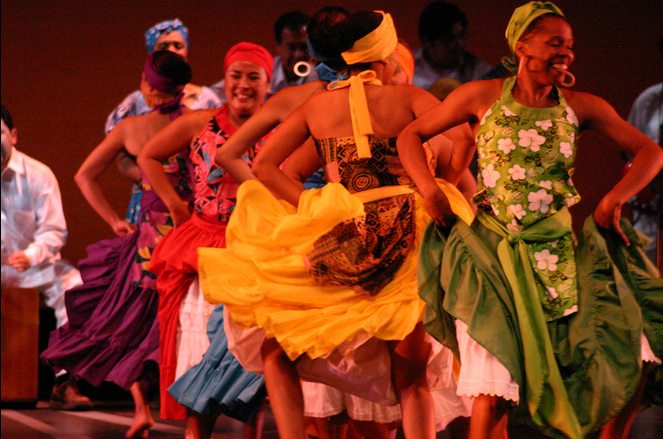
Vals is the most valuable cultural expression of Peruvian criollismo. Due to its multiple cultural influences, Vals is an iconic dance encompassing our vast Peruvian diversity.

Dancing is not an activity disassociated with the world. Every dance is a living entity shaped by both historical and daily events. A minor change in the flow of events can provoke repercussions in the fate of any particular dance. This is how dances are developed, grow or simply decay.

In the late 1890’s, the fusion of African tunes, the French Minuet, the Polish Mazurka, the Viennese waltz and the Spanish jota produced the Peruvian Vals. Most Limeños, who loved Opera, didn’t pay attention to it. Gradually, fabulous performers as Felipe Pinglo and Chabuca Granda brought Vals to great acclaim. If a Limeño from Colonial times would materialize today, he would be astonished to see that Vals, a music generally despised then, is now the main symbol of Peruvian criollismo.

Vals, with slight steps and cadent tempo, is the most conventional of Peruvian dances.

Marinera Norteña - A Romantic Coastal Dance

Hands down, Marinera is the most iconic of Peruvian coastal dances. Along with Vals, Marinera also imbibed a manifold of cultural currents. Therefore, any serious exhibition of Peruvian dances would be incomplete without Marinera.

Despite multiple theories, Marinera probably arose from Zamacueca. There is a striking resemblance in the steps of both typical dances.

While men danced Marinera wearing shoes, women did so barefooted. Proud of their fortitude, women even sought coarser grounds to dance on. Hence, they created the motto: “the coarser the ground, the greater the dancer.” Women then exhibited their calloused soles to earn the respect of skillful dancers. Some women also danced Marinera holding a Chicha bottle on their heads.

Although we also have ‘Marinera Limeña’, ‘Marinera Norteña’ surpassed the former in popularity. The Norteño dance exudes joy, energy and speed. “La Concheperla” is the most popular Marinera song.

Why was it named Marinera (Sea dance)? Nobody knows. The swings and swirls of ‘Marinera’ assimilate those of sea waves. And some say Trujillano seamen may have baptized it so. Others assert that Trujillano writer Abelardo Gamarra picked that term in 1879.


*♥*

11.7.15

Just follow the river...

 
Huayno
Music Of Peru
Vol. 1
1989

Tracks:

01. Río de Paria - Jilguero Del HuascaraN - 3:03
02. Chonginada - Los Romanticos De Sicay - 2:55
03. Quisiera Olvídarte - Pastorita Huaracina - 2:33
04. Señor Diputado - El Cholo Chanka - 2:28
05. Carnaval Cristalchay - Conjunto Musical Amauta - 3:09
06. Neblina Blanca - La Huaricinita - 2:48
07. Misti Gallo - El Cholo Chanka - 2:04
08. Señor Diputado 2 - La Pallasquinita - 3:07
09. Cholo Orgulloso - La Pallasquinita - 2:40
10. Vengo del Prado - Rio Lira Paucina - 2:42
11. Vaca Ratay - Duo Las Perlas De Huancavalica - 3:07
12. Urpichalláy - Conjunto Los Chankas Apurimac - 2:09
13. Mis Quejas - Conjunto Los Chankas Apurimac - 3:06
14. Chall Huaschalláy - Conjunto Condemayta De Alcomayo - 2:42
15. Perlas Challáy - Perlas Challay - 3:26
16. Tostando Cancha - FabiaN Ochoa - 2:50
17. Engaños del Mundo - Enganos Del Mundo - 2:35
18. Pio, Pio - Amanda Portales - 3:29
19. Inti Sol - Manuel Silva - 3:38
20. Adiós Caminito - Julia Illanes - 4:02
21. El Hombre - Manuel Silva - 3:43
22. Licor Maldito - Julia Illanes - 4:05

♫☆`*♥¸¸.•*¨*•♫☆`*♥¸¸.•*¨*•☆♫

.ღ•:*´♥`*:•ღ. 

♫☆`*♥¸¸.•*¨*•☆♫`*♥¸¸.•*¨*•☆♫

 Music from the Peruvian Andean heritage by popular commercial recording artists who came from the high mountains to Lima in search of better economic opportunities. 

Edited by John Cohen. 

Originally released on 45s by Discos IEMPSA 1948-89.

***

 “Except for a few cuts on anthologies, this is the first U.S. release of what album editor John Cohen calls the `popular music of the Andean people,' played by the region's `hillbilly musicians.' Like American `country' music, Huayno (pronounced `wino') is the result of the meeting of traditional mountain music with its high-pitched vocals, insistent beat, and breathy flutes - and more commercial, urban sounds, including those of Colonial music from Spain. Like contemporary North American musical hybrids, moreover, the kinds and combinations of instruments are often surprising: harps and harmonicas, mandolins and saxophones, panpipes and accordions, as well as guitars, violins and charangas. While many of the album's twenty-two cuts are highly arranged, none exhibits the self-conscious eclecticism of much of today's `new' music. Nor, though the sound is often ethereal and spacey, does this music display the directionlessness of the New Agers. What it does reveal is an emotional intensity, most clearly evident in the high sometimes strident, femaIe vocals and slippery violins, and an exuberence bordering in places on the boisterous, with lots of whooping, clapping and shouting. In short, it is both weird and wonderful. John Cohen's notes place the music in its cultural-social context and point out the distinctions among the various regional Huayno styles. Translations for most of the songs are also included.”

-Mark Greenberg — Sing Out!

“Huayno (pronounced `wino' ) is the everyday music of the Peruvian Andean people. Dating back to the Incas, Huaynos have evolved but keep a particular rhythm (a stressed 1st beat followed by two short beats) tunes cover a broad canvas, instrumentals and songs instruments include fiddle, harp, mandolin, accordion, saxophone, guitar, and lute. Even when the playing is exuberant and accompanied by cries of joys, there remains the profound sadness that is such a distinctive feature of Andean music.”

-Paul Lashmar — Folk Roots

Huayno 

(Wayñu in Aymara and Quechua) is a genre of popular Andean Music and dance originally from Serrania, Peru. It is especially common in Peru, but also present in Chile, Bolivia, Argentina and Ecuador, and is practiced by a variety of ethnic groups, including the Quechua and Aymara people. The history of huayno dates back to the colonial Peru as a combination of traditional rural folk music and popular urban dance music. High-pitched vocals are accompanied by a variety of instruments, including quena (flute), harp, siku (panpipe), accordion, saxophone, charango, lute, violin, guitar, and mandolin. Some elements of huayno originate in the music of the pre-Columbian Andes, especially on the territory of former Inca Empire. Huayno utilizes a distinctive rhythm in which the first beat is stressed and followed by two short beats.

Dance

The dance begins with the man offering his right arm to the women as an invitation for her to dance (there is even a special word for this action, Quechua: wayñukuy "to invite woman to dance a wayñu"). Alternatively, he puts his handkerchief on the shoulder of the woman. Next, the partners walk along an enclosure, and finally they dance. The dance consists of an agile and vigorous stamping of the feet during which the man follows the woman, opposite to front, touching her with his shoulders after having turned around, and only occasionally he touches his right arm to the left hand of his partner while both swing to the rhythm of the music. His movements are happy and roguish.

- wiki


♥

10.7.15

Down in the Valley...


Huaynos y Danzas
Religious and secular music 
of the Callejón de Huaylas, Peru
1999

Tracks:

01. Shaqshas - Group of Men from Carhuaz - 4:38
02. Huanquillas - Group of Men from Huauya - 2:51
03. Antihuanquillas - Processional Band From Carhuaz - 2:18
04. Ñustas - Processional Band From Carhuaz - 4:10
05. Caballeros De Huari - Processional Band From Carhuaz - 2:25
06. Negritos (Little Negroes) - Negritos - 3:43
07. Atahuallpas - Hijos Del Sol - 2:50
08. Cajas and Huanquillas - Processional Band From Caraz - 3:24
09. Cajas and Roncadoras - Processional Band From Huaylas - 2:47
10. El Condor Pasa - Banda Musical Estrella Andina - 4:09 ♥
11. Rio Santa - Lorenzo Piscoche & Victor Mejia - 1:53
12. A Los Filos De Un Cuchillo (To the Edges of a Knife) - Eloy Cano - 2:56
13. Tomando Cerveza (Drinking Beer) - Pastor Aguilar & Remigio Rojas - 2:37
14. En El Cielo Las Estrellas (Stars Are in Heaven) - Feliciano Oliveira, Lucio León & Alberto Oliveira - 2:42
15. Huaraz Cuculi (Dove from Huaraz) - Los Aventureros de Tumpa - 2:36
16. Hay Noches (There Are Nights) - Juventud de Yungay - 2:23
17. Hoy Estoy Aqui (Today I Am Here) - Banda Orquesta Hijos de Shupluy - 2:20
18. Ayer Te Vi (I Saw You Yesterday) - Los Hermanos del Ande - 2:51
19. Contamenina - Pedro Espinoza - 3:14
20. Yungay - Los Jilgueros de Matacoto - 2:51
21. La Resbalosa (The Slippery One) / Pichichanka Maliciosa (Naughty Sparrow) - Juventud de Yungay - 4:36
22. Muchachita No Seas Celosa (Little Girl, Don't Be Jealous) - Pedro Espinoza - 3:20
23. Kiswar Punta [On Top of Kiswar Hill) - Pedro Espinoza & Lorenzo Piscoche - 2:24

The recordings were made in 1980-1981, during an 18 month stay in the valley by Elisabeth den Otter.

♫☆`*♥¸¸.•*¨*•♫☆`*♥¸¸.•*¨*•☆♫

.ღ•:*´♥`*:•ღ. 

♫☆`*♥¸¸.•*¨*•☆♫`*♥¸¸.•*¨*•☆♫

  The Callejón de Huaylas is a 150 km. long valley in the Department of Ancash, in the north-central Peruvian highlands, 400 km. north of Lima. It is bordered by two mountain ranges, the Cordillera Negra (Black Range) to the West and the Cordillera Blanca (White Range) to the East. As the name indicates, there is no snow on the peaks of the Black Range; the glaciers of the White Range, like the Huascarán, reach over 6,000 meters above sea level. In 1970, an earthquake loosened a piece of this glacier, causing a mud avalanche which destroyed a number of villages. The Santa river runs all along the valley, into the Pacific Ocean near Chimbote.

The population of the Callejón consists of Quechua-speaking indians, mostly peasants who live in the mountain villages, and Spanish-speaking Mestizos (people of mixed indian and Spanish origin) who live in the small towns along the Santa river. The Mestizos dominate the indians, economically and politically, but changes in the life of the indians are brought about by (temporal) migration, education, military service and tourism.

The beauty of the valley, the horror of the earthquake, and the difficult everyday life of the inhabitants are the subjects of many songs.

Secular music & Religious music


Secular forms of music and dance in the Callejón de Huaylas are the huayno, the marinera and the waltz.

Religious music is played mostly during processions, at the occasion of patron saint festivals, Holy Week and Corpus Christi. Flute and drum ensembles and brass bands play special music, and traditional dance groups are accompanied by flutes and drums, harps and violins, or brass band instruments such as clarinets. During patron saint festivals, secular music - mostly huaynos - is played in the homes of the sponsors or in small bars...

 
read it all here : )
  
 
The population of the Callejón de Huaylas is primarily Quechua and Spanish-speaking Andeans, most of them small-scale and subsistence-farmers living in mountain villages, mixed with Spanish-speaking Mestizos in the small towns and cities along the Santa river. The richer Mestizos dominate politically and economically, but migration, education and tourism have brought changes in the population in recent decades.

Most Quechua families adhere to traditional forms of food, music, and dress, yet still have cell phones and typically raise Guinea Pigs and other farm animals in their farms. Although men have typically adopted modern pants, collared shirts and sweaters, Quechua women continue to wear llikllas and layered colored skirts called polleras in Spanish. Both men and women wear llanq'is, rudimentary sandals in the traditional style, although they are now made from recycled rubber from car tires. One can buy them in any size from the various markets in the region, for around 5 soles a pair.

  
♥


22.5.15

Nadah Benagolze

  
Wood That Sings
Indian Fiddle Music of the Americas
1997

Tracks:

01. Violín - José Enrique Benítez - 2:54
02. La Guaneña - Danubio Azul Group, The - 2:34
03. Danza a Santiago - Townspeople of Llacuari Pueblo - 3:02
04. Kariso - Antonio Lorenzano - 1:20
05. Araku - Gervasio Martínez - 2:10
06. Nantu ("Luna") - Pedro Nayap - 3:39
07. Yan Tox - Mateo Mo Xal and Crisanto Coc - 2:08
08. Jacaltenango - Grupo Jolom Conob - 3:52
09. Aires Fandango - Marcelino Poot Ek, Pedro Ek Cituk, and Esteban Caamal Dzul - 4:39
10. Tzacamson - Townspeople of Tancanhuitz - 1:55
11. Son Para Entregar a la Novia - José Augustín and José Martín Cruz - 4:00
12. Wiricuta - Mariano, Pablo, Rosenda, and Augustín - 2:05
13. Melody Played on the Enneg - Francisco Barnet Astorga - 0:48
14. I'll Go with You - Chesley Goseyun Wilson - 3:25
15. Pahko'ola Dance Song - Felipe Molina and the Yaqui Deer Singers - 3:37
16. Never Alone - The San Xavier Fiddle Band - 2:15
17. Strathspey and Reel Medley - Lee Cremo Trio - 4:49
18. Jig Medley - Lee Cremo Trio - 5:13
19. Finale Medley - Lawrence Houle - 7:26
20. Eagle Island Blues: Athapaskan Love Song - Bill Stevens, Frances Williams, and Lisa Jaeger - 4:28
21. Turkey in the Straw - Georgia Wettlin-Larsen - 1:17
22. Road to Baroche - Jimmie LaRocque, Gerry McIvor, and Kim Chartrand - 2:28
23. Big John McNeill - Jimmie LaRocque, Gerry McIvor, and Kim Chartrand - 2:07

Countrys:

Argentina; Bolivia; Canada; Colombia; Ecuador; Guatemala; Mexico; Peru; United States; Venezuela
 
Culture Groups:

Apache; Assiniboine; Chapaco; Gwich'in; Huichol; Kanjobal Maya; Kekchi; Maya; Mbya; Micmac; Nahua; Ojibwa; Quechua; Seri; Shuar; Tenek; Tohono O'Odham; Warao; Yaqui

Instruments:

Baritono; Bombo (Drum); Enneg; Fiddle; Flute; Guitar; Harp; Jigger; Kitar; Monochord; Piano; Rebec; Seke-Seke; Tambura; Tiple (Plucked instrument); Torola; Trumpet; Violin

♫☆`*♥¸¸.•*¨*•♫☆`*♥¸¸.•*¨*•☆♫

.ღ•:*´♥`*:•ღ. 

♫☆`*♥¸¸.•*¨*•☆♫`*♥¸¸.•*¨*•☆♫

This anthology of Indian fiddle music of the Americas features performances by Indian musicians from Nova Scotia and Manitoba to North Dakota and Arizona, to Mexico, Peru, and elsewhere in Latin America. Using this most popular of instruments as a way to explore the great variety and creativity of Indian musical traditions—from chicken scratch to the indigenous Apache fiddle—this recording expresses the capacity of Native cultures to adapt and synthesize non-Native influences.  


Chasi, Bonito's Son, an Apache musician playing the "Apache fiddle"

 Jonathan Colcord writes:

 Here is an interesting anthology of songs performed by native Americans. My first reaction to these recordings was that they were old. While much of the material may be, the recordings are all of relativley recent vintage. The most wonderful aspect of this release is the way the works are placed in relation to one another, almost like a musical map. It begins in Bolivia with a piece simply titled 'Violin' from Jose Enrique Benitez. We are moved from there to Colombia, Peru, Venezuela, Agentina, Ecuador, Guatamala, and into Mexico. At this point you realize what is happening stylistically as we progress northward. Familiar western styles begin to emerge, epecially when Mexico emerges.

From there we move into Arizona, and from there, clear up to Cape Bretton. Mi'Kmaq group the Lee Cremo Trio play relatively straight forward Cape Bretton style fiddle music much to my surprise. It becomes more of a tribute to native musicians themselves than another collection of traditional songs, otherwise obscure. When we arrive in Manitoba, the styles bend more toward country fiddling even including a bit of the 'Orange Blossom Special'. In the US, stops are made in Alaska, Wisconsin, and North Dakota. One of the highlights for me was Jimmie Laroque, a Chippewa from Norht Dakota and 'Road To Batoche', a song which reminded me of 'Jerusalem's Ridge', one of my all-time favorite fiddle-tunes. Another high-point is Georgia Wettlin-Larsen, Assiniboine Nakota from Wisconsin performing 'Turkey In The Straw' including vocals in both English and her native language.

 Jim Nelson says:

Listening to this CD is like taking a musical journey among the Indian peoples that reside throughout the Western Hemisphere, from the Chapaco in Argentina to Gwich'in Athapaskans in Alaska, with stops all along the way. Some folks may be a bit surprised by the fact that fiddling itself is so commonplace among such diverse Indian cultures, and at the same time, by how remarkably similar some of this music sounds to fiddling traditions in the U.S. and Canada which derive directly from Scottish, Irish, and French sources with which they may be familiar. In fact, some of the fiddlers included here play in a style that is virtually identical to their Anglo counterparts. Leo Creomo and his trio, for example, play straight-ahead dance tunes not unlike those heard played throughout their native Cape Breton Island. Metis fiddlers Lawrence "Teddy Boy" Houle and Jimmie LaRocque both exhibit traces of Scottish as well as other European-rooted traditions, including Irish and French-Canadian. Both, for instance, play the well-known tune "Big John McNeill." Houle plays a medley of tunes that suddenly careens into bluegrass territory with versions of "Orange Blossom Special," "Old Joe Clark," and "Boil Them Cabbage Down."

While some of the tunes and styles played by the fiddlers from the U.S. and Canada often seem to have some familiar quality about them, the music on this disc played by the South and Central American musicians definitely sounds like it comes from a different time and place. Alternately mesmerizing or high-spirited, down-to-earth or downright spooky, the music captured on this CD is some of the most captivating and beautiful that I have experienced in some time. It is next to impossible to pick out favorites among the pieces as I hear something completely new each time I give this disc a listen.

This CD is a joint project of the National Museum of the American Indian and the Smithsonian Institution. The music was for the most part, recorded "in the field" by ethnomusicologists and folklorists from all parts of the Americas. As one might expect, the accompanying notes are extensive and informative, scholarly yet comprehensible, and help to provide the listener with clear contextual background about the music, the various types of violins and other instruments played, and the people who play them. The notes, which include bibliographical references, a discography and videography help to promote the sense that this CD is an important document. Any way one approaches it, Wood That Sings contains some lovely and captivating listening.  
 
Highly recommended.


 *♥*