Showing posts with label Congas. Show all posts

11.11.13

A mi me gusta la Plena!

  
Plena Libre - Mas Libre
2000

Tracks:

01. La Plena Bien Sabrosa
02. Maria Luisa
03. El Bravo
04. Tema De Luis Gabriel
05. Chiviriquiton
06. Somos Diferentes
07. Malcria'o
08. Quiereme
09. A Mi Manera
10. Dos Ojos
11. Pa'qui Pa'lla

Plena Libre es:

GARY NUÑES - Bajo "baby" y eléctrico, coro y arreglos musicales, productor y direción musical
ISRAEL VELEZ - Pandero Seguidor 
ANGEL SANTIAGO - Pandero Seguidor
PABLO GONZALEZ - Güiro y percusión menor
GINA VILLANUEVA - Congas
VICTOR MUNIZ - Cantante, coro y punteador
RUBEN ROMAN - Cantante, coro y percusión menor
CARLOS "KALIE" VILLANUEVA - Cantante y Percusión menor
RAFAEL TORRES - Piano y teclados
EDWIN CLEMENTE - Timbal, batá y campana
RAFAEL TORRES, DANIEL FUENTES, ANTONIO VAZQUEZ, JORGE DIAS, VICTOR VAZQUEZ - Trombón
TITO ALLEN - Coro 

Músicos Invitados:

JOSE ALBERTO "El Canário" Cantante en "Somos Diferentes"
NESTOR TORRES Flauta en " Tema de Luiz Gabriel"
PEPE LUCAS Piano en "Malcria'o"
CHARLIE SEPULVEDA Trumpeta en "El Bravo"
JORGE LABOY Guitarras en "El Bravo" y " Quiéreme"
FREDDIE DIAS Percusión brasileña en "El Bravo"
JUAN CASTILLO Sinfonía de mano en "Mária Luisa"
GEORGIE SALGADO Batería en "Quiéreme"
HECTOR PEREZ Güiro cubano y maracas en "El Bravo" y "Somos Diferentes"
   
♫☆`*♥¸¸.•*¨*•♫☆`*♥¸¸.•*¨*•♫


♫☆`*♥¸¸.•*¨*•☆♫`*♥¸¸.•*¨*•♫
   
 Founded by bassist Gary Nunez in 1994, Plena Libre reclaimed the long-ignored Puerto Rican folklore-derived plena style from the obscurity following its brief '50s/early-'60s popularity. Contemporary dance arrangements were all that was needed to return the style to prominence; the group's debut album, Juntos Y Revueltos, was recorded on a shoestring budget, but proved an instant sensation on the island. Subsequent recordings included an eponymous 1998 album, Plena Libre's first for the international market. Mas Libre followed two years later. 


Plena Libre revives the best of Puerto Rican musical traditions
 
By Jesse "Chuy" Varela

 
TALKING TO bassist Gary Nuñez, leader of the Puerto Rican ensemble Plena Libre, you realize he's on a mission to modernize some of the island's oldest beats with a new outlook. Born out of the island's Afro-Caribbean experience, the sounds of bomba y plena are what musically identify the African-Spanish heritage so prominent in its culture. Sometimes messing with tradition is not looked at favorably, but not with Plena Libre. "We're considered one of the top orchestras regardless of genre," says Nuñez in Spanish from his home in San Juan. "Yes, Plena Libre is a bomba y plena band, but people don't see us as that. We're like any other artists interpreting our music."
 
They are considered youthful revivalists who rescued a genre that fell into obscurity after its reign of popularity in the 1950s with pivotal figures like Rafael Cortijo and Ismael Rivera. Since its formation in 1994, Plena Libre has unclogged the cultural logjam against these folkloric forms and scored a hit with "El Party." As a result, the band has inspired many salseros and young Puerto Rican jazz artists to explore these traditional rhythms.    

  
The bomba y plena garnered a foothold as a popular expression in the late 1800s. During the Spanish-American War, the idiom served as the newspapers of the people as troubadours sang about events and prominent figures. It was largely a guitar and hand-percussion sound with soulful, tearful voices. In the 1920s, it migrated to New York City, and troubadours like Rafael Hernandez and Manuel Jimenez ("Canario") became the voice of the people. The essence of bomba y plena lies in its communal form as a percussive act of call and response. Plena Libre makes strong use of these rudiments, including the handheld panderetas, to pound out infectious beats on tambourinelike hand-drums without the metal shingles.
 
"We put the panderos back in fashion," Nuñez explains. "They disappeared with the music of Rafael Cortijo, who was the first to begin using conga drums to play bomba y plena. The panderos were forgotten. They are instruments that were invented to be played with this music. That's why we use them." From its 1995 self-produced debut CD, Cogelo, que ahi te va!, the 13-piece Plena Libre has stayed largely intact with virtuosic performers like conga-drummer Gina Villanueva and singer Giovanni Lugo. The band's latest album, Mas Libre (RykoLatino), features the prolific songwriting skills of Nuñez.
 
"For our generation, thematic subjects from a bygone era about sugarcane and trains don't connect," Nuñez says. "Our reality has to do more with cellphones and beepers. We're another generation that bring a different point of view which I try to reflect in the themes Plena Libre touches. I believe that we need to show who we are today as Puerto Ricans. So we do songs that touch on the question of Vieques and that articulate the sentiments of our people--in principle, we are still troubadours." 
 
  
 ...Whereas bomba is purely African origin, plena blends elements from Puerto Ricans' wide cultural backgrounds, including music that the Taíno tribes may have used during their ceremonies. This type of music first appeared in Ponce about 100 years ago, when performing the plena became a hallmark of Spanish tradition and coquetry.
 
Instruments used in plena include the güiro, a dried-out gourd whose surface is cuts with parallel grooves and, when rubbed with a stick, produces a raspy and rhythmical percussive noise. The Taínos may have invented this instrument. From the guitars brought to the New World by the Spanish "conquistadores" emerged the 10-stringed cuatro. To the güiro and cuatro added the tambourine, known as panderos, originally derived from Africa. Dancing plena became a kind of living newspaper. Singers recited the events of the day and often satirized local politicians or scandals. Sometimes plenas were filled with biting satire; at other times, they commented on major news events of the day, such as a devastating hurricane.

Bomba y plena remain the most popular forms of folk music on the island, and many cultural events highlight this music for entertainment. ...


♥

13.5.11

Friends

  
Humberto Ramirez & Giovanni Hidalgo
Best Friends
1999
 
Tracks:

1. San Juan Ritual
2. Celebrando
3. Hasta Decir No Mas
4. A Puerto Rico
5. Clean
6. Herencia
7. La Perla
8. Best Friends

Personnel:

Humberto Ramirez : Trumpet
Giovanni Hidalgo : Percussion
Oskar Cartaya : Bajo Sexto
Papo Lucca : Piano
Horacio "El Negro" Hernández : Bateria
Carmen Luz Quiñones : Peinado

Special Guests:

Tito Puente : Timbales

and with a very special appearance by their fathers:

Humberto "Pipo" Ramírez on Tenor Sax
José "Mañegue" Hidalgo on Congas.
  
♫☆`*♥¸¸.•*¨*•♫☆`*♥¸¸.•*¨*•♫
        
        
♫☆`*♥¸¸.•*¨*•☆♫`*♥¸¸.•*¨*•♫
  
For Humberto Ramirez and Giovanni Hidalgo, this recording was more than a mere opportunity to reunite in a studio. It was a 'reliving' process. For two humble individuals that were both born in 1963, in Old San Juan, that grew up together, this was a recording that ‘had’ to happen somewhere down the road. More than being childhood friends, their paths have had their turns and twists, but their bond has never been touched.

After close to a decade performing with his own group (the Humberto Ramirez Jazz Project), Humberto has developed his voice, direction and vision on the trumpet and has become a respected record producer in the process. In the mean time, Giovanni's congas and percussion have recorded Grammy nominated albums (‘Hands Of Rhythm’ with Michel Camilo) and performed with world named acts (Paul Simon and Mickey Hart, among them) around the globe. These experiences, blended with the commonality of their backgrounds and brotherhood were put to the test on this historic recording.
  
    
Latin jazz is generally hot-blooded music, but a quiet fire is maintained by the music of trumpeter/flugelhornist Ramirez and percussionist Hidalgo. Not that this is salsa light; far from it. The music sports a tempura-like crust: airy, simply melodic, and spicy, but not burning. The heat does come from Hidalgo on congas and timbales alongside the exciting drummer Horacio "El Negro" Hernandez, while pianist Papo Lucca and bassist Oskar Cartaya match Ramirez, step-for-calm, patient step. Just about every well established Afro-Cuban/Puerto Rican rhythm is heard during the eight cuts, five penned by Ramirez. "San Juan Ritual" sets the compact, non-threatening tone in mambo fashion. This piece and the easy cha-cha-cha "Celebrando" reserve space for Ramirez to trade fours with the Hidalgo and Hernandez cooking on timbales and drums. "A Puerto Rico" uses standard clave rhythm, closest to a 50/50 latin/jazz mix, the trumpeter's effortless lines recognizing the witty pianistics of Lucca before Hernandez steals the show with an incredible solo. "Herencia" and the title track relieves Ramirez of writing chores. The former features the hottest montuno piano on the date with other guest "best friends" Tito Puente on timbales, and the fathers of the leaders, "Pipo" Ramirez on a piquant tenor sax solo, and Jose "Manengue" Hidalgo on ripping conga drums. "Best Friends" is ostensibly a descarga between the co-leaders, Ramirez using sweet muted and non-muted trumpet to inform Hidalgo in various improvisational notions. Hidalgo wrote "Clean," a beautifully conceived, repeated piano chord sequence, heavy yet delicately balanced, based in part on the melody of "Summertime." He also penned "La Perla," a classic rumba with more repetition on the piano by Lucca, and lilting trumpet. A bomba or plena Afro-Rican motif with hints of "The Peanut Vendor," establishes with precise montuno piano "Hasta Decir No Mas," again with a percussion workout that is a common thread for the end of most bridges in these selections. There's a consistency of tempo heard throughout; nothing boils over, nothing gets too soppy slow, and nothing is boring or overtly copped. It's as if the intent is to simmer and bubble, an alluring technique that serves the participants and the listener well. A fine release from these expert musicians for the general latin-jazz public. Recommended. 
~ Michael G. Nastos
 
 *♥*
  
I dedicate this post to all my friends out there and to YOU too :)
   
♥

10.10.10

Rumba a la Patato

  
Marlon Simon and the Nagual Spirits
Rumba a la Patato

2000
 
Tracks:
 
1. Rumba A La Patato
2. Songo Pa Monk
3. Humble And Innocent
4. Ericka
5. Something For Carol
6. Easy Mood
7. Sandra Malandra
8. Belleza India
9. Clear To Take Off
 
Personnel:
 
Marlon Simon- drum set, batas, timbales, percussion;
Edward Simon, Luis Perdomo- piano;
John Benitez, Andy Gonzalez- bass;
Bobby Watson- alto saxophone, soprano saxophone;
Peter Brainin- tenor saxophone;
Brian Lynch, Michael Simon- trumpet;
Roberto Quintero- congas, bongo, guiro.
   
♫☆`*♥¸¸.•*¨*•♫☆`*♥¸¸.•*¨*•♫
        
        
♫☆`*♥¸¸.•*¨*•♫☆`*♥¸¸.•*¨*•♫
   
"Pure pleasure best describes Venezuelan percussionist Marlon Simon' and the nagual spirits Rumba a la Patato cd. Nagual is the part of us for which there is not a description, no words, no names. This music reaches out to the" nagual" within each listener and touches the soul. The numbers are alive with emotions from the Joyful Songo Pa Monk to the sweet Ericka to the haunting Belleza India. The percussion on this recording moves as Simon himself and Roberto Quintero propel the songs forward. The pair are extraordinarie, and the numbers positively swing." Linette Tobin. Clave Magazine.
    
Venezuela-born percussionist/composer Marlon Simon is a veteran sideman with Jerry Gonzalez, Chucho Valdés, and Hilton Ruiz. Rumba a la Patato features bassists John Benitez and Fort Apache's Andy Gonzalez and pianists Ed Simon (Marlon's younger brother) and Luis Perdomo, highlighting the leader's skills as a composer of stateside jazz laced with Afro-Cuban rhythms. Simon's compositional style centers on singable melodies that overlay complex rhythmic signatures, which make for nice solo showcases. Alto saxophonist (and ex-member of Art Blakey's Jazz Messengers) Bobby Watson delivers his Birdlike soprano and alto sax lines on the moving midtempo piece, "Ericka," and the Thelonious Monk tribute, "Songo pa Monk." The title track, a riveting rumba with a 6/8 introduction, is written for the pioneering conguero Carlos "Patato" Valdes and is brightened by trumpeter (and Eddie Palmieri bandmate) Brian Lynch's clave-blooded solo. On "Sandra Malandra," Simon melds mainstream jazz with Cuban rhythm, and on "Something for Carol," the Trinidadian calypso and Dominican merengue are brought together under Simon's sexy groove flag. As this recording shows, Marlon Simon knows how put together Latin jazz for the head, hips, and heart. --Eugene Holley Jr.
   
RUMBA A LA PATATO is an exceptional first effort by Marlon Simon and the Nagual Spirits. Marlon Simon is following in the footsteps of great (Latin) Jazz bands like Jerry Gonzalez's Fort Apache Band and Ray Barretto's New World Spirit. The project is dedicated to the legendary Patato Valdes.
 
"Marlon Simon feels that the flow of creativity stems from the suffering pain, and violence we are inundated with on a daily basis. It is up to the artists to consolidate all of these negative happenings and convert them into positive ones." So states Peter La Barabara in the liner notes. Marlon Simon's music definitely has a spiritual feeling that is undeniable.
 
Marlon and crew serve up a variety of rhythms: Rumba, Songo, Mozambique, Calypso and even a little Merengue!
 
My favorite tracks thus far are RUMBA A LA PATATO, SONGO PA MONK and HUMBLE AND INNOCENT. The compositions are complex, rhythmic and full of masterful improvisations by the band members. Marlon Simon maintains a low profile on percussion but makes his presence felt throughout.
 

By     Thomas Pena


9.10.10

King Conga

  
Johnny Blas
King Conga
1999

Tracks:

01-Con Ganas
02-King Conga
03-Mi Madre
04-The Sidewinder
05-The Beat of the Conga
06-Quien Sabe
07-Sobale
08-Socorro
09-Rican Conga
10-Inglesas
11-M.J.'s Mambo
12-Little Sunflower
13-Our Sound
14-Debbie's Mambo
15-Bomba Dance

Personnel:

Johnny Blas: Congas, percusión
Angelito Rodríguez: timbales, percusión, bongó, campana
Dan Weinstein: trombón
Kerry Loeschen: trombón
Humberto Ruiz: trombón
Edwin Blas: trombón
Mark Gutiérrez: piano
Paul Pérez: bajo
Terry Delgado: coro

Recorded at Private Island Trax, Hollywood, California on June 23 & 24, 1999. 
Includes liner notes by Dan Weinstein.
 
♫☆`*♥¸¸.•*¨*•♫☆`*♥¸¸.•*¨*•♫
        
        
♫☆`*♥¸¸.•*¨*•♫☆`*♥¸¸.•*¨*•♫
  
This latest release from percussionist/bandleader Johnny Blas, his fourth as a leader, exhibits signs of growth and more depth in his and the group's musical interpretations and compositions. Propelled mainly by the triple threat of Johnny Blas on percussion and flute, Dan Weinstein on trombone and violin, and Mark Gutiérrez on piano and guitar, the group has hammered out their own style and sound, working together for years.

Also present in this recording as in previous releases is the healthy herd of four trombones, deploying monster brass colors, reminiscent of some of the early urban sounds of New York's Latin bands. Aside from the title track King Conga, a Dan Weinstein composition in the traditional Latin jazz genre, the CD also features many other compositions which fuse other Latin rhythms and styles with jazz. Mi Madre is a jazzy chachachá which pianist Mark Gutiérrez takes advantage of. The classic Lee Morgan composition The Sidewinder is transformed here into a boogaloo. Sobale, a Johnny Blas original, is a pachanga borderline descarga where everyone gets off. Another interesting composition is Socorro, composed and arranged by Dan Weinstein in the vein of the bossa nova and the bolero-chá. But my choice track is M.J.'s Mambo. Composed and arranged by Gutiérrez, the selection smokes with mucho sabor and commendable solos by Gutiérrez on piano and tres guitar, Johnny Blas on percussion, and Edwin Blas on the trombone.

Seven years into his career, percussionist Johnny Blas continued to propel the Latin jazz idiom further into the 21st century with some of the most exquisitely arranged, consummately executed music the genre had heard in some time. Not a major departure from his first two albums with Ubiquity's Cubop imprint (1997s Skin & Bones and 1998s Mambo 2000), King Conga nonetheless maintains the standards of those sets. Joining Blas once again are guitarist/pianist Mark Gutierrez and trombonist/violinist Dan Weinstein: linchpins of the percussionist's combo since his 1995 debut, A Night in L.A. In addition to lending their substantial improvisational skills to the date, they combine with Blas to form a formidable writing trio. Percussionist Angelito Rodriguez also makes impressive contributions, sharing credit with Blas on five cuts. It's worth noting that King Conga's eight originals (not counting the tasty percussion interludes sprinkled throughout) are more than capable of holding their own alongside Freddie Hubbard's "Little Sunflower" and Lee Morgan's "The Sidewinder," the second and third cover versions ever recorded by the group. Album highlights include "Sobale," an up-tempo track that adds both flute and violin to an otherwise trombone-heavy mixture; "Socorro," a soft-stepping ballad adorned with a rich string arrangement by Weinstein; and "Debbie's Mambo," a lively eight-minute track presumably dedicated to Blas' wife. The latter features an outstanding arrangement for the band's four trombones and an inspired (and slightly deranged) piano solo from Weinstein. This is Latin jazz (circa 1999) at its very best. 


♥

8.10.10

Hands in Motion

  
Giovanni Hidalgo & Michel Camilo
Hands of Rhythm

1997

Tracks:
  
1. And Sammy Walked In - Camilo    5:53
2. Footprints - Shorter    5:07
3. Amo Esta Isla - Milanes    4:22
4. Softly, As in a Morning Sunrise - Romberg, Hammerstein    4:15
5. My Soul Beat - Hidalgo    4:10
6. Papa Boco - Acosta, Chapuseaux, Chapuseaux    4:50
7. Blue Monk - Monk    3:47
8. If You Knew... - Camilo    5:14
9. En Mi Viejo San Juan - Estrada    4:05
10. Hello and Goodbye - Camilo    6:17
11. Hands in Motion - Hidalgo    3:02

Personnel:

Giovanni Hidalgo 
(floor tom, bongoes, congas, timbales, wood blocks, cymbals, chimes, cricket guiro, cowbell, goat nails, jawbone, tambourine, shakers, shekere, vibratone, cascaras, maracas, sound effects);
Michel Camilo 
(piano)
♫☆`*♥¸¸.•*¨*•♫☆`*♥¸¸.•*¨*•♫
        
        
♫☆`*♥¸¸.•*¨*•♫☆`*♥¸¸.•*¨*•♫
Could a collaborative effort between piano virtuoso Michel Camilo and Giovanni Hidalgo, who is commonly known as the finest living conguero, possibly live up to the expectations? The answer Hands of Rhythm offers is nothing short of "All that and them some, baby." The beautiful thing about hearing both Camilo and Hidalgo in a rare duo format is that unlike larger band contexts, their genius does not compete for sonic space with anyone. Every note, every stroke is clearly audible, and crystal clear. Almost as fantastic as the instrumental performance was the repertoire chosen. In fact, the overall flavor is not what one might expect from two players known well for blistering speed. A haunting, sensitive rendition of "Footprints" and the reminiscent "En Mi Viejo San Juan" are welcome surprises from a percussion lead duo. "Softly as in the Morning" and "Blue Monk" are swinging from start to finish. With these jazzy selections, the bossa nova-at-its-best "If You Knew," and the merengue "Papa Boco," Hands of Rhythm shies away from the clave-driven music that made these two men famous. And yet, they prove themselves as adept in any one idiom as the other. Hidalgo and Camilo make up for their small numbers with both taste and sheer brilliance. Hands of Rhythm is required listening for both these musician's loyal fan bases, and the Latin jazz listening public alike. 
~ Evan C. Gutierrez, All Music Guide
  
Widely acknowledged among the greatest congueros of his generation, Giovanni Hidalgo was born in San Juan, Puerto Rico, in 1963, first taking up the drums five years later; the son of the noted percussionist Jose "Manengue" Hidalgo, he was educated in Latin rhythms from childhood onward, and as a teen regularly walked to local gigs with his congas strapped to his back. He soon caught the attention of the legendary Dizzy Gillespie, touring in his United Nations All-Star Orchestra for four years; Hidalgo also became a noted session player, recording with Freddie Hubbard, Paul Simon, and Mickey Hart's Planet Drum project.
In 1992, he recorded his debut solo LP, Villa Hidalgo; Worldwide followed a year later, and for 1997's Hands of Rhythm, a collaboration with pianist Michel Camilo, Hidalgo earned a Grammy nomination in the Best Latin Jazz Album category. His Greatest Hits collection followed the next year. 
~ Jason Ankeny, Rovi 
 
An exciting and high-powered virtuoso pianist, Michel Camilo came from a very musical family (with all nine of his uncles being musicians). Originally playing accordion, he switched to piano when he was 16. After moving to New York in 1979, his song "Why Not?" became a hit for the Manhattan Transfer and caught on as a standard, and "Caribe" entered the repertoire of Dizzy Gillespie. Camilo, who worked with Paquito d'Rivera's band for three years (cutting an album with "Why Not?" as the title cut), recorded for Electric Bird (sessions reissued by Evidence) and Columbia, and worked as a leader beginning in the mid-'80s. He has released numerous albums under his own name, including Spirit of the Moment in 2007.
~ Scott Yanow, Rovi
♫

7.10.10

Mas Congas

 
The Conga Kings
Giovanni Hidalgo - Candido - Patato Valdes
2000

Tracks:

01. Tumbando Caña
02. Elube Chango
03. Guaganc¢ Pa' Las Tumbadoras
04. Nagüe
05. Avísale A Mi Contrario
06. Tuna Se Quemó
07. Descarga De Los Reyes
08. Duet I: Temporal
09. Duet II
10. Duet III
11. Conga Kings Grand Finale

Personnel:

Giovanni Hidalgo - Conga, Vocals
Candido Camero - Conga, Vocals
Carlos "Patato" Valdes - Conga, Vocals

Guillermo Edghill - Bass
Joe Gonzalez - Bongos Mauricio
Smith - Flute
Nelson Gonzalez - Vocals, Tres

José Francisco Valdés: Claves
Hermengildo Olivera: Vocals
Nelson González III: Coro
Luis Rosa: Coro

Ray Santos: director musical
♫☆`*♥¸¸.•*¨*•♫☆`*♥¸¸.•*¨*•♫
        
        
♫☆`*♥¸¸.•*¨*•♫☆`*♥¸¸.•*¨*•♫
  
These guys are the undisputed kings of conga. All three of the main players are the undisputed kings of Afro-Cuban drumming. They are Candido Camerera (the old master who can still belt them out with the best of them), Patato Valdes (the technician who is a master of unique combinations and rhythms) and Giovanni Hildalgo (the young gun, a child prodigy turned world-class musician).

This CD, which was recorded in a St. Peter's Episcopal Church in Manhattan and supervised by musical director Ray Santos, who had worked independently with each of the Kings. The CD was/is the brainchild and pet project of Chesky Records owner David Chesky who also served as the producer). The Conga Kings were recorded live with each player's drums fed directly into one microphone which was then digitized. Upon further production, it is possible to hear the individuality that each drummer personifies.

Backed-up by a veritable who's who of Latin musicians, The Conga Kings is more than an album about drumming. The music here is layered in such a way that it is possible to hear all of the players: the high-pitched (and sometimes piercing) flute supplied by Mauricio Smith, the bass of Guillermo Edghill, Nelson Gonzalez on tres and coro, John Benthel on second tres, Jose Francisco Valdes on claves, Herman Olivera Jr. on coro, Luis Rosa on coro and Joe Gonzalez on bongos.

Each piece is beautifully arranged to show off the mastery of one, two and even all three of the Kings, but the most moving and amazing offering on the disc is the final track, "The Conga King's Grand Finale" which showcases the talents of each of these wonderful drummers and attests to the appreciation and affinity that these men feel toward each other.

This Conga Kings recording is a testament to the genre. 


♥

6.10.10

Conguero

  
Francisco Aguabella
h2o
1999

Tracks:

1. Short Story   3:30
2. Quien Eres Tu   5:12   
3. Wood Place   4:24   
4. Nena   4:57   
5. Cavalie   3:18   
6. Son To Any Kid   4:55   
7. Intensity   4:02   
8. Vencido   4:31
9. Caito   4:46   
10. Danzonete   4:56
  
Personnel:

 Congas, Percussion - Francisco Aguabella
Bongos - David Romero
Double Bass - Jonathan Pintoff
Drums - Ed Smith
Lead Vocals - Nengue Hernandez
Piano - Joe Rotondi Jr.
Saxophone - Charles Owens
Trombone - Danny Weinstein
Trumpet - Luis Gonzalez
  
Remastered, remixed edition of 1986 release on Olm.

♫☆`*♥¸¸.•*¨*•♫☆`*♥¸¸.•*¨*•♫
        
        
♫☆`*♥¸¸.•*¨*•♫☆`*♥¸¸.•*¨*•♫
  
There is no shortage of conguero-led Afro-Cuban and Latin jazz groups in the world. With so many household names like Poncho Sanchez and Ray Barretto to choose from, why stop and take notice of the slightly below the radar Francisco Aguabella? All questions will be answered and doubt will disappear at the first listen to 1999's H2O. While other percussionist/bandleaders have their roots firmly in the mambo dance craze of the '50s and '60s, Aguabella's music is born of rhumba. The difference is palpable. From his distinct, clear, sharp tone to his enigmatic, quinto-driven phrasing, Francisco, though a staple of the New York scene for many decades, never left Havana. Producer Orlando "Cachaito" Lopez, a Latin jazz headliner himself, managed to capture the raw, no-frills energy of Aguabella's style on H2O beautifully. Sonically, the record has the closeness and intensity of first-row seats in a small, smoky club. Stylistically a little less folkloric than Francisco's first release, Agua de Cuba, there's a dance sensibility that drives the record. The arrangements are plenty jazzy, but without losing the visceral punch that so many bandleaders sacrifice. The selections with vocals are definitely salsa, but without being homogenized or slick, maintaining the funky quality so often sacrificed in preference toward shiny production. If there is such a thing, Aguabella is both the modern master and original gangster of Afro-Cuban music.
~ Evan C. Gutierrez

This ultra-rare and highly sought-after piece of Latin jazz history has finally been reissued for the world to experience! This CuBop re-release corrected previous mix problems; and the album was completely remixed and remastered     "Francisco Aguabella's H2O, originally released on the Olm label in 1986 and long out of print, is the kind of forgotten gem that all too often stays that way. So Latin-jazz fans should thank their lucky stars that Cubop has seen fit to reissue it in all its fiery glory. H2O is a white-hot recording that showcases precisely why Aguabella, a master percussionist who was born in Matanzas, Cuba, and who has been a driving force in Latin jazz and Afro-Cuban music since his U.S. arrival in 1957, is a certified living legend. Bristling with tight salsa arrangements that spotlight Aguabella's topnotch ensemble (including Nengue Hernandez on timbales and vocals and trombonist Dan Weinstein, who's also appeared with Aguabella to great effect on 1999's Agua de Cuba), H2O still leaves plenty of room for Aguabella to shine. "Wood Place" intertwines a delicious piano montuno with some thrilling interplay between Aguabella's congas and the horn section, "Nena" boasts some tricky unison vocal work from Hernandez, Aguabella, and Orlando Lopez, and "Danzonette" presents Aguabella's riveting take on the classic Cuban danzon style. About the only quibble with H2O is its woeful lack of information in the packaging--surely not Cubop's fault, as the album was licensed from a small, fly-by-night label, but missed nonetheless. Still, as anyone who hears this will agree, that's a minor point: the music here is enough."
-Ezra Gale, Amazon.com


"Aguabella is the John Coltrane of the Conga Drums.”
~ Dizzy Gillespie
  

5.10.10

Conga y mas...

  
John Santos & Machete
Tribute to the Masters
1999
 
Tracks:

01 - Tin Tin Deo   
02 - Lyesa
03 - So What
04 - Himno De La Razas    
05 - Descarga lyawo    
06 - Itim    
07 - Moose The Mooch    
08 - Chango    
09 - Syeeda's Song Flute       
10 - Matters Not    
11 - Foreign Exchange       
12 - Salt Peanuts    
13 - Obalufon
 
Personnel:
 
John Santos - Percussion, Arranger, Conga, Gong, Synthesizer Programming, Wind Chimes, Waterphone, Guiro, Shaker, Quinto, Bata, Chekere, Claves, Piano
Israel "Cachao" López - Bass
Rebeca Mauleón - Piano, Arranger, Keyboards, Vocals
Wayne Wallace - Trombone, Arranger, Keyboards, Adaptation, Synthesizer Programming, Mixing
Bill Ortiz - Trumpet
Melecio Magdaluyo - Sax (Alto), Sax (Tenor)
Rev. Ron Stallings - Sax (Soprano)
Orestes Vilató - Bongos, Timbales, Bells
Yosvany Terry - Sax (Alto)
Paul Wageningen - Drums (Snare)
John Calloway - Flute
Ron Stalling - Sax (Tenor)
David Belove - Bass
John Calloway - Flute, Piano, Arranger
Jeff Cressman - Trombone, Engineer, Mixing Advisor, Flugelhorn
   
♫☆`*♥¸¸.•*¨*•♫☆`*♥¸¸.•*¨*•♫
        
        
♫☆`*♥¸¸.•*¨*•♫☆`*♥¸¸.•*¨*•♫
    
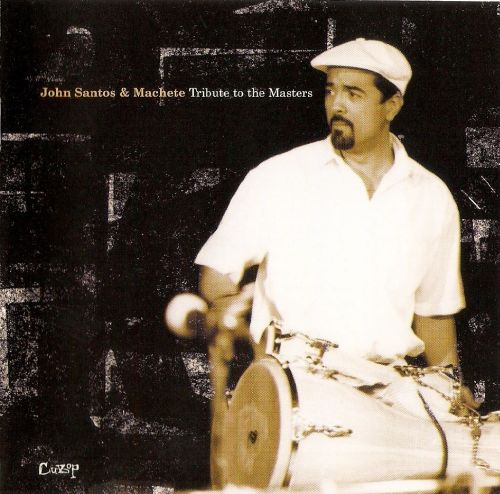
John Santos is one of the foremost proponents of Afro - Latin music in the world today. This tribute to acknowledged masters of Afro - Latin and jazz features Israel “Cachao” Lopez, Orestes Villato, Wayne Wallace and more. The new John Santos & Machete album is titled "Tribute to the Masters" and salutes acknowledged masters of the jazz and Afro - Cuban worlds. Cubop is proud to have released this recording on February 8th, 2000.
  

Most of the selections on this CD, the third from John Santos' Machete Ensemble, are from 1998 - 1999, but there are also four cuts from 1989 - 1990. Ranging from Latin bop (including "Tin Tin Deo," "Moose the Mooche," and "Salt Peanuts") and folkloric chant pieces to Latinized versions of Miles Davis' "So What" and John Coltrane's "Syeeda's Song Flute," the music is continually intriguing and inspiring. The key soloists include trombonists Wayne Wallace and Jeff Cressman, Melecio Magdaluyo on various reeds, pianist Rebeca Mauleon, and many percussionists. Recommended. 
~ Scott Yanow, All Music Guide
    
Percussionist John Santos and his Machete Ensemble have won a devoted following in their native San Francisco Bay Area and among Latin - jazz aficionados the world over with their wide - ranging excursions into Afro - Caribbean music. Tribute to the Masters finds Santos and company paying tribute to individual icons like John Coltrane ("Syeeda's Song Flute"), Dizzy Gillespie ("Salt Peanuts"), and Miles Davis  ("So What") as well as to various Afro - Cuban religious music and to different Latin styles in general. Aside from a musical career that includes work with Gillespie, Eddie Palmeiri, Tito Puente, and Francisco Aguabella, Santos has long been known for his scholarly contributions to the field of Afro - Latin music as a writer and historian. In that sense, Tribute to the Masters  is a kind of historical survey of Latin music and a natural for Santos. The beauty of the disc, though, is that he and his breathtaking ensemble -  - which includes legendary guest musicians like bassist Israel "Cachao" Lopez and timbale player Orestes Villato -  - breathe life into homages to Afro - Cuban Santeria saints ("Chango" and "Iyesa") and fiery Latin - jazz workouts like "Moose the Mooche." ~ Ezra Gale
 
 
John Santos (photo by Tom Ehrlich)
 
 
♥
 

4.10.10

Congas y mas

 
Ray Armando & His Playground Quintet
Mallet Hands
2000

Tracks:

1. Con Mi Guaguanco
2. Boxer
3. Eighty One
4. Mallet Hands
5. Take The 'A' Train
6. Soko
7. Elizete
8. In Sid's Thing
9. As We Were

Personnel:

Ray Armando (whistles, congas, percussion);
Ben Clatworthy (saxophone);
Jorge Valentin Griffin, Theo Sanders (piano);
Eddie Resto (bass);
Enzo Todesco (drums);
Robertino Melendez (bongos, shekere, bells);
Jose "Papo" Rodriguez (bongos, bells).
    
♫☆`*♥¸¸.•*¨*•♫☆`*♥¸¸.•*¨*•♫
        
        
♫☆`*♥¸¸.•*¨*•♫☆`*♥¸¸.•*¨*•♫
   
By Egidio Leitao

Ray Armando has appeared on some of the greatest jazz and Latin albums of all time and has played with Duke Ellington, Stan Getz, Antonio Carlos Jobim, Joao Gilberto, Nina Simone, Gato Barbieri, Tito Puente and Lionel Hampton, just to name a few. After all these years-he started his involvement with Latin percussion at age 8-he finally has an album of his own.

Mallet Hands, produced by Bobby Matos, is a collection of nine original compositions featuring heavyweight players Ben Clatworthy (tenor sax), George Griffin and Theo Sanders (piano), Eddie Resto (bass), Enzo Tolesco (drums) and Robertito Melendez and Jose "Papo" Rodriguez (bongos). These players do some incredible work. Clatworthy's tenor solos are stunning, and his interplay with Griffin and Sanders is a knockout on the delectable closing track, "Con Mi Guaguanco."

Despite all the talented sidemen, however, your attention is never far from Armando's awesome percussive pyrotechnics. Billy Strayhorn's classic "Take the 'A' Train," for example, is transformed into an infectious, swinging samba. Armando's use of a Brazilian cu¡ca is astounding.

Mallet Hands is a roller-coaster trip of rhythms.

source


Born on January 27, 1939 in Brooklyn, the young Armando would listen closely to his father’s Machito and Arsenio Rodriguez records and to the voice of his mother, a professional singer, dancer, and actress. While his dreams of becoming a baseball player were never realized, he did manage to become skilled on the conga drums at an early age.

He was first involved with Latin percussion through his uncle at the age of 8. His first real influence and teacher was Mongo Santamaria, who lived across the street from his family. At the age of fifteen, he went on the road with Elmo Garcia’s Big Band. After paying his dues with Garcia, he went on to work with the Mambo King himself, Tito Puente, with whom he would play at the legendary Palladium in New York City. After his stint with Puente, he continued his studies in percussion instruments and guitar compositions, delving into elements of harmony, theory and counterpoint.


♥