Showing posts with label Birds. Show all posts

2.11.10

Birdsong

  
Vogelhochzeit
A Symphony of birdsong
during the mating season

Tracks:
 
1. Black Woodpecker Drumming. 03:23
2. Black Woodpecker Courtship. 02:52
3. Black Woodpecker, Feeding of Young. 01:50
4. Robin. 04:45
5. Tawny Owl Territorial Fights at Night in Autumn. 02:34
6. Tawny Owl Courtship in the Early Spring. 01:24
7. Sound of Waves on Lake Constance. 00:53
8. Reed Warbler Territorial Dispute. 02:26
9. Little Grebe Courtship and Antagonistic Displays. 03:46
10. Water Rail Courtship Display. 03:41
11. Spotted Crake Advertising. Call. 02:31
12. River Warbler and Cuckoo. 02:22
13. Morning Chorus Before a Thunderstorm. 01:57
14. Morning Thunderstorm. 08:47
15. After the Storm. 08:43
16. Golden Oriole. 01:48
17. Norhern Burgenland Golden Oriole. 01:55
18. Syrian Woodpecker and Golden Oriole. 03:25
19. Southern Burgenland Golden Oriole.  01:59
 
♫☆`*♥¸¸.•*¨*•♫☆`*♥¸¸.•*¨*•♫
        
        
♫☆`*♥¸¸.•*¨*•♫☆`*♥¸¸.•*¨*•♫
 
Schwarzspecht, Rotkehlchen, Waldkauz, Teichrohrsänger, Zwergtaucher, Wasserralle, Tüpfelsumpfhuhn, Schlagschwirl, Kuckuck, Pirol, Blutspecht
 
   
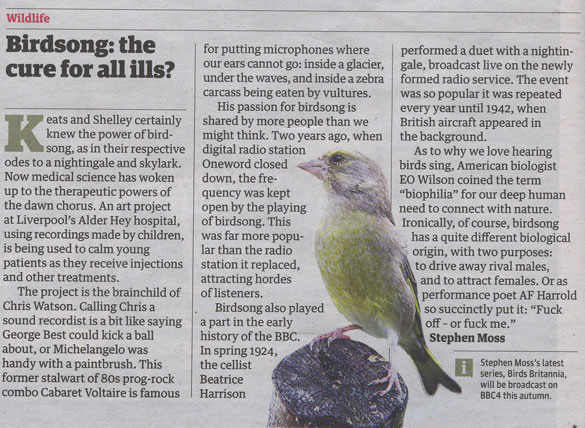
As to why we love hearing birds sing, American biologist E.O.Wilson coined the term "biophilia" for our deep human need to connect with nature. Ironically, of course, birdsong has a quite different biological origin, with two purposes: to drive away rival males, and to attract females.
  
Or as performance poet A.F.Harrold so succinctly put it: 
"Fuck off - or - Fuck me."


29.7.10

Sounds of Nature

  
Field Guide To The Voice Of Nature In Taiwan's Forest
台灣森林自然聲音圖鑑
  
Tracks:
 
01 Small-winged blackbird
02 Bülbül
03 Yellow-breasted blue flycatcher
04 Taiwan's thrush
05 White ear thrush
06 Bataan white-eye
07 Bülbül
08 Colored Barbet
09 Little Pi pelican
10 Lanyu scops owl
11 Brown hawk owl
12 White-breasted Waterhen
13 Ring-necked pheasant
14 Crow-ray head
15 Muntjac
16 Flying squirrel
17 Formosan macaques
18 Japanese tree frog
19 Day tree frog
20 Mo's Tree Frog
21 White Frog
22 Chinese Tree Frog
23 Spotted frogs
24 Gunther's frog
25 Rain frog
26 Sawa frog
27 Tiger frog
28 Mei Wen Cricket
29 Grasshopper Si
30 Taiwan Sao Si
31 Bear cicada
32 Taiwan Sao cicada
33 Yangmingshan Higurashi
  
♫☆`*♥¸¸.•*¨*•♫☆`*♥¸¸.•*¨*•♫
        
        
♫☆`*♥¸¸.•*¨*•♫☆`*♥¸¸.•*¨*•♫
  
Beauty of Forest
 
Most regions passed through by the Tropics are deserts or arid grasslands, but in Taiwan monsoon and tropical cyclones bring plentiful precipitation and enrich the ecological growth. The dramatic geographical change from sea level up to about 4,000 meters contributes to complicated climate happening in this narrow 36,000-square-kilometer island, in addition to the intersection between south-north mountains and monsoon.

The conditions provide diverse natural resources for wide spectrum of vegetation, ranging from alpine frigid bushes (above 3500 meters), subalpine coniferous forest (3000-3500 meters), cold coniferous forest (2500~3000 meters), temperate mountainous coniferous forest (1500-2500 meters), temperate mountainous broad-leaved forest (700-1500 meters), subtropical mountainous broad-leaved forest (beneath 700 meters), to tropical coastal forest; the abundant plants have promoted the island the precious forest treasure to explorers for centuries.

Portuguese saw the island's verdant beauty from the sea in the 16th century and couldn’t help by cry aloud “Formosa!” Mark Western, a Canadian married to a Taiwanese girl, shared the same sentiment in 2004 after he rowed his canoe around the island in 34 days.

"Formosa" means the beautiful island with dense forests. 


11.5.10

Cantus Arcticus

   
Finland's senior composer was a student and heir apparent to the great Jean Sibelius, to whom he is inevitably compared whenever he spins out one of his trademark long, Romantic melodies. In the '60s, Rautavaara began experimenting with tape and electronic sounds, and in 1972 he created the remarkable Cantus Arcticus, a concerto where the soloist wasn't human, and wasn't even live. Using tapes of arctic birds that he recorded in northern Finland, he wrote a three-movement concerto where the orchestral music seems to grow organically out of the birdsongs. Winds are asked to retune a bit to accommodate the birds' tuning; melodies take flight majestically and reappear later in slightly altered form, as if returning from a long journey. 
  
  
Einojuhani Rautavaara
Cantus Arcticus
Concerto for Birds and Orchestra, Op. 61 (1972)
Lahti Symphony Orchestra
Osmo Vänskä
Label: BIS
Catalogue No: BIS-CD-1038

Tracks:

I. Suo (The Bog) (6:39)
II. Melankolia (Melancholy) (4:05)
III. Joutsenet muuttavat (Swans Migrating) (6:59)
  
♫☆`*♥¸¸.•*¨*•♫☆`*♥¸¸.•*¨*•♫
  
Cantus
  
♫☆`*♥¸¸.•*¨*•♫☆`*♥¸¸.•*¨*•♫
  
Subtitled Concerto for Birds and Orchestra it incorporates tape recordings of birdsong recorded near the Arctic Circle and on the bogs of Liminka in northern Finland.

The work is in three movements: The bog opens with a flute duet, after which the other woodwinds join in, followed by the birds. The second movement, Melancholy, features a slowed-down recording of the song of the shore lark. The final movement, Swans migrating, takes the form of a long crescendo for orchestra, with the sounds of whooper swans, before both birdsong and orchestra fade, as if into the distance.

Cantus Arcticus was commissioned by the University of Oulu for its first doctoral degree ceremony.

The Beauty of Birdsong

  
Les plus beaux chants d'oiseaux
The Beauty of Birdsong
Die schönsten Gesänge aus der Vogelwelt     
Jean C. Roché
France : Auvidis, p1987
  

Tracks:

01. Alouette lulu
02. Alouette des champs
03. Sirli du désert
04. Rouge-gorge
05. Rossignol progné
06. Rossignol philomèle
07. Merle noir
08. Grive musicienne
09. Hypolais icterine
10. Fauvette orphée orientale
11. Fauvette des jardins
12. Fauvette à tête noire
13. Corbeau-flûteur pie
14. Petit gobe-mouche bleu des collines
15. Merle shama
16. Gonolek à ventre blanc
17. Merle à poitrine tachetée
18. Cossyphe de Ruppel
19. Cossyphe d'Heuglin
20. Cossyphe choriste
21. Cossyphe du Natal
22. Troglodyte musicien
23. Siffleur des montagnes
24. Grive des bois
 
♫☆`*♥¸¸.•*¨*•♫☆`*♥¸¸.•*¨*•♫
  
♫☆`*♥¸¸.•*¨*•♫☆`*♥¸¸.•*¨*•♫
 
Some musicologists believe that birdsong has had a large influence on the development of music.  Although the extent of this influence is impossible to gauge, it is sometimes easy to see some of the specific ways composers have integrated birdsong with music.
  

8.5.10

Nightingale

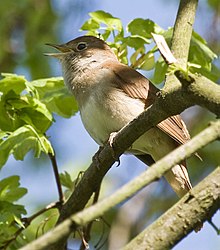
The Nightingale (Luscinia megarhynchos), also known as Rufous  and Common Nightingale, is a small passerine  bird that was formerly classed as a member of the thrush family Turdidae, but is now more generally considered to be an Old World flycatcher, Muscicapidae. It belongs to a group of more terrestrial species, often called chats.
   
   
Nightingales are named so because they frequently sing at night as well as during the day. The name has been used for well over 1,000 years, being highly recognizable even in its Anglo-Saxon form - 'nihtingale'. It means 'night songstress'. Early writers assumed the female sang when it is in fact the male. The song is loud, with an impressive range of whistles, trills and gurgles. Its song is particularly noticeable at night because few other birds are singing. This is why its name includes "night" in several languages. Only unpaired males sing regularly at night, and nocturnal song is likely to serve attracting a mate. Singing at dawn, during the hour before sunrise, is assumed to be important in defending the bird's territory. Nightingales sing even more loudly in urban or near-urban environments, in order to overcome the background noise. The most characteristic feature of the song is a loud whistling crescendo, absent from the song of Thrush Nightingale. It has a frog-like alarm call.

  
♫☆`*♥¸¸.•*¨*•♫☆`*♥¸¸.•*¨*•♫
  
Nightingal 
   
♫☆`*♥¸¸.•*¨*•♫☆`*♥¸¸.•*¨*•♫
 
Lucretius/Creech
 
a link