

Ali Jihad Racy
Simon Shaheen
Taqasim
Taqasim
Improvisation in Arab Music
1977
Tracks:
1. Maqam Kurd 20:20
2. Maqam Nahawand 13:10
3. Maqam Bayyati 8:53
Performers:
Tracks:
1. Maqam Kurd 20:20
2. Maqam Nahawand 13:10
3. Maqam Bayyati 8:53
Performers:
Ali Jihad Racy: buzuq
Simon Shaheen: 'ud
♫☆`*♥¸¸.•*¨*•♫☆`*♥¸¸.•*¨*•☆♫
.ღ•:*´♥`*:•ღ.
♫☆`*♥¸¸.•*¨*•☆♫`*♥¸¸.•*¨*•☆♫
.ღ•:*´♥`*:•ღ.
♫☆`*♥¸¸.•*¨*•☆♫`*♥¸¸.•*¨*•☆♫
The Art Of Improvisation in Arabic Music, with Ali Jihad Racy, Buzuq, and world famous Simon Shaheen, Ud. Two virtuosos perform extended, magnificent improvisation.
This album retains its special place, despite Ali Jihad Racy's later recital.
This album retains its special place, despite Ali Jihad Racy's later recital.
Taqasim (the plural of taqsim) are extended, non-metrical instrumental improvisations. This collection of three such pieces features Simon Shaheen on 'ud and Racy on buzuq, offering a rare opportunity to hear the sublime, at times feverish, interactions of two virtuoso performers.
***
Taqasim is an exceptional recording issued by Lyrichord Records of improvisations by two masterful musicians, buzuq player Ali Jihad Racy and oud performer Simon Shaheen. This 1991 album is said to be the first instance of these two instruments paired together and the three tracks, "Magam Kurd;" "Maqam Nahawand;" and "Maqam Bayyati" feature phenomenal playing as the men alternate solos building upon a melody on their respective instruments, demonstrating both exceptional speed and control as well as wonderful melodic invention.
Generally, taqasim have been employed in supportive roles in Arabic music performances, either as introductory to a song or as a connective bridge between two parts of a larger suite. In some cases, longer taqasim performances have been demonstrated, although the constraints of modern recording limited its availability in that format. With this record, however, the opening "maqam" or melodic development, is 20 minutes long, while the remaining two are 13 and 9 minutes, respectively. In any case, listening to these two masters "duel" with their exceptional soloing makes the time go by so quickly.
Of note is the way in which Racy and Shaheen build off the melodic theme, using four-note tetrachords of varying scales and pitches to modulate from one maqam or melodic mode to another. So, while there is a defined structure with the tetrachords as established within the maqam, the skilled improviser has a great deal of freedom in creating those modulations.
The names of the pieces are, in fact, the monikers given for tetrachords, that is, the "Kurd;" "Nahawand;" and "Bayyati" are tetrachord types which define how Racy and Shaheen craft their interpretations. The Nahawand, for example, is roughly analogous to the first four notes of a minor scale in classical music in the West. The "Kurd" generally corresponds to those notes in the Phrygian mode. The Bayyati (Bayati) is the more common of the tetrachords used in Arab music.
As to the instruments, they are similar in appearance, having pear-shaped bodies with plucked lute strings, but the oud has a deeper sound and is unfretted and the buzuq has a longer neck, smaller body, frets, and a more metallic, ringing sound.
Racy, a native of Lebanon, is a long-time professor of ethnomusicology in the renowned department at the University of California, Los Angeles and has recorded two other Lyrichord albums and a collaboration with the tremendous Kronos Quartet (whose Howl, U.S.A. album has been featured on this blog.) In addition to the buzuq, which has a relationship to the saz, which comes from Iran and Turkey (a great Axiom Records release by Talip Ozkan is to be detailed here, as well.) He is also a master of the nay, a reed flute that is to be noted in a later post here on the amazing music of the Whirling Dervishes.
Shaheen, who hails from Palestine, is also a dual instrumentalist of note, being also a violinist. He performed on another featured item from the blog, Material's Hallucination Engine and his connection to that collective's leader, Bill Laswell, led to a Shaheen album, released on Laswell's fantastic Axiom label, devoted to the music of Egyptian composer Mohammed Abdel Wahab, who skillfully blended Arabic and Western styles together in rich orchestral pieces--this record will also be covered here. Shaheen also made a complement of sorts to Taqasim, when he released Saltanah with Vishwa Mohan Bhatt, a musician from India who created his own sitar/slide guitar hybrid--another album, blending the maqam with the raga, that will someday make an appearance here. Recipient of a National Heritage Award from President Clinton, Shaheen has two bands, lectures, composes film soundtracks and much more.
It is hard to think of an album that has as much power, grace, skill, and art using improvisation from established structures than this--jazz improvisationis equally as thrilling. Moreover, anyone interested in guitar music can easily see how the origins of that Western instrument can be traced back to the many impressive musical traditions of the Near and Middle East. Finally, music is the "universal language" and examples like Taqasim show that, whatever cultural differences exist in a sometimes polarized and politicized world, music gives an opportunity to transcend those variations through something relatable and unifying.
no mistake to visit the source : )
***
Taqasim is an exceptional recording issued by Lyrichord Records of improvisations by two masterful musicians, buzuq player Ali Jihad Racy and oud performer Simon Shaheen. This 1991 album is said to be the first instance of these two instruments paired together and the three tracks, "Magam Kurd;" "Maqam Nahawand;" and "Maqam Bayyati" feature phenomenal playing as the men alternate solos building upon a melody on their respective instruments, demonstrating both exceptional speed and control as well as wonderful melodic invention.
Generally, taqasim have been employed in supportive roles in Arabic music performances, either as introductory to a song or as a connective bridge between two parts of a larger suite. In some cases, longer taqasim performances have been demonstrated, although the constraints of modern recording limited its availability in that format. With this record, however, the opening "maqam" or melodic development, is 20 minutes long, while the remaining two are 13 and 9 minutes, respectively. In any case, listening to these two masters "duel" with their exceptional soloing makes the time go by so quickly.
Of note is the way in which Racy and Shaheen build off the melodic theme, using four-note tetrachords of varying scales and pitches to modulate from one maqam or melodic mode to another. So, while there is a defined structure with the tetrachords as established within the maqam, the skilled improviser has a great deal of freedom in creating those modulations.
The names of the pieces are, in fact, the monikers given for tetrachords, that is, the "Kurd;" "Nahawand;" and "Bayyati" are tetrachord types which define how Racy and Shaheen craft their interpretations. The Nahawand, for example, is roughly analogous to the first four notes of a minor scale in classical music in the West. The "Kurd" generally corresponds to those notes in the Phrygian mode. The Bayyati (Bayati) is the more common of the tetrachords used in Arab music.
As to the instruments, they are similar in appearance, having pear-shaped bodies with plucked lute strings, but the oud has a deeper sound and is unfretted and the buzuq has a longer neck, smaller body, frets, and a more metallic, ringing sound.
Racy, a native of Lebanon, is a long-time professor of ethnomusicology in the renowned department at the University of California, Los Angeles and has recorded two other Lyrichord albums and a collaboration with the tremendous Kronos Quartet (whose Howl, U.S.A. album has been featured on this blog.) In addition to the buzuq, which has a relationship to the saz, which comes from Iran and Turkey (a great Axiom Records release by Talip Ozkan is to be detailed here, as well.) He is also a master of the nay, a reed flute that is to be noted in a later post here on the amazing music of the Whirling Dervishes.
Shaheen, who hails from Palestine, is also a dual instrumentalist of note, being also a violinist. He performed on another featured item from the blog, Material's Hallucination Engine and his connection to that collective's leader, Bill Laswell, led to a Shaheen album, released on Laswell's fantastic Axiom label, devoted to the music of Egyptian composer Mohammed Abdel Wahab, who skillfully blended Arabic and Western styles together in rich orchestral pieces--this record will also be covered here. Shaheen also made a complement of sorts to Taqasim, when he released Saltanah with Vishwa Mohan Bhatt, a musician from India who created his own sitar/slide guitar hybrid--another album, blending the maqam with the raga, that will someday make an appearance here. Recipient of a National Heritage Award from President Clinton, Shaheen has two bands, lectures, composes film soundtracks and much more.
It is hard to think of an album that has as much power, grace, skill, and art using improvisation from established structures than this--jazz improvisationis equally as thrilling. Moreover, anyone interested in guitar music can easily see how the origins of that Western instrument can be traced back to the many impressive musical traditions of the Near and Middle East. Finally, music is the "universal language" and examples like Taqasim show that, whatever cultural differences exist in a sometimes polarized and politicized world, music gives an opportunity to transcend those variations through something relatable and unifying.
no mistake to visit the source : )
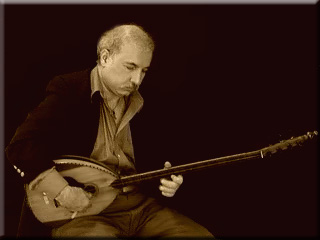
Ali Jihad Racy (born 1943 in Ibl al-Saqi, Southern Lebanon, moved to USA in 1968) is a Lebanese born American performer, composer and Professor of Ethnomusicology at the University of California at Los Angeles. Racy is internationally recognized for his extraordinary musicianship and his numerous publications, including his award-winning book, Making Music in the Arab World: The Culture and Artistry of Tarab (Cambridge University Press, 2003). He is a master of many traditional instruments, particularly the nay, and the buzuq.
♥





+Front.jpg)


