12.11.10

Timple two

   
Totoyo Millares
Antologia Del Timple
1999

Tracks:

01. Folia
02. Campanas De Vegueta
03. Arrejalese Pa CA
04. Mazurca
05. Sombra Del Nublo
06. Tanganillo, Santo Domingo Y Tajaraste Lagunero
07. Malaguenas
08. Isa
09. Tajaraste Gomero
10. Adios, Canaria Querida
11. Polca Majorera
12. Baile De La Virgen
13. Arrorro De Los Cantos Canarios
 
♫☆`*♥¸¸.•*¨*•♫☆`*♥¸¸.•*¨*•♫
        
        
♫☆`*♥¸¸.•*¨*•♫☆`*♥¸¸.•*¨*•♫
 
The timple, and Totoyo, are from the Canary Islands. It turns out the timple is the national instrument of the Canary Islands, and Totoyo Millares is the master of the timple.
 
Totoyo Millares, hijo del intelectual republicano Juan Millares Carló y hermano de una saga de pintores, músicos, escritores y poetas, entre los que destaca el pintor Manolo Millares, condujo al timple, el instrumento popular por excelencia de Canarias, a un grado de virtuosismo inexistente hasta su aparición en la escena cultural de Canarias desde los años 50.

Fundador del grupo Los Gofiones y de la Orquesta Canaria de Timples, Totoyo Millares, aparte de su extraordinario currículum discográfico y artístico que lo llevó a tocar el instrumento en tres continentes, ejerció también una extensísima labor musical pedagógica. Por su magisterio docente han pasado miles alumnos, algunos de ellos tan destacados en el desarrollo artístico del instrumento como el fallecido José Antonio Ramos. Otros timplistas y músicos canarios se sienten deudores del legado de Totoyo, que abrió un camino de hallazgos estilísticos para un instrumento que, hasta que llegó a sus manos, sólo era usado como acompañante en los grupos instrumentales populares de las Islas.

La trayectoria de Totoyo Millares no deja lugar a dudas; desde su nacimiento en el seno de una familia de poetas y músicos, la creación del primer método de Timple con tan solo diez años y la primera academia de Timple del archipiélago, paseando durante toda su vida su origen isleño y el Timple por todo el mundo y dejando constancia sonora de su quehacer en mas de 80 discos.

En 1942 compone para Timple Mazurca y Polka majorera, inspirada en aires populares, a lo que seguirán casi todos los temas populares punteados, tales como: Folía, Malagueñas, Isas, etc.

Estudia piano y violín. En 1945 (con 10 años de edad) comienza a dar clases de Timple con un método creado por él mismo (el primer método de Timple) y funda la primera academia de Timple del archipiélago (aún no de modo oficial).

A partir de 1950 se dedica plenamente a la enseñanza, convirtiéndose en el mayor pedagogo y maestro de timplistas que han conocido las islas, extendiendo sus clases, también, por los colegios de gran canaria: suma 42 colegios de la isla y, desde 1944 y a lo largo de su vida como pedagogo del Timple, más de 45.000 alumnos.

En 1954 funda, ya oficialmente, su primera academia de timple del archipiélago. Recorre las islas investigando y rescatando el folclore más puro y funda el grupo los gofiones en 1969.

A lo largo de su vida como timplista convierte al instrumento popular de Canarias en instrumento solista, grabando discos y ofreciendo recitales y conciertos. Incluso, llega a fundar la primera orquesta popular de Timple (1983).

Sus enseñanzas han llegado a todos los estratos de la sociedad, desde los más humildes hasta relevantes personajes de las artes y las ciencias.

En el año 2005 recibe un merecido homenaje por parte de la Mancomunidad de Municipios de Medianías de Gran Canaria, encuadrado en el encuentro Medianías del Timple de ese año, entidad que colabora en la edición de la “Antología del Timple”, recuperando así una grabación de 1979 que estaba descatalogada.


♥
 

11.11.10

Romanian Feelings


Cvartetul Transilvan
Suite româneşti
  
Nicuşor Silaghi: Suite Românesti pour quatuor à cordes
  
Tracks:

01. Transilvania - Maramures
02. Moldova
03. Banat
04. Muntenia - Oltenia

Personnel:

Gabriel Croitoru, violin
Nicusor Silaghi, solo violin
Marius Suarasan, viola
Vasile Jucan, violoncell

♫☆`*♥¸¸.•*¨*•♫☆`*♥¸¸.•*¨*•♫
        
        
♫☆`*♥¸¸.•*¨*•♫☆`*♥¸¸.•*¨*•♫
   
The Transylvanian Quartet (Cvartetul Transylvania), composed of members of the symphony orchestra of Cluj, recorded under the name Romanian Suite (Suite româneşti) a graceful garland of folk songs. No "recreation" as scholarly for this scheme Nicusor Silaghi, concertmaster of the ensemble, but the original songs in their simple harmony. A successful experience. Each of the four-movement suite (42 minutes total) paid tribute to the folklore of a region of Transylvania and Maramures, Moldavia, Banat, and finally Muntenia and Oltenia. The course work ends with the singing of the lark (Ciocarlie) in melodic climax of this festival.


THE TRANSYLVANIAN QUARTET was founded in 1987, by four young and valuable players from the orchestra of the Cluj Philharmonic. In 1989, in recognition of its outstanding artistic level, this chamber ensemble acquired the statute of state quartet.

While Nicusor Silaghi (born 1957), Marius Suarasan (born 1957) and Vasile Jucan (born 1957) were founders of the quartet, first violin George Dudea joined the ensemble in 1989, abandoning a high ranked position as leader of the Cluj Philharmonic Orchestra. Beginning with 2000, the quartet functions in a new formula, George Dudea being replaced by the well-known soloist Gabriel Croitoru, one of the most appreciated Romanian violin players.

All the members are virtuosos on their instruments. During the course of their studies, they all won many awards, and afterwards involved with such activities as solo playing, chamber music and recordings for broadcast and television. As for the string quartet playing, it is worth mentioning that they attended the international courses held at Nyrbator (Hungary), Oberschützen (Austria) with Alban Berg String Quartet member Thomas Kakuska, at Pommersfelden (Germany) with Professor Reiner Kusmaul.

While participating in the Orlando Festival in Kerkrade (The Netherlands) in 1990, they were remarked by Professor Earl Carlyss, former member of the Julliard String Quartet, who invited them to participate in the Aspen Festival, Colorado, in 1990, and offered them a grant for the Aspen Center for Advanced Quartet Studies. This was a most beneficial opportunity for the young musicians to work with such personalities as The Emerson String Quartet, The American String Quartet, Professors Steve Clapp and Donald Weilerstein, former member of the Cleveland String Quartet.

The Transylvanian String Quartet is widely performing in Romania and abroad – in Italy, Germany, The Netherlands, Spain, Austria, Denmark, USA, Italy, Germany, Great Britain (at the well-known Wigmore Hall in London), Finland. The quartet won several prizes – at the “Gh. Dima” competition in Cluj, 1987, and twice at the National Art Festival of Romania, in 1987 and 1989. They also participated at prestigious festivals, such as the Festival of Aspen, the Festival Ravinia in Chicago, in Edinburgh, Kuhmo (Finland), Aldebourgh (England), The Mozart Festival in Chemnitz (Germany) and Cluj, the Festival Cluj Musical Autumn.
  
       
“An absolutely outstanding string quartet: an excellent interpretation and a deep penetration of the sense of music. Its virtuosity transcends the individual level towards a perfect unity of the group.” (Diario de Burgos, November 1990)
  
♥

10.11.10

Tambores

  
Cuba
Merceditas Valdéz
y los tambores bata de Jesús Pérez
1996

Tracks:

01. Elegguá
02. Mango Mangue
03. Oggún
04. Drume Negrita
05. Obatalá
06. Yambambo
07. Yemayá
08. Lacho
09. Ochún
10. Quirino
11. Changó
12. Osain
13. Elegguá II
14. Ay Que Bueno
15. Changó II

Personnel:

Merceditas Valdéz, voc
Tambores Bata de Jesús Pérez, perc, voc (1,3,5,7,9,11,13,15)
Los Amigos with Frank Emilio, p (2,4,6,8,10)
Grupo Oru, Sergio Vitier y su grupo (12, 14)
  
Reissue of original EGREM recordings, recording date unknown
  
♫☆`*♥¸¸.•*¨*•♫☆`*♥¸¸.•*¨*•♫
        
        
♫☆`*♥¸¸.•*¨*•♫☆`*♥¸¸.•*¨*•♫
  
Merceditas Valdés was born in the densely populated Neptuno street in Cayo Hueso neighborhood in Havana on October 14, 1928.
When she was 12 years old, and without her parents´consent, she applied to compete in the Corte Suprema del Arte and sang two pieces: "Babalú", a theme popularized by Miguelito Valdés and "La negra Mercé", by Ernesto Lecuona.
Her career began with the singing of yoruba religion prayers in amphitheaters and radio stations and her performances at Radio Cadena Suaritos´ musical programs are considered anthological. There, the participating orchestra was conducted by Obdulio Morales - composer, musical arranger and promoter of the Afro-Cuban liturgical music " together with a group of batá drums led by Trinidad Torregrosa, with Merceditas as the main soloist. For the first time, the batá drums were broadcasted by the radio, outside the temples, and many people even went to the radio station with the only purpose of greeting Merceditas at the end of the program.

  
read it all here 
 
Jesús Pérez on the iyá sitting in the middle
  
♫
 

9.11.10

¡Baila!

  
JOSSIE ESTEBAN
tropical
2000

Tracks:

01. El baile del pato
02. De fin de semana
03. Borracho y sigo para'o
04. Esto si esta bueno
05. Gzando
06. Nadie
07. Nena
08. Carino mio
09. Te sigo queriendo
10. Solo, solo
11. Historia de amor
12. Ron compai
13. Me gustan to'a las mujeres
  
♫☆`*♥¸¸.•*¨*•♫☆`*♥¸¸.•*¨*•♫
        
        
♫☆`*♥¸¸.•*¨*•♫☆`*♥¸¸.•*¨*•♫
 
This release from Jossie Esteban is one my favorites from this exceptionally talented merengue artist. Formally the lead singer of La Patrulla 15, as a soloist artist for many years now Jossie is in his element. This album follows his classic high energy, upbeat and extremely rhythmic merengue. The lyrics are hilarious as usual which will inspire you to dance and enjoy every inch of each song. This album has plenty of hits to choose from. My personal favorites are: "El baile del Pato", "Borrachao y Sigo Para'o", "Gozando", "Nadie" and "Solo,Solo'. If you like Jossie Esteban then you know what to expect. He does not disappoint. Therefore don't miss out on this wonderful album.
~Marianopolita2005 
 
***
  
Jossie Esteban y la Patrulla 15 is a leading merengue band from Dominican Republic, formed by Jossie Esteban (born Esteban Grullón) and Alberto Martínez (known as Ringo).
The group was formed by these Dominican childhood friends in May 1979, and included musicians from Puerto Rico, but mostly Dominican Republic. Their debut album El Cuchu Cu Cha was a hit, and since then they have recorded more than 20 records, winning awards such as “the gold congo” in Colombia, “orchestra of the year” in New York, and a number of platinum discs. Some of their hit songs are "Agua de Coco" (Coconut Water), "Pirulo", "El Can" (The Party), "Un hombre busca una mujer" (a man looks for a woman), "Enamoraito" (love-struck) etc.
Since 1992 Jossie Esteban has also been part of the successful merengue threesome Zona Roja.
Mr. Esteban got strange beliefs about being born... but no trouble with music.


El Baile Del Pato

El baile del pato, Cuá, Cuá, Cuá

Un pato salió de fiesta, pa' lla pa' la capital

Se llevó muchas mujeres, para poder disfrutar

El pato bailand mucho, le ha dado mucho calor

Lo meto entre mi laguna, el paso media mejor

El baile del pato, Cuá, Cuá, Cuá
 
 ...
 
♥

7.11.10

Trombone Pirates

  
Papo Vasquez
Pirates Troubadours
Carnival in San Juan

2003

Tracks:

1. Carnival in San Juan
2. Mundo Bizarro
3. Las Torres
4. Plena Pa' Las Nenas
5. Worlds
6. Vianda con Bacalao
7. En La Cueva de Tan
8. Stuffy Turkey
9. Like a Little Child
10. Snow Angel
11. Carlitos Coco
12. Fireflies from the Orion Nebula & Belen

Personnel:

Bill Lee, Tito Cepeda, Arturo O' Farrill, Milton Cardona, Willie Williams, John Benitez, Horacio Hernandez, Roberto Cepeda, Joe Gonzalez, Fred McFarlane, Victor Jones, Roberto Cepeda, Mario Rivera, Ivan Renta, Carlos Henriquez, Dafnis Prieto, Papo Vasquez
 
♫☆`*♥¸¸.•*¨*•♫☆`*♥¸¸.•*¨*•♫
        
        
♫☆`*♥¸¸.•*¨*•♫☆`*♥¸¸.•*¨*•♫
 
Trombonist/composer/arranger Papo Vazquez, along with his group Pirates Troubadours, has just unleashed Carnival in San Juan, a multifaceted celebration which captures the spirit of its title.

And the title cut is quite an opening statement. Vazquez’ solo bursts with rapid-fire phrases, and tenor man Willie Williams follows with a rollicking upper register attack. Pianist Arturo O’Farrill plays his solo at the same tempo but with the feelings of an observer, not a participant. The percussion of Horacio “El Negro” Hernandez, Roberto and Tito Cepeda, and Joe Gonzalez keep the rhythm going full speed ahead. “Mondo Bizarro” is a crisply arranged mid-tempo tune which includes a horn riff reminiscent of the electric guitar intro on The Temptations’ “Cloud Nine.”

The mood becomes somber on “Las Torres,” a wrenching 9/11 tribute. Gonzalez delivers a passionate bilingual lamentation while the other band members pick up the chorus behind him. The raucous “Plena Pa’ Las Nenas” takes us back to the carnival, then things cool down again with Vazquez’s arrangement of bassist Bill Lee’s “Worlds.” The group goes for the jugular on “Vianda con Bacalao,” a solid Latin funk. Vazquez and Williams wail on their horns, Benitez lays down a pumping electric bass groove and the percussion section is absolute tachychardia.

Vazquez shows that he can also play straight-ahead with perfect fluency. His letter perfect arrangement of Monk’s “Stuffy Turkey” underscores the composer’s trademark eccentricity and features crisp drumming by guest Victor Jones and swinging piano by Fred McFarlane, as well as more fine soloing by Vazquez and Williams. “Carlito’s Coco” has free jazz overtones worthy of Ornette Coleman. 
 
From every genre, tempo and angle, Carnival in San Juan is a total triumph for Papo Vazquez.

This review originally appeared in AllAboutJazz-New York
  
 
  "Trombone virtuoso and innovative composer, Papo combines the best of jazz and Latin music to create a genre that is unique and wild. He's redefined Latin jazz!" 
 
~ Michael Brecker 
 
 
♥

6.11.10

Maestro Duda

  
Quintetto Brassil plays Brazil
Brass Music from Northeastern Brazil

1995

Tracks:

1. Suite Recife, Pt. 1
2. Suite Recife, Pt. 2
3. Suite Recife, Pt. 3
4. Suite Recife, Pt. 4
5. Suite Recife, Pt. 5
6. Gonzagueando
7. Concertino Para Trompete, Pt. 1
8. Concertino Para Trompete, Pt. 2
9. Concertino Para Trompete, Pt. 3
10. Musica Para Metais No 1
11. Marquinhos No Frevo
12. Trilogia Matuta, Pt. 1
13. Trilogia Matuta, Pt. 2
14. Trilogia Matuta, Pt. 3
15. Andrezza (waltz)
16. Coletânea '93, Pt. 1
17. Coletânea '93, Pt. 2
18. Coletânea '93, Pt. 3
19. Coletânea '93, Pt. 4
20. Serenata No Capibaribe
21. Cirandas (16), For Piano, A. 220, Pt. 1
22. Cirandas (16), For Piano, A. 220, Pt. 2
23. Cirandas (16), For Piano, A. 220, Pt. 3
24. Nairam  (frevo)
25. Tema Para Umk Trompetista
26. 220
 
All tracks: José Ursicino Da Silva "Duda"
But:
12-14: Dímas Segundo Sedicías
21-23: Heitor Villa-Lobos
26: Antônio Manuel Do Espírito Santo
 
Personnel:
 
Quintetto Brassil:
Nailson Simoes, Ayrton Benck (trumpet, flugelhorn);
Radegundis Feitosa (trombone, euphonium);
Walmir Vieira (tuba);
Cisneiro De Andrade (horn).

Additional personnel:
Glauco Andreza (percussion).

Quintetto Brassil dedicates this record to Maestro Duda on his 60th birthday.

Recorded at the Cultural Foundation Theatre, Joao Pessoa, Brazil on March 22-26, 1995.
Includes liner notes by Ricardo Canzio.  
Producer: Ricardo Canzio, Robin Broadbank
  
♫☆`*♥¸¸.•*¨*•♫☆`*♥¸¸.•*¨*•♫
        
        
♫☆`*♥¸¸.•*¨*•♫☆`*♥¸¸.•*¨*•♫
 
Jose Ursicino Da Silva, or Duda, as he is known in his native Brasil, is a 75-year-old composer arranger with an extensive background.He has been a member of the Recife Symphony Orchestra as a woodwind player and arranger. He has also written for jazz bands and for television. In recent years he has written many original works for the Quintetto Brassil. This quintet is an ideal vehicle for his style, based as it is on the brass band tradition. 


♥

5.11.10

Les fanfares bavaroise

  
Musik aus Bayern
Musique bavaroise
1994

Tracks:

1. Heinz Gotzel/Oberlander Kapelle Coburg - Tiroler Holzhacker Baub'n
2. Heinz Gotzel/Oberlander Kapelle Coburg - Ich Hab' Dich Gern
3. Alfred Paulus/Original Bayern Kapelle - Waldler Marsch
4. Die Bückeburger Jäger/Wilfried Majowski - Prima! Prima!
5. Die Bückeburger Jäger/Wilfried Majowski - Potpourri
6. Oberlander Kapelle Coburg - Beliebt und Bekannt
7. Alfred Paulus/Original Bayern Kapelle - Appenzeller Jodler
8. Die Bückeburger Jäger/Wilfried Majowski - Alte Kameraden
9. Die Bückeburger Jäger/Wilfried Majowski - Flascherl Wein
10. Heinz Gotzel/Oberlander Kapelle Coburg - Unter Maibaum/Auf Der Wies'n
11. Alfred Paulus/Original Bayern Kapelle - Polka Perlen
12. Alfred Paulus/Original Bayern Kapelle - Blaue Augen
13. Oberlander Kapelle Coburg - Bayrischer Defiliermarsch (Parade of the Bavarian Troops)
14. Alfred Paulus/Original Bayern Kapelle - Polka Marsch
15. Die Bückeburger Jäger/Wilfried Majowski - Hymne À la Joie
 
♫☆`*♥¸¸.•*¨*•♫☆`*♥¸¸.•*¨*•♫
        
        
♫☆`*♥¸¸.•*¨*•♫☆`*♥¸¸.•*¨*•♫
 
   
As the only representative of Bavarian Beer Hall Music, this album rates an easy "5". Classics such as "Walder-Marsch" and "Blaue Augen" will bring tears to any respectable Bavarian's eyes, and the medely of Marlene Deitrich songs is not to be missed! A must for anyone planning an Oktoberfest party!

In the Bavarian Alps just an hour away from München (Munich) there is a small monestary, Andechs, perched on a hill. You can reach it by 'subway' from downtown. During "Bock Bier Zeit" the monks fast, subsisting only on the dark brown beer brewed from the sludge at the bottom of the barrels. Is it any wonder they have 'visions'? This album gives you the perfect introduction to the unique and festive culture of the Bavarians.

~ Thomas A Schulz
 
 
Oans, Zwoa,... Gsuffa :)
 
♥

4.11.10

Les fanfares funk

   
Fanfares Festival
18 Fanfares Qui Ont Le Vent En Poupe
2000

Tracks:

1. Ceux Qui Marchent Debout - Slowpress
2. Zdong - The Dong
3. Toups Berey & Le Spirit Pan African Brass Company - Aghata
4. Qui Sème Le Vent - Simon
5. L'occidentale De Fanfare - La Marche Des Déménageurs-rondeaux De L'an 2000
6. Les Chevals - Cactus
7. Les Astiaous - Pauvre Marius
8. Sergent Pepere - Bris De Bec Louche
9. Les Fils De Teuhpu - Iron Vulva
10. Les Haricots Rouges - I´m Walking
11. Uranus Bruyant - General Grente
12. Pistons Flingueurs - Portier Au Queen
13. Balkan Brass Band - Balkans Brass
14. Accoules Sax - Marseille
15. Quelques Fiers Mongols - Heartbreaker
16. El Zef - Pas De Panique
17. Boukovo - Romski Cocek
18. Pistons Circus - Le Poinconneur Des Lilas
 
♫☆`*♥¸¸.•*¨*•♫☆`*♥¸¸.•*¨*•♫
        
        
♫☆`*♥¸¸.•*¨*•♫☆`*♥¸¸.•*¨*•♫
  
A fanfare, a typical French, Dutch and Belgian orchestra, with trumpets, trombones, flugelhorns, French horns/saxhorns, tubas, saxophones and percussion.
  
Les fanfares funk :)
  
    
some ideas for your next shopping list: ici :)
 
 
♫

3.11.10

Les fanfares ethniques

   
Fanfares
2003

Tracks:

01. El Vito - Une Anche Passe
02. Batuta de Zece Prajini - Fanfare De Zece Prajini
03. Carga Sito - Ahmet Ozden Et Kumpanya Istanbul
04. Kiye Bwa - Societe Kiye Bwa
05. La Petite Cantate - La Banda Municipal De Santiago De Cuba
06. Mandilatos - Une Anche Passe
07. Rituel de Noces - Fanfare De Zece Prajini
08. Vasa Prema Dalli - New Bharat Brass Band
09. Chant des Repiqueurs de Riz - Troupe De La Societe Generale D' Alimentation
10. El Machete de Oro - La Banda Municipal De Santiago De Cuba
11. Charter pour Hale-Bopp - Une Anche Passe
12. Etoman - Ongo Trogode
13. Estergon - Ahmet Ozden Et Kumpanya Istanbul
14. Batuta de Dagata - Fanfare De Zece Parjini
15. Canzone Arrabbiata - Une Anche Passe
16. G.R. - Toups Bebey & Le Spirit Pan-African Brass Company
 
♫☆`*♥¸¸.•*¨*•♫☆`*♥¸¸.•*¨*•♫
        
        
♫☆`*♥¸¸.•*¨*•♫☆`*♥¸¸.•*¨*•♫
 
  
When most people think of brass bands, they generally think of New Orleans-style Dixieland bands. Fanfares is an overview of the brass band tradition from around the world. Africa, India, the Middle East, and Cuba are all represented on this excellent recording that showcases the true diversity of the brass band tradition. This is fun, generally fast-paced stuff that's recommended to open-minded listeners. ~ Sean Westergaard
 

☆

2.11.10

Birdsong

  
Vogelhochzeit
A Symphony of birdsong
during the mating season

Tracks:
 
1. Black Woodpecker Drumming. 03:23
2. Black Woodpecker Courtship. 02:52
3. Black Woodpecker, Feeding of Young. 01:50
4. Robin. 04:45
5. Tawny Owl Territorial Fights at Night in Autumn. 02:34
6. Tawny Owl Courtship in the Early Spring. 01:24
7. Sound of Waves on Lake Constance. 00:53
8. Reed Warbler Territorial Dispute. 02:26
9. Little Grebe Courtship and Antagonistic Displays. 03:46
10. Water Rail Courtship Display. 03:41
11. Spotted Crake Advertising. Call. 02:31
12. River Warbler and Cuckoo. 02:22
13. Morning Chorus Before a Thunderstorm. 01:57
14. Morning Thunderstorm. 08:47
15. After the Storm. 08:43
16. Golden Oriole. 01:48
17. Norhern Burgenland Golden Oriole. 01:55
18. Syrian Woodpecker and Golden Oriole. 03:25
19. Southern Burgenland Golden Oriole.  01:59
 
♫☆`*♥¸¸.•*¨*•♫☆`*♥¸¸.•*¨*•♫
        
        
♫☆`*♥¸¸.•*¨*•♫☆`*♥¸¸.•*¨*•♫
 
Schwarzspecht, Rotkehlchen, Waldkauz, Teichrohrsänger, Zwergtaucher, Wasserralle, Tüpfelsumpfhuhn, Schlagschwirl, Kuckuck, Pirol, Blutspecht
 
   
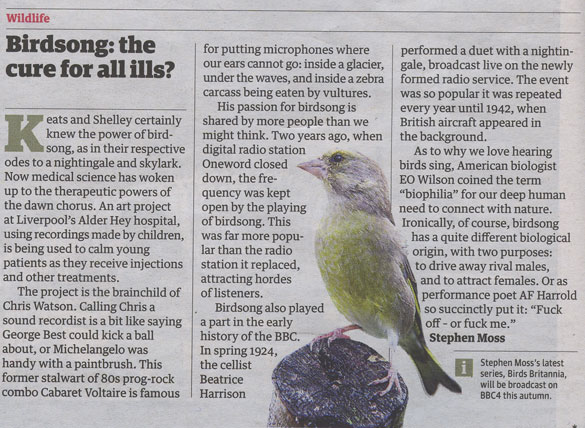
As to why we love hearing birds sing, American biologist E.O.Wilson coined the term "biophilia" for our deep human need to connect with nature. Ironically, of course, birdsong has a quite different biological origin, with two purposes: to drive away rival males, and to attract females.
  
Or as performance poet A.F.Harrold so succinctly put it: 
"Fuck off - or - Fuck me."
   
   
♥

1.11.10

Souffle

  
Souffle
breath
Musique Du Monde

1998

Tracks:

1. Arménie : Yeghish Manoukian - Hautbois Duduk
2. Equateur :     Shuar - Ocarina Pututu
3. Namibie : Himba - Flûte Ongembo
4. Mongolie : Kazakh - Flûte Sigizbi
5. Iran : Mohamed Musavi - Flûte Ney (extrait)
6. Maroc : Ait Bou Guemmez - Clarinette Aghamin
7. Federation De Russie : Udege - Trompes Kuinki
8. Afrique Centrale : Trompes D'ivoire
9. Australie : Bamboma - Trompes Didjeridoo
10. Guyane : Wayana - Clarinettes Waitakala
11. Bali : Flûtes Suling
12. Europe : Une Anche Passe - Saxophone Taragot Et Clarinettes
13. Chine : Haubois Suona
14. Japon : Yoshikazu Iwamoto - Flûtes Shakuhachi
15. Cameroun : Peil - Hautbois Ghaïta (extrait)
16. Vietnam : Hmong Noir - Orgue à Bouche Khèn (extrait)
17. Maroc. : Ait Bou Guemmez - Flûte 'awwada (qasba) (extrait)
18. Baloutchistan : Flûte Doneli
19. Kirghizstan : Ocarina Copo Coor
20. Papouasie Nouvelle Guinnée : Sepik - Flûtes Harmoniques
21. Zaïre : Mongo - Ocarina Lolofongo
22. Papouasie Nouvelle Guinée : Huli - Flûte De Pan Gulupobe
 
♫☆`*♥¸¸.•*¨*•♫☆`*♥¸¸.•*¨*•♫
        
        
♫☆`*♥¸¸.•*¨*•♫☆`*♥¸¸.•*¨*•♫
  
Recordings of ethnic flutes and reed instruments, often with percussion, from Musique Du Monde releases.

Souffle : La Base De Toutes Les Traditions Des Musiques Du Monde

If vocal music was the first man-made music and percussion the second, wind instruments would undoubtedly be the third (and the first melody making instrument). The idea that a dead bone or cut plant had a voice of its own was not simply considered interesting it was magic – used to aid man with his communication with the world of spirits, to cure illness, protect crops etc.
Originally primitive one-note instruments would be blown in sequence by a collection of primitive beings to form a primitive melody. Amazingly around this time the use of harmonics was also used to extend melodic possibilities (blowing harder to get a different note – a harmonic of the basic note).
  
  
thanks for the music 123
  
:)