17.10.10

Caminhos Me Levem

   
Almir Sater
Caminhos Me Levem

1996

Tracks:

1. O vento e o tempo Ouvir (Paulo Simões, Almir Sater)
2. Caminhos me levem Ouvir (Paulo Simões, Almir Sater)
3. Brasil poeira Ouvir (Almir Sater, Renato Teixeira)
4. Floresta do arco-íris Ouvir (Almir Sater)
5. Pagode bom de briga Ouvir (Paulo Simões, Almir Sater)
6. Milhões de estrelas Ouvir (Paulo Simões, Almir Sater)
7. Viola fora de moda Ouvir (Capinan, Edu Lobo)
8. Cabecinha no ombro Ouvir (Paulo Borges)
9. Sodade matadeira Ouvir (Dorival Caymmi)
10. Mochileira Ouvir (Geraldo Roca)
  
♫☆`*♥¸¸.•*¨*•♫☆`*♥¸¸.•*¨*•♫
        
        
♫☆`*♥¸¸.•*¨*•♫☆`*♥¸¸.•*¨*•♫
  
Almir Sater brings to us the sweet music of the Brazilian wilderness of Pantanal, one of the most beautiful parts of the Earth, most of it still untouched. All the mystery, the starry nights, simple country love, the lonely train crossing the plains and the little boat sailing down the mighty river, all these images and draems, that's what the music is all about. All through his voice and the voice of his viola (the brazilian ten strings guitar). Great music!
~ Alexandre D. Tenorio

Muita paz.
Canções com ritmo , que fazem pensar no mundo em que vivemos, na vida e nos acontecimentos... Lindos versos, poesia, excelente para românticos... Alguns ritmos lembram o velho oeste. As instrumentais fazem viajar a um mundo inexistente... cheio de paz.
~ Marianna Degen Alves
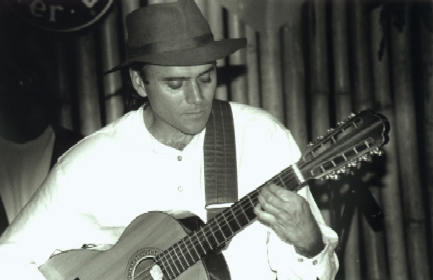
 
      
Almir Eduardo Melke Sater (Campo Grande, 14 de novembro de 1956) é um violeiro, compositor, cantor e ator brasileiro.

Born in Mato Grosso do Sul (CW), he used to play the guitar as a child, but only discovered the viola caipira (an adapted acoustic guitar, smaller than the usual 6-string, used in the countryside) in Rio de Janeiro, where he was studying Law. Sater gave up becoming a lawyer and, instead, decided to take guitar lessons with Tião Carreiro. Later, he returned to Campo Grande (capital of Mato Grosso do Sul) and lined-up the duo Lupe & Lampião. In 1979, he moved to São Paulo, becoming a back up musician to singers like Tetê Spíndola and Diana Pequeno. His debut album, "Almir Sater", was released on Continental in 1981, followed by "Dona", on RGE. Three years later, he put the Comitiva Esperança together, touring the pantanal region and researching the music from the area. After releasing other albums and playing the Free Jazz festival, in 1989, Sater played a part in a soap-opera, which helped projecting his music. He released "Terra dos Sonhos" in 1994...
 
 
♥
 
Música Caipira (Brazilian Country Music)

Brazilian countryside on viola strings
Rosa Nepomuceno

The catholic chants brought by Jesuits were mixed with Portuguese tunes and the dance and music of the Indians, original landlords of the newly discovered tropical country. Many styles emerged from that mixture, especially in the southeast, then in the south and center-western regions, integrating what would be known as "música caipira" (literally, country music). The viola, a Brazilian type of small, acoustic guitar, was carved from tree trunks. In the early days, the strings were made out of animals’ guts; later, they were switched to wire, and through the years, the viola has been testified as the basic instrument for the countryside style. Caipira is one among many words emerged from the incorporation of tupi and other indigenous idioms with Portuguese in colonial times. When broken down, we have caa (bushes), pir (something that cuts) and cururu, which is how the Indians attempted to say cruz (cross).

Missionaries moved
To prove their love
To the natives that feared
The foreign invader
But hearing the mellow sound
Of a weeping viola
The careful primitives
Leaned over to enjoy it.

(Assim Nasceu o Cururu, Cap. Furtado e Laureano)
 
...

...Through the 90s, the pop-sertanejo (tailored for foreign markets) and the neo-caipiras (educated musicians interested in rescuing the original roots of the style) managed to live in harmony. 

The latter have developed their own independent labels and show circuits. The key artists for the movement are Renato Teixeira and viola expert Almir Sater. Currently, Roberto Corrêa, Ivan Vilela, Pereira da Viola and Chico Lobo (from Minas Gerais), and Miltinho Edilberto (from São Paulo) are some of the greatest caipira music performers/composers.

...read the whole thing here

***
 
   
Roberto Correa
Viola Caipira
 

♫

15.10.10

Ao Clarão da Lua

  
Aqua
A música das lavadeiras do Jequitinhonha
Jequitinhonha washerwomen's song
La música de las lavanderas

2004

Tracks:

01 - Navio de Guerra / Cessando Areia
02 - Beira Mar da Vigia
03 - Cai Bananeira
04 - Córrego Novo
05 - Senhora Santana
06 - Mestra Diôla
07 - Peneira Gavião
08 - Tributo ao Jequitinhonha
09 - Da Sala pra Varanda
10 - Rala o Coco Bem-te-vi
11 - Ao Clarão da Lua
12 - Rosa no Batuque
13 - Saude de Portugal

As lavadeiras-cantoras são:

Adélia Barbosa da Silva, Ana Isabel da Conceição, Emília Maria de Jesus, Juracy Lima da Silva, Mirian Fernandes Pessoa, Santa de Lourdes Pereira, Sebastiana Dias Silva, Teresa Fernandes de Souza Novais e Valdenice Ferreira Santos.

A banda básica é formada por:

Carlos Farias (violão e regência),
Carlinhos Ferreira e Guê Oliveira (percussões),
Sanráh (violão solo),
Ivan Virgílio (sopros)
Aloísio Horta (baixo).
 
♫☆`*♥¸¸.•*¨*•♫☆`*♥¸¸.•*¨*•♫
        
        
♫☆`*♥¸¸.•*¨*•♫☆`*♥¸¸.•*¨*•♫
 
Get on with the washerwomen's song

The washerwomen from the Jequitinhonha Valley, region located in the Northeast of Minas Gerais, Brazil, are old songs keepers - batuques, sambas, afoxés, frevos, rodas, modinhas and toadas (Brazilian rhythms and beatings)- which origin is lost in time's memory. They are working, playing and laudation canticles, influenced by the African, Indian and Portuguese tradition. They reveal the ethnic blending that bred the rich Brazilian Popular Music.
  
  
The history of "The Choir of the Washerwomen" began in 1991 when they were encouraged by the she singer and cultural researcher Carlos Farias and started to sing as a group and built up an association in the city of Almenara, where they still live. The recording of the CD-Book "Batukim Brasileiro", a gathering part of this collection, and its launching at Ilha da Madeira - Portugal, in 2002, just like the fulfilling of a victorious tour over many Brazilian Cities, consolidated a work that quests for enriching Brazilian immaterial cultural heritage, generate income and promote social inclusion. "Aqua", released in 2005 by Carlos Farias, is the sequence of this project. The rhythm and the lyrics reveal the interbreeding and the Brazilian religious blending. It really worth listening to CDs, and specially be touched by their in live performance. In both situations, the fusion of their voices with the sounds from the drums, the rattles, the guitars and the flutes create a revealing and fascinating presentation of the Brazilian soul." 


♥
 
Contact for shows, speeches and CDs requesting:

epovaleeventos@yahoo.com.br

carlosfarias@terra.com.br

14.10.10

Grande Poder

  
«Tum Tum Tum by Déa Trancoso was born eternal. The repertoire is unique, universal, of rare beauty and essence. Music runs through time praying in joy, showing, on an impeccable production, the heart of Jequitinhonha. It’ll strike for many, many years within the best Brazilian music analogical albums.» 
Tavinho Moura
 
  
Déa Trancoso
TUM TUM TUM

2006

Tracks:

01. Filho Da Folha - catimbó
02. Tupinamba - catimbó
03. Passarinho Pintadinho - lundu
04. Grande Poder - coco
05. Indio-Filho Do Mato
06. Beija-Flor - congo
07. Rainha - catimbó
08. Luandas - maracatu
09. Benzim Veloso - acalanto
10. Canarim Do Mato
11. Meus Amo - coco
12. Canto De Uma Terra
13. Lagartixa No Fuba
  
♫☆`*♥¸¸.•*¨*•♫☆`*♥¸¸.•*¨*•♫
        
        
♫☆`*♥¸¸.•*¨*•♫☆`*♥¸¸.•*¨*•♫
  
Déa Trancoso

It all began with a ten year research on the traditions of Vale da Jequitinhonha, Minas Gerais, Brazil. The result was Tum Tum Tum, an album well acclaimed by the critics and nominated to several best record and best singer awards, alongside names such as Maria Bethânia, Alcione and Marisa Monte.

Influenced by violeiros (guitar players), cantadores (singers) and foliões (merrymakers) from Jequitinhonha, Déa Trancoso presents a work based on the mineira tradition of Terno de Catopés from Bocaiúva, a centenary group that accompanied her through a series of shows. Winner of the X Festivale – Popular Culture of Jequitinhonha Festival, Déa Trancoso entered the Brazilian musical scene with her natural voice surprising by its tuning but also by its technical abilities.

Endless scholar (with a degree on journalism and vocal techniques) she studies musical Brazilian roots, addresses to the origins of samba and its connection to the popular music of Congo and Angola, building rhythms both traditional and contemporary. In the words of the musician Ivan Vilela her voice has a “coming out of God knows where” strength and Egberto Gismonti, one of the most ingenious Brazilian composers, considers her voice to be incredibly beautiful and truthful.


“Este CD me dá a certeza do diamante jubiloso de Diamantina, que, como parte do Vale, aclarou os caminhos assanhados da Déa. Uma beleza inesgotável: Déa Jequitinhonha Trancoso!
As músicas têm o sabor que mais se gosta de saborear, o ritmo que mais se gosta de dançar, o sacolejo que se deve vascolejar até o riso se engraçar. Têm cantoria, melodia, harmonia e ladainha com ternura e meiguice. Têm invento, invenção e achado. Têm mentira com tanta verdade que parece coisa inventada, encantador, parece coisa encantada! “TUM TUM TUM” é muito perigoso porque quando a gente se agarra nele não consegue se soltar nem de noite pra sonhar”
Egberto Gismonti


♥

13.10.10

Viola Caipira

  
Ivan Vilela
Paisagens

1998

Tracks:

1. Prá Matar a Saudade de Minas
2. Armorial
3. Saudade da Minha Terra
4. Cururu prá São João
5. Asa Branca
6. Valsa para Viver um Grande Amor
7. Paisagens
8. Calma Roceira
9. Nananenem
10. Pula brincando
11. Cabriolinha
12. Catira de Mariamar
13. Cururu prá São João
14. No Balanço do Jacá
15. Baiãozim Calungo
16. Solidão
17. A Força do Boi

Ivan Vilela: Viola Caipira (Ten String Guitar)

Ilustração e projeto gráfico: Fernando Vilela
  
   
♫☆`*♥¸¸.•*¨*•♫☆`*♥¸¸.•*¨*•♫
        
        
♫☆`*♥¸¸.•*¨*•♫☆`*♥¸¸.•*¨*•♫
  
Ivan Vilela
  
Ivan Vilela is one of the main ten-string guitarists nowadays. With a special style and very developed technique, he has more than 13 albums recorded, solo or with different groups, and was nominated or awarded in several prestigious prizes in Brazil.

He is also the director and arranger of the Orquestra Filarmônica de Violas and a researcher of the traditional music from São Paulo and Minas Gerais - two Brazilian states rich in countryside culture.

He has been frequently performing not only in Brazil, but also in Spain, France, Britain, Italy and Portugal.
 
***
 
Ivan Vilela (born August 28, 1962 in Minas Gerais) is a Brazilian composer, arranger, research, teacher and viola caipira player. Ivan Vilela is teacher of the School of Arts and Communication, University of São Paulo. He is director of Orquestra Filarmônica de Violas, a Brazilian orchestra composed by Brazilian violas. Ivan Vilela is one of the main ten-string guitarists (viola caipira) nowadays. With a special style and very developed technique, he has more than 15 albums recorded, solo or with different groups, and was nominated or awarded in several prestigious prizes in Brazil.
  
Biography

Ivan Vilela is the youngest of a family of eleven children. When he was 11 years, Ivan has gained from his father a guitar. The first guitar teacher was in 1973, Amaury Vieira, Itajubá. He began his artistic career at 18 years, integrating the "Pedra" Group and then the "Àgua doce" Group, who did research on the music roots from the state of Minas Gerais. Vilela attended the faculty of history before joining the course in Music Composition from the Universidade Estadual de Campinas (UNICAMP) where he completed a BA and MA in Arts. In 1989, he moved to Campinas. In 1995, he assumed the viola as a solo instrument. Since 1996 he has been frequently performing not only in Brazil, but also in Spain, France, Britain, Italy and Portugal. Vilela worked for over 20 years of research with popular culture. He is currently completing a doctorate in social psychology from the University of São Paulo with a thesis on the social history of Brazilian country music.


♫

12.10.10

Galo cantou

  
Coral Trovadores do Vale
Beira Mar Novo

1997

Tracks:

01) Bóia, Boiadeiro
02) Beira-Mar da Leonor
03) Paulista das Meninas de Salinas
04) Tirana do Limoeiro
05) Vilão
06) Roda da Margarida
07) Beira-mar dos canoeiros, da Lira
08) Batuques do Presépio
09) Bendito de São José
10) Incelências
11) Roda de Valentino
12) Galo cantou
13) Oi, pescador
14) Saudade de Taperoá
15) Você diz que eu tou doido
16) Eu não sou daqui
17) Dança da tecedeira
18) Cadê meu dedo
19) Coco da velha
20) Roda da carambola
 
Ficha Técnica:

Direção Musical e Regência: Ivan Vilela
Direção Artística e Produção Executiva: Maria de Fátima Marques, Miracy Pereira da Silva Sebastião Roque (Coral Trovadores do Vale)
Arranjos: Ivan Vilela e Alexandre Lunsqui
Arranjos para Percussão: Carlinhos Ferreira
 
Músicos Convidados:
 
Carlinhos Ferreira - Percussão; 
Esdras Rodrigues Silva – Rabeca; 
Josino Medina e Ivan Vilela - Violas; 
Jorge Sebastião Vieira dos Santos – Sanfona
 
♫☆`*♥¸¸.•*¨*•♫☆`*♥¸¸.•*¨*•♫
        
        
♫☆`*♥¸¸.•*¨*•♫☆`*♥¸¸.•*¨*•♫
  
For this CD, was selected a vast repertoire of songs and dances. Chants of Labour, like the Cattle, of Weaver and Beira Mar. The latter sung by the boatmen. Also part of the hard dance parties and created to animate the souls of those who participate in them: Contra-dances, Dances of Villain, Circle Dances. In some of these dances the verses are played by one person or another circle. It also includes Paulista Dance, Weaver Dance and songs for religious reasons as Batuquinhos of Bethlehem, sung at Christmas in honor of the birth of baby Jesus and the Blessed and Incelências- songs ordering the soul of someone who left. The cultural proximity to the Northeast Valley is recorded by a Coco Stylish Bambelôs of Bahia, with its wild and contagious rhythms.

The repertoire of this CD are composed also of songs with beautiful melodies like Limon. Finally, a repertoire that brings the listener, back at times, at the time Blacks, Indians and Portuguese had not yet amalgamated as it is today perceived in the Brazilian culture "

(Text written by the poet, journalist, writer and photographer John the Evangelist Robinson extracted from the CD booklet SEASIDE NEW)
 

google tried to translate again :)
 

The members of the choir are of humble origin, all belonging to the community, are workers of different professions, barns, masons, shoemakers, artisans and business people, housewives, laundresses, teachers and students.


♥♥♥

...just another cd with *********** out of ten :)
tio Miguel
 

11.10.10

Guitarra, Tiple, Bandola, Requinto

  
De Medellin à Popayan
Les Guitares Des Andes Colombiennes
Colombia: Guitarra, Tiple, Bandola, Requinto
1995

Tracks:

1. Volando - Trio Morales Pino d'Alvaro Romero
2. Tunjuelito - Jorge Ariza
3. Atardecer - Trio Morales Pino d'Alvaro Romero
4. Mariquitena - Jorge Ariza
5. Flor De Romero - Trio Morales Pino d'Alvaro Romero
6. Maria - Trio Morales Pino d'Alvaro Romero
7. El Paisa - Virgilio Rojas
8. Radio Santa Fe - Trio Morales Pino d'Alvaro Romero
9. Esto Es Torbellino - Jorge Ariza
10. Esteros Del Camajuan - Jorge Ariza
11. Orquideas - Jorge Ariza
12. Torbellino Veleno - Jorge Ariza
13. Irradiacion - Trio Morales Pino d'Alvaro Romero
14. Vivita - Trio Morales Pino d'Alvaro Romero
15. Torbellino Chipateno - Jorge Ariza
16. Jorcasti - Jorge Ariza
17. Que Vivan Los Novios - Jorge Ariza
18. Reyesco - Jorge Ariza
19. Sobre El Humo - Trio Morales Pino d'Alvaro Romero
20. Esperancita - Trio Morales Pino d'Alvaro Romero

Personnel:
 
Trio Morales Pino d'Alvaro Romero (Guitarra, Tiple, Bandola)
Jorge Ariza (Requinto)
Virgilio Rojas (Guitarra)
  
♫☆`*♥¸¸.•*¨*•♫☆`*♥¸¸.•*¨*•♫
        
        
♫☆`*♥¸¸.•*¨*•♫☆`*♥¸¸.•*¨*•♫
     
This volume of the Musique du Monde series documents traditional music for string instruments (performed on guitarra, tiple, bandola, and requinto) performed by the Andean folk group Trio Morales Pino d'Alvaro Romero, and assisted by Jorge Ariza on requinto and Virgilio Rojas on guitarra. De Medellin à Popayan covers the heavily Spanish-influenced folk styles of this region: bambuco, pasillo, guabina, and torbellino. The music is energetic and celebratory and would typically be played in village gatherings. The instruments combine to create interesting textures, with the strings providing both rhythm and melody. An intriguing document of the rural highlands of Columbia, De Medellin à Popayan shows the lasting impact of Spanish colonization. ~ Stacia Proefrock, All Music Guide
  
Like its esmeralds, this a gem of Colombian music unknown to many but deeply appreciated by few. Listen once to this music and you will fall in love with it. Trio Morales Pino started around 1899, I recommend these albums: De Mi Tierra, Tiple Guitarra y Bandola, Recuerdos del Pasado, Colombia en Mi Violin, Meridiano Bogota. ~ Camilo

The Morales Pino Trío was a Colombian band. The trio was innovative in its use of Colombian traditional instruments: the Bandola, Tiple, and guitar. Its name was inspired by Pedro Morales Pino, one of the most beloved composers and musicians in Colombia.

The main members of the Morales Pino Trio were:

    * Álvaro Romero Sánchez - director, composer and guitarist
    * Diego Estrada Montoya - Bandola
    * Peregrino Galindo - Tiple

The trio developed a successful career in the Colombian musical scene, recording over 24 LP records with record label Sonolux.


♫

10.10.10

Rumba a la Patato

  
Marlon Simon and the Nagual Spirits
Rumba a la Patato

2000
 
Tracks:
 
1. Rumba A La Patato
2. Songo Pa Monk
3. Humble And Innocent
4. Ericka
5. Something For Carol
6. Easy Mood
7. Sandra Malandra
8. Belleza India
9. Clear To Take Off
 
Personnel:
 
Marlon Simon- drum set, batas, timbales, percussion;
Edward Simon, Luis Perdomo- piano;
John Benitez, Andy Gonzalez- bass;
Bobby Watson- alto saxophone, soprano saxophone;
Peter Brainin- tenor saxophone;
Brian Lynch, Michael Simon- trumpet;
Roberto Quintero- congas, bongo, guiro.
   
♫☆`*♥¸¸.•*¨*•♫☆`*♥¸¸.•*¨*•♫
        
        
♫☆`*♥¸¸.•*¨*•♫☆`*♥¸¸.•*¨*•♫
   
"Pure pleasure best describes Venezuelan percussionist Marlon Simon' and the nagual spirits Rumba a la Patato cd. Nagual is the part of us for which there is not a description, no words, no names. This music reaches out to the" nagual" within each listener and touches the soul. The numbers are alive with emotions from the Joyful Songo Pa Monk to the sweet Ericka to the haunting Belleza India. The percussion on this recording moves as Simon himself and Roberto Quintero propel the songs forward. The pair are extraordinarie, and the numbers positively swing." Linette Tobin. Clave Magazine.
    
Venezuela-born percussionist/composer Marlon Simon is a veteran sideman with Jerry Gonzalez, Chucho Valdés, and Hilton Ruiz. Rumba a la Patato features bassists John Benitez and Fort Apache's Andy Gonzalez and pianists Ed Simon (Marlon's younger brother) and Luis Perdomo, highlighting the leader's skills as a composer of stateside jazz laced with Afro-Cuban rhythms. Simon's compositional style centers on singable melodies that overlay complex rhythmic signatures, which make for nice solo showcases. Alto saxophonist (and ex-member of Art Blakey's Jazz Messengers) Bobby Watson delivers his Birdlike soprano and alto sax lines on the moving midtempo piece, "Ericka," and the Thelonious Monk tribute, "Songo pa Monk." The title track, a riveting rumba with a 6/8 introduction, is written for the pioneering conguero Carlos "Patato" Valdes and is brightened by trumpeter (and Eddie Palmieri bandmate) Brian Lynch's clave-blooded solo. On "Sandra Malandra," Simon melds mainstream jazz with Cuban rhythm, and on "Something for Carol," the Trinidadian calypso and Dominican merengue are brought together under Simon's sexy groove flag. As this recording shows, Marlon Simon knows how put together Latin jazz for the head, hips, and heart. --Eugene Holley Jr.
   
RUMBA A LA PATATO is an exceptional first effort by Marlon Simon and the Nagual Spirits. Marlon Simon is following in the footsteps of great (Latin) Jazz bands like Jerry Gonzalez's Fort Apache Band and Ray Barretto's New World Spirit. The project is dedicated to the legendary Patato Valdes.
 
"Marlon Simon feels that the flow of creativity stems from the suffering pain, and violence we are inundated with on a daily basis. It is up to the artists to consolidate all of these negative happenings and convert them into positive ones." So states Peter La Barabara in the liner notes. Marlon Simon's music definitely has a spiritual feeling that is undeniable.
 
Marlon and crew serve up a variety of rhythms: Rumba, Songo, Mozambique, Calypso and even a little Merengue!
 
My favorite tracks thus far are RUMBA A LA PATATO, SONGO PA MONK and HUMBLE AND INNOCENT. The compositions are complex, rhythmic and full of masterful improvisations by the band members. Marlon Simon maintains a low profile on percussion but makes his presence felt throughout.
 

By     Thomas Pena


9.10.10

King Conga

  
Johnny Blas
King Conga
1999

Tracks:

01-Con Ganas
02-King Conga
03-Mi Madre
04-The Sidewinder
05-The Beat of the Conga
06-Quien Sabe
07-Sobale
08-Socorro
09-Rican Conga
10-Inglesas
11-M.J.'s Mambo
12-Little Sunflower
13-Our Sound
14-Debbie's Mambo
15-Bomba Dance

Personnel:

Johnny Blas: Congas, percusión
Angelito Rodríguez: timbales, percusión, bongó, campana
Dan Weinstein: trombón
Kerry Loeschen: trombón
Humberto Ruiz: trombón
Edwin Blas: trombón
Mark Gutiérrez: piano
Paul Pérez: bajo
Terry Delgado: coro

Recorded at Private Island Trax, Hollywood, California on June 23 & 24, 1999. 
Includes liner notes by Dan Weinstein.
 
♫☆`*♥¸¸.•*¨*•♫☆`*♥¸¸.•*¨*•♫
        
        
♫☆`*♥¸¸.•*¨*•♫☆`*♥¸¸.•*¨*•♫
  
This latest release from percussionist/bandleader Johnny Blas, his fourth as a leader, exhibits signs of growth and more depth in his and the group's musical interpretations and compositions. Propelled mainly by the triple threat of Johnny Blas on percussion and flute, Dan Weinstein on trombone and violin, and Mark Gutiérrez on piano and guitar, the group has hammered out their own style and sound, working together for years.

Also present in this recording as in previous releases is the healthy herd of four trombones, deploying monster brass colors, reminiscent of some of the early urban sounds of New York's Latin bands. Aside from the title track King Conga, a Dan Weinstein composition in the traditional Latin jazz genre, the CD also features many other compositions which fuse other Latin rhythms and styles with jazz. Mi Madre is a jazzy chachachá which pianist Mark Gutiérrez takes advantage of. The classic Lee Morgan composition The Sidewinder is transformed here into a boogaloo. Sobale, a Johnny Blas original, is a pachanga borderline descarga where everyone gets off. Another interesting composition is Socorro, composed and arranged by Dan Weinstein in the vein of the bossa nova and the bolero-chá. But my choice track is M.J.'s Mambo. Composed and arranged by Gutiérrez, the selection smokes with mucho sabor and commendable solos by Gutiérrez on piano and tres guitar, Johnny Blas on percussion, and Edwin Blas on the trombone.

Seven years into his career, percussionist Johnny Blas continued to propel the Latin jazz idiom further into the 21st century with some of the most exquisitely arranged, consummately executed music the genre had heard in some time. Not a major departure from his first two albums with Ubiquity's Cubop imprint (1997s Skin & Bones and 1998s Mambo 2000), King Conga nonetheless maintains the standards of those sets. Joining Blas once again are guitarist/pianist Mark Gutierrez and trombonist/violinist Dan Weinstein: linchpins of the percussionist's combo since his 1995 debut, A Night in L.A. In addition to lending their substantial improvisational skills to the date, they combine with Blas to form a formidable writing trio. Percussionist Angelito Rodriguez also makes impressive contributions, sharing credit with Blas on five cuts. It's worth noting that King Conga's eight originals (not counting the tasty percussion interludes sprinkled throughout) are more than capable of holding their own alongside Freddie Hubbard's "Little Sunflower" and Lee Morgan's "The Sidewinder," the second and third cover versions ever recorded by the group. Album highlights include "Sobale," an up-tempo track that adds both flute and violin to an otherwise trombone-heavy mixture; "Socorro," a soft-stepping ballad adorned with a rich string arrangement by Weinstein; and "Debbie's Mambo," a lively eight-minute track presumably dedicated to Blas' wife. The latter features an outstanding arrangement for the band's four trombones and an inspired (and slightly deranged) piano solo from Weinstein. This is Latin jazz (circa 1999) at its very best. 


♥

8.10.10

Hands in Motion

  
Giovanni Hidalgo & Michel Camilo
Hands of Rhythm

1997

Tracks:
  
1. And Sammy Walked In - Camilo    5:53
2. Footprints - Shorter    5:07
3. Amo Esta Isla - Milanes    4:22
4. Softly, As in a Morning Sunrise - Romberg, Hammerstein    4:15
5. My Soul Beat - Hidalgo    4:10
6. Papa Boco - Acosta, Chapuseaux, Chapuseaux    4:50
7. Blue Monk - Monk    3:47
8. If You Knew... - Camilo    5:14
9. En Mi Viejo San Juan - Estrada    4:05
10. Hello and Goodbye - Camilo    6:17
11. Hands in Motion - Hidalgo    3:02

Personnel:

Giovanni Hidalgo 
(floor tom, bongoes, congas, timbales, wood blocks, cymbals, chimes, cricket guiro, cowbell, goat nails, jawbone, tambourine, shakers, shekere, vibratone, cascaras, maracas, sound effects);
Michel Camilo 
(piano)
♫☆`*♥¸¸.•*¨*•♫☆`*♥¸¸.•*¨*•♫
        
        
♫☆`*♥¸¸.•*¨*•♫☆`*♥¸¸.•*¨*•♫
Could a collaborative effort between piano virtuoso Michel Camilo and Giovanni Hidalgo, who is commonly known as the finest living conguero, possibly live up to the expectations? The answer Hands of Rhythm offers is nothing short of "All that and them some, baby." The beautiful thing about hearing both Camilo and Hidalgo in a rare duo format is that unlike larger band contexts, their genius does not compete for sonic space with anyone. Every note, every stroke is clearly audible, and crystal clear. Almost as fantastic as the instrumental performance was the repertoire chosen. In fact, the overall flavor is not what one might expect from two players known well for blistering speed. A haunting, sensitive rendition of "Footprints" and the reminiscent "En Mi Viejo San Juan" are welcome surprises from a percussion lead duo. "Softly as in the Morning" and "Blue Monk" are swinging from start to finish. With these jazzy selections, the bossa nova-at-its-best "If You Knew," and the merengue "Papa Boco," Hands of Rhythm shies away from the clave-driven music that made these two men famous. And yet, they prove themselves as adept in any one idiom as the other. Hidalgo and Camilo make up for their small numbers with both taste and sheer brilliance. Hands of Rhythm is required listening for both these musician's loyal fan bases, and the Latin jazz listening public alike. 
~ Evan C. Gutierrez, All Music Guide
  
Widely acknowledged among the greatest congueros of his generation, Giovanni Hidalgo was born in San Juan, Puerto Rico, in 1963, first taking up the drums five years later; the son of the noted percussionist Jose "Manengue" Hidalgo, he was educated in Latin rhythms from childhood onward, and as a teen regularly walked to local gigs with his congas strapped to his back. He soon caught the attention of the legendary Dizzy Gillespie, touring in his United Nations All-Star Orchestra for four years; Hidalgo also became a noted session player, recording with Freddie Hubbard, Paul Simon, and Mickey Hart's Planet Drum project.
In 1992, he recorded his debut solo LP, Villa Hidalgo; Worldwide followed a year later, and for 1997's Hands of Rhythm, a collaboration with pianist Michel Camilo, Hidalgo earned a Grammy nomination in the Best Latin Jazz Album category. His Greatest Hits collection followed the next year. 
~ Jason Ankeny, Rovi 
 
An exciting and high-powered virtuoso pianist, Michel Camilo came from a very musical family (with all nine of his uncles being musicians). Originally playing accordion, he switched to piano when he was 16. After moving to New York in 1979, his song "Why Not?" became a hit for the Manhattan Transfer and caught on as a standard, and "Caribe" entered the repertoire of Dizzy Gillespie. Camilo, who worked with Paquito d'Rivera's band for three years (cutting an album with "Why Not?" as the title cut), recorded for Electric Bird (sessions reissued by Evidence) and Columbia, and worked as a leader beginning in the mid-'80s. He has released numerous albums under his own name, including Spirit of the Moment in 2007.
~ Scott Yanow, Rovi
♫

7.10.10

Mas Congas

 
The Conga Kings
Giovanni Hidalgo - Candido - Patato Valdes
2000

Tracks:

01. Tumbando Caña
02. Elube Chango
03. Guaganc¢ Pa' Las Tumbadoras
04. Nagüe
05. Avísale A Mi Contrario
06. Tuna Se Quemó
07. Descarga De Los Reyes
08. Duet I: Temporal
09. Duet II
10. Duet III
11. Conga Kings Grand Finale

Personnel:

Giovanni Hidalgo - Conga, Vocals
Candido Camero - Conga, Vocals
Carlos "Patato" Valdes - Conga, Vocals

Guillermo Edghill - Bass
Joe Gonzalez - Bongos Mauricio
Smith - Flute
Nelson Gonzalez - Vocals, Tres

José Francisco Valdés: Claves
Hermengildo Olivera: Vocals
Nelson González III: Coro
Luis Rosa: Coro

Ray Santos: director musical
♫☆`*♥¸¸.•*¨*•♫☆`*♥¸¸.•*¨*•♫
        
        
♫☆`*♥¸¸.•*¨*•♫☆`*♥¸¸.•*¨*•♫
  
These guys are the undisputed kings of conga. All three of the main players are the undisputed kings of Afro-Cuban drumming. They are Candido Camerera (the old master who can still belt them out with the best of them), Patato Valdes (the technician who is a master of unique combinations and rhythms) and Giovanni Hildalgo (the young gun, a child prodigy turned world-class musician).

This CD, which was recorded in a St. Peter's Episcopal Church in Manhattan and supervised by musical director Ray Santos, who had worked independently with each of the Kings. The CD was/is the brainchild and pet project of Chesky Records owner David Chesky who also served as the producer). The Conga Kings were recorded live with each player's drums fed directly into one microphone which was then digitized. Upon further production, it is possible to hear the individuality that each drummer personifies.

Backed-up by a veritable who's who of Latin musicians, The Conga Kings is more than an album about drumming. The music here is layered in such a way that it is possible to hear all of the players: the high-pitched (and sometimes piercing) flute supplied by Mauricio Smith, the bass of Guillermo Edghill, Nelson Gonzalez on tres and coro, John Benthel on second tres, Jose Francisco Valdes on claves, Herman Olivera Jr. on coro, Luis Rosa on coro and Joe Gonzalez on bongos.

Each piece is beautifully arranged to show off the mastery of one, two and even all three of the Kings, but the most moving and amazing offering on the disc is the final track, "The Conga King's Grand Finale" which showcases the talents of each of these wonderful drummers and attests to the appreciation and affinity that these men feel toward each other.

This Conga Kings recording is a testament to the genre. 


♥

6.10.10

Conguero

  
Francisco Aguabella
h2o
1999

Tracks:

1. Short Story   3:30
2. Quien Eres Tu   5:12   
3. Wood Place   4:24   
4. Nena   4:57   
5. Cavalie   3:18   
6. Son To Any Kid   4:55   
7. Intensity   4:02   
8. Vencido   4:31
9. Caito   4:46   
10. Danzonete   4:56
  
Personnel:

 Congas, Percussion - Francisco Aguabella
Bongos - David Romero
Double Bass - Jonathan Pintoff
Drums - Ed Smith
Lead Vocals - Nengue Hernandez
Piano - Joe Rotondi Jr.
Saxophone - Charles Owens
Trombone - Danny Weinstein
Trumpet - Luis Gonzalez
  
Remastered, remixed edition of 1986 release on Olm.

♫☆`*♥¸¸.•*¨*•♫☆`*♥¸¸.•*¨*•♫
        
        
♫☆`*♥¸¸.•*¨*•♫☆`*♥¸¸.•*¨*•♫
  
There is no shortage of conguero-led Afro-Cuban and Latin jazz groups in the world. With so many household names like Poncho Sanchez and Ray Barretto to choose from, why stop and take notice of the slightly below the radar Francisco Aguabella? All questions will be answered and doubt will disappear at the first listen to 1999's H2O. While other percussionist/bandleaders have their roots firmly in the mambo dance craze of the '50s and '60s, Aguabella's music is born of rhumba. The difference is palpable. From his distinct, clear, sharp tone to his enigmatic, quinto-driven phrasing, Francisco, though a staple of the New York scene for many decades, never left Havana. Producer Orlando "Cachaito" Lopez, a Latin jazz headliner himself, managed to capture the raw, no-frills energy of Aguabella's style on H2O beautifully. Sonically, the record has the closeness and intensity of first-row seats in a small, smoky club. Stylistically a little less folkloric than Francisco's first release, Agua de Cuba, there's a dance sensibility that drives the record. The arrangements are plenty jazzy, but without losing the visceral punch that so many bandleaders sacrifice. The selections with vocals are definitely salsa, but without being homogenized or slick, maintaining the funky quality so often sacrificed in preference toward shiny production. If there is such a thing, Aguabella is both the modern master and original gangster of Afro-Cuban music.
~ Evan C. Gutierrez

This ultra-rare and highly sought-after piece of Latin jazz history has finally been reissued for the world to experience! This CuBop re-release corrected previous mix problems; and the album was completely remixed and remastered     "Francisco Aguabella's H2O, originally released on the Olm label in 1986 and long out of print, is the kind of forgotten gem that all too often stays that way. So Latin-jazz fans should thank their lucky stars that Cubop has seen fit to reissue it in all its fiery glory. H2O is a white-hot recording that showcases precisely why Aguabella, a master percussionist who was born in Matanzas, Cuba, and who has been a driving force in Latin jazz and Afro-Cuban music since his U.S. arrival in 1957, is a certified living legend. Bristling with tight salsa arrangements that spotlight Aguabella's topnotch ensemble (including Nengue Hernandez on timbales and vocals and trombonist Dan Weinstein, who's also appeared with Aguabella to great effect on 1999's Agua de Cuba), H2O still leaves plenty of room for Aguabella to shine. "Wood Place" intertwines a delicious piano montuno with some thrilling interplay between Aguabella's congas and the horn section, "Nena" boasts some tricky unison vocal work from Hernandez, Aguabella, and Orlando Lopez, and "Danzonette" presents Aguabella's riveting take on the classic Cuban danzon style. About the only quibble with H2O is its woeful lack of information in the packaging--surely not Cubop's fault, as the album was licensed from a small, fly-by-night label, but missed nonetheless. Still, as anyone who hears this will agree, that's a minor point: the music here is enough."
-Ezra Gale, Amazon.com


"Aguabella is the John Coltrane of the Conga Drums.”
~ Dizzy Gillespie