5.10.11

ΛΥΡΑ

  
The Greek Folk Instruments Vol. 01 
Lyra
1995

Tracks:

a) Constantinople lyra

Asia Minor Dance Suite   
1. Taximi Hijaz    2:35   
2. Zeibekikos    3:03
3. Syrtos Azizie    3:33
4. Karsilamas    1:41

5. Taximi Kiourdili Hijazkiar    1:59
6. Zeibekikos "Whenever you see two cypress trees"    2:59

Socrates Sinopoulos, Constantinople Lyra
Pericles Papapetropoulos, Tambour
Amin Ala Gabu, Bentir   

Socrates Sinopoulos was born in Athens in 1974

b) Cretan Lyra   

7. Syrta Rodinou    5:36   
A medley of traditional melodies named in honour of Andreas Rodinos (1912-1934) after the manner in which he himself performed (and in 1934 recorded) them. They form a significant part of the Cretan musical tradition.

8. Rethemiotiki sousta    3:12
9. Stafidianos melody (manes)    3:03
10. "Kondylies" from Mylopotamos and a fast "pentozali" (Cretan dance)    5:16
11. "Kastrinos" dance (Maleviziotikos)    5:02

Zaharias Spyridakis, Cretan lyre (with supplementary string, #3-6 &without #7),
Karolos Kouklakis, Laouto (lute)
Pericles Papapetropoulos, Boulgari (#3,4,6,7)
Vangelis Karipis, Bentir (#3) & Toumbaki (#5)
Tambour (#3: 3,

Zaharias Spyridakis was born in Athens in 1971 and in 1984 began studying with Kostas Mountakis.
   
c) Pontic Lyra

12. Kotsari. From the district of Kars    2:58
13. Lament (Charon)    2:46
14. Omal (4/4) From the region of Garasar    2:56
15. Tik (5/8) From the Matsoka area of the Pontus. Solo dance    2:57
16. Dipat (9/8) From the district of Trebizond. A woman's dance    2:55
("kodespiniakos").   
17. Tas (6/8) From the district of Kars.    2:43
18. Pyrrihios-Sera (3/8). From the Matsouka area in the district of Trebizond. 2:40

George Amarantidis was born in 1944 in Kapnohori, Kozani. His father was also a lyra player and singer. He grew up and was taught his art in an environment where the Pontic musical tradition was authentic and alive. At the age of 15 he began playing the lyra at weddings, festivals and other celebrations. After arriving in Athens around 1973-74, he met Dora Stratou with whom he worked for nine years, as well as with Domna Samiou. He has always tried to remain faithful to the Pontic tradition, avoiding innovations. Therefore his recordings only include old traditional songs. The lyra he plays in this collection is 300 years old, made of plum wood and of course, originates in the Pontus.
Daouli played by Yiorgos Yevyelis.

♫☆`*♥¸¸.•*¨*•♫☆`*♥¸¸.•*¨*•♫
        
        
♫☆`*♥¸¸.•*¨*•☆♫`*♥¸¸.•*¨*•♫
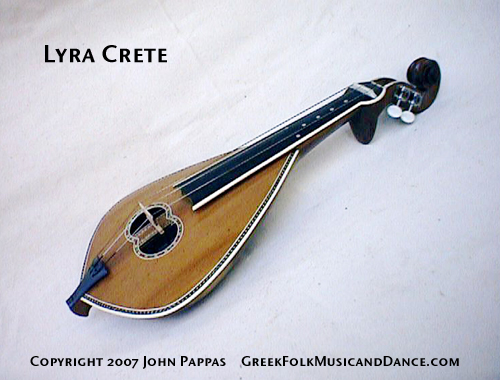
 
   
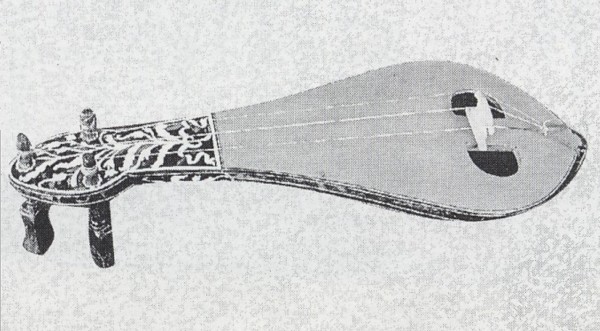
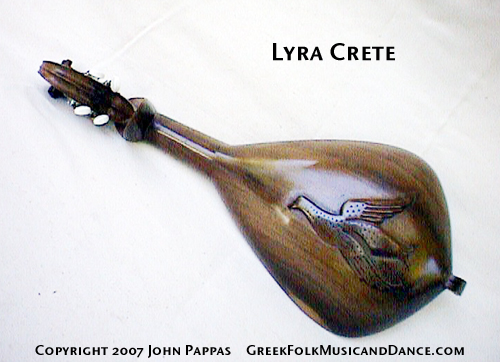
The Cretan lyra is the most popular melody instrument on the island of Crete (Kriti). It is a bowed instrument similar to the violin (violi), and it usually has three strings which are tuned in fifths. The lyra players play the lyra in an upright position. They sometimes rest it on the kneee, or, if they are standing, they will put one foot up on a chair and rest the lyra on the thigh. They have an unusual way of fingering the strings. Instead of pressing the strings with the finger tips (like violinists or guitarists do), they press against the sides of the strings with the tops of their finger nails. Sometimes the lyra players play unaccompanied, and it was not uncommon for the bow to have small bells attached to lend a rhythmic accompaniment to the melodies as the lyratzis played his lyra. The most common instrument used to accompany the lyra is the Cretan laouto, which is typically larger than the mainland laouto and tuned lower. The Cretan laouto players often play melodies with the lyra rather then just chords and rhythm. Sometimes two laoutos accompany the lyra, with one playing melody and the other playing rhythm and chords.
  
 
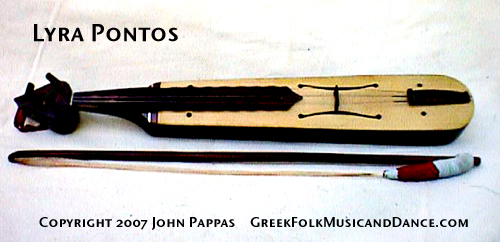
The LYRA of the Greeks of Pontos (Black Sea region of Asia Minor) is also known as the Kementse. It is played like a violin (violi) with a primitive style bow, but the musicians hold the lyra in an upright position. Sometimes they rest the instrument on their knee when they are sitting, and sometimes it is held out in front of them. They sometimes even dance in front of the dancers while holding the lyra in that way. The lyra usually has three strings. There are several tunings. Common tunings include: a-a-d, e-a-d, and many others. Since the instrument was often played alone, the tuning was often done according to the preference of the musician and his voice's range. Sometimes percussion instruments like a defi or daouli might be played to accompany the lyra. The musicians usually play two or all three strings at the same time, utilizing the open string(s) as a sort of drone to the melody. Sometimes they play the melody on two strings at once, giving a primitive harmony in fourths. They tend to play with many trills and embellishments, and with the unusual harmonies, the Pontian music has a very unique sound.


Constantinople lyra ("politiki" i.e. "of the city" or "polis")
The type of lyra encountered in Constrantinople (Istanbul) is pear-shaped with three strings. What distinguishes it from the other types of lyra found in Crete, the Dodecanese, Thrace and Bulgaria is its small size, nasal sound and the playing technique.

Until the beginning of the 20th century, its repertoire included popular songs and instrumental pieces performed by famous Greek and Turkish lyra-players in the taverns of Constantinople, accompanied solely by the Constantinople lute. At the beginning of this century, thanks to the Greek master Vasilakis, the lyra was introduced into art music ensembles of the "city", replacing the "rebab" and the violin. As a consequence, the technique changed, chiefly due to Vasilakis' pupil Tanbouri Cemil Bey, who introduced new techniques in fingering as well as in the use of the bow, influenced by the tambour, his first instrument. Unfortunately his predecessors, including Vasilakis himself, left no recordings. Nonetheless sufficient evidence of the old technique is to be found on recordings of more recent musicians (during the 20th century) who had not been greatly influenced by Cemil Bey. The most prominent of these are Paraschos, Alekos Bazianos and Lambros Leondaridis.


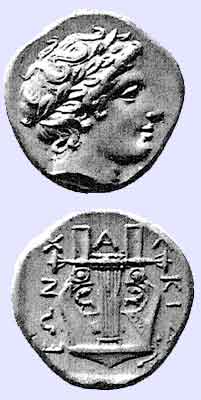
Orpheus obtained the Lyre from Apollo when he was a child and lessons how to play it. Historical it is an instrument that was known at least around 3000 BC in Ur. The lyre was known in Crete at least before 1400 as the Agia Triada Sarcophagus fresco shows a musician who plucks at a seven-stringed lyre with a plectrum (and also an Aulos player is shown). According to a story Orpheus Lyre was thrown in a river and after a journey reached Apollo's temple in Lesbos. Apollo asked Zeus the Lyre to become a constellation, the Lyra constellation, with the known star Vega that once was the polar star. (It is called by the Britons also King Athur's Harp Star).


4.10.11

Friends at Anogeia village - No 3


Nikiforos Aerakis - Nikos Xilouris
Anogiani parea 3

Tracks:

1. Parapona ts' agapis
a. Pouli ts' avgis min kelaidis
b. Ta vasana mou ine vouna (N. Xilouris)
2. Kontilies tsi nixtas (G. Vitoros, N. Vrentzos, M. Skoulas)
3. Anogiano tragoudi (N. Xilouris)
4. Mes tou Varsamou to nero (N. Aerakis)
5. Skopi tis Pareas
a. Na hamilonan ta vouna
b. Sinefo ginetai o sevntas
c. Egerasa na s' agapo
6. Anogianes kontilies
a. Den exi i agapi sinora
b. Mono ts' agapis o kaimos
c. Skila kai poso itane
(N. Aerakis, G. Vitoros, N. Vrentzos, M. Skoulas)

Giannis Vitoros - Nikos Vrentzos
Giorgis Xilouris - Kostas Xilouris
Miron Skoulas

♫☆`*♥¸¸.•*¨*•♫☆`*♥¸¸.•*¨*•♫
        
        
♫☆`*♥¸¸.•*¨*•☆♫`*♥¸¸.•*¨*•♫
  
Listening to live recordings of Cretan music are considered by many as the most direct way to introduce oneself with the way the Cretan people celebrate their joyous events.

Nikiforos Aerakis accompanied by Giorgis Vitoros, Nikos Vrentzos, Kostas Xylouris and Miron Skoulas, give us a unique chance to have a taste of these authentic moments and of the atmosphere and emotions that ‘take over’ the Cretans in such occasions.

 
Nikiforos Aerakis was born in February 1945 at the village Anogeia, in Rethimnon. He continues to live there with his wife and kids. Over three decades of music recordings and his even lengthier career as a professional musician allows us to include him in the list of the most talented artists of Cretan Music.

Motivated by his instinct and imagination, he has left his mark to the history of Cretan music while it is certain that his music will be remembered in the years to come.
His unconventional presence that sometimes has reached the limits of a soulful primitivism, leads to a musical truthfulness that can only be sensed rather than being understood. Instead of an obvious artistic expedience, his music promotes the simplicity and honesty of what is still pure. Holding on to the memories of the past, Nikiforos Aerakis skillfully reinvents them while keeping alive the same feelings and produces those very sounds that are characteristic of Anogia and the Cretan music.

Perhaps it is nowadays that his art as well as the art of any other artist of his class is needed more than ever. Because we live in times that the world of music is ‘bombarded’ by flat - and most of the times - tasteless versions of old sounds. Any artistic and musical individuality even if it does not follow the standard technical routes, is preferable to a globalized version of bad taste.


Nikiforos Aerakis was born in 1945 in Anoghia (in the Cretan region of Rethymno), where he has lived until today. With his fellow workers and fellow villagers Myron Mavroudis and Vasilis Xylouris, he played for a number of years at local parties and had great success, so much even, that his recorded work gained much praise in Greece and all over the world. He is known for his musical performances and recordings such as "Anoghian Band" and "Of the Anoghian Wedding". Anoghia, also the birth place of the famous Cretan folk music family of Xylouris (Nikos, Antonis and Giorgis), is still a nice villagelike town, where people can be part of parties, such as name days and weddings. Although touristified throughout the years, Anoghia has still kept some of its originality as a Cretan town with people like Nikiforos Aerakis still living and playing music there.
  
  
Big thanks friend Kostas for the music :)


get your CD here :)

2.10.11

Music from the island of Karpathos


Grèce: 
Musique de l'île de Karpathos
Recordings by Giuliano d’Angiolini, 1994-1995
1996

Tracks:

01. Sousta
Nikos Nikolaou-lyra
Andreas Fasakis - laouto
02. Skopi tis nichtas, Pano Choros and Sousta
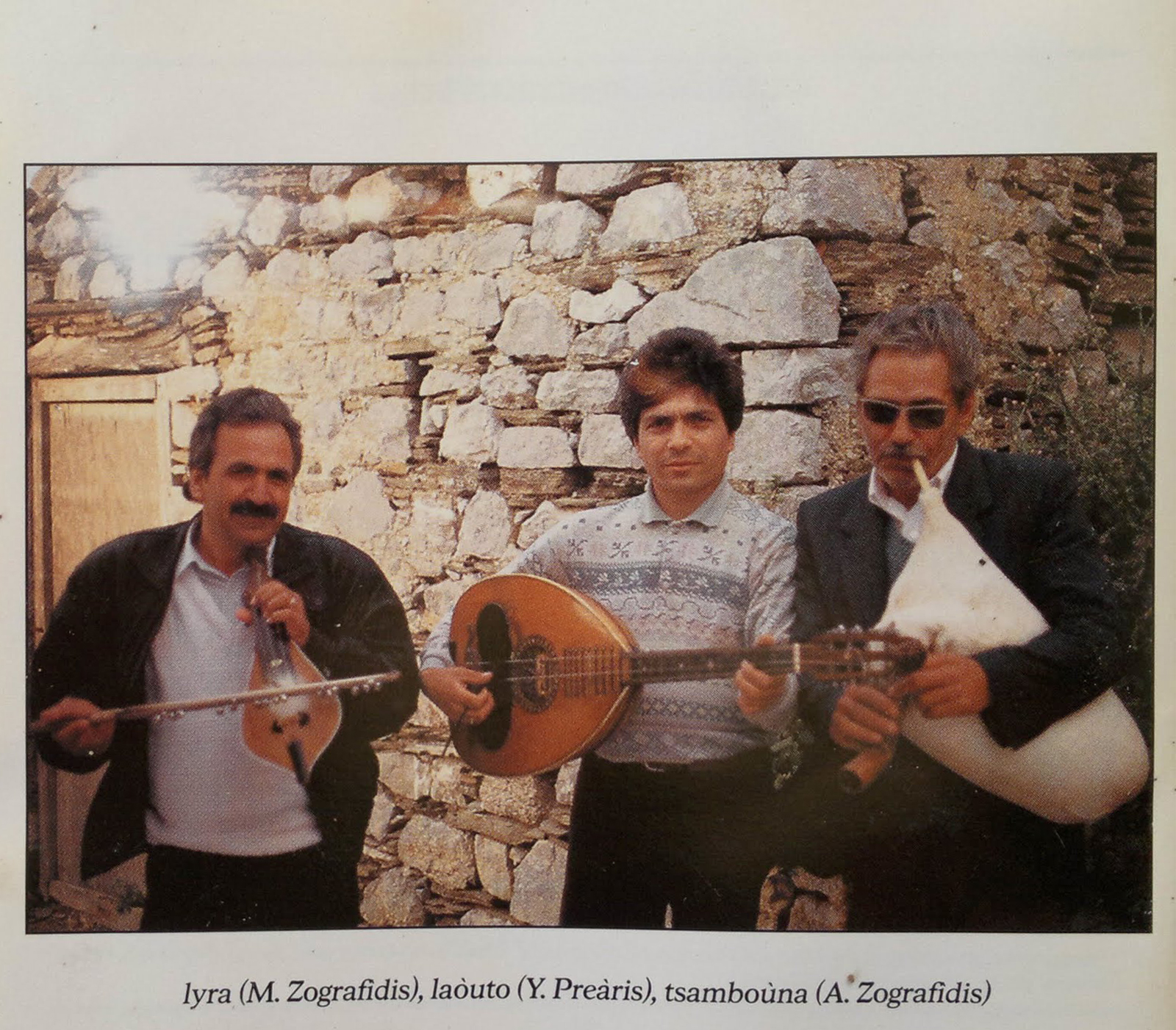
Andonis Zografidis- tsambouna,
Michalis Zografidis- song and lyra
Yiannis Prearis, Yiorghos Zografidis- laouto
03. Pathos
Michalis Zografidis- song and lyra
Yiannis Prearis- laouto
04. Syrmatikos and ''Sta marmara tou Galata"
Andonis Zografidis- tsambouna,
Michalis Zografidis- song and lyra
Yiannis Prearis- laouto
05. Mandinadha
Michalis Zografidis- song and lyra,
Yiannis Prearis,Yiorghos Zografidis - laouto
06. Mandinadha
Michalis Zografidis- lyra,
Yiorghos Protopapas- laouto
07. Pano Choros
Andreas Fasakis- lyra
Nikos Nikolaou- laouto


♫☆`*♥¸¸.•*¨*•♫☆`*♥¸¸.•*¨*•♫
        
        
♫☆`*♥¸¸.•*¨*•☆♫`*♥¸¸.•*¨*•♫
  
  
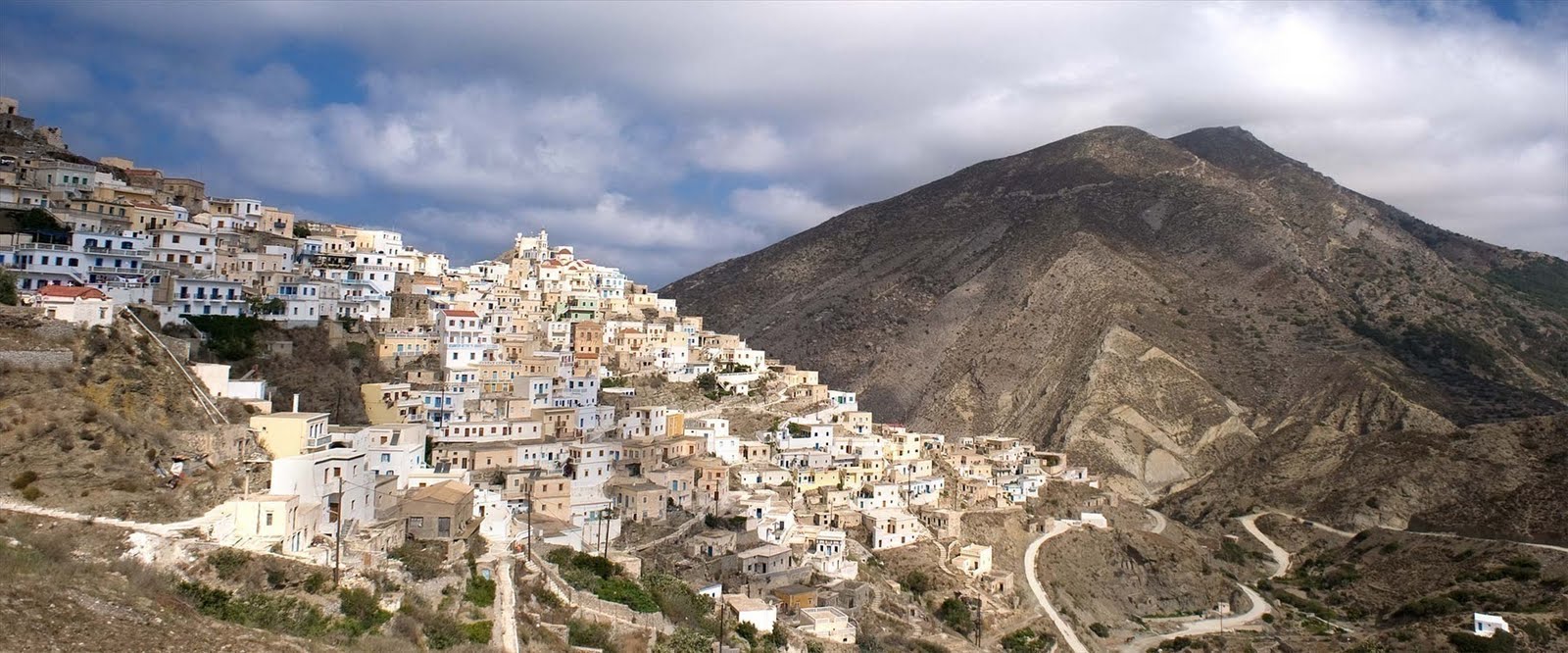
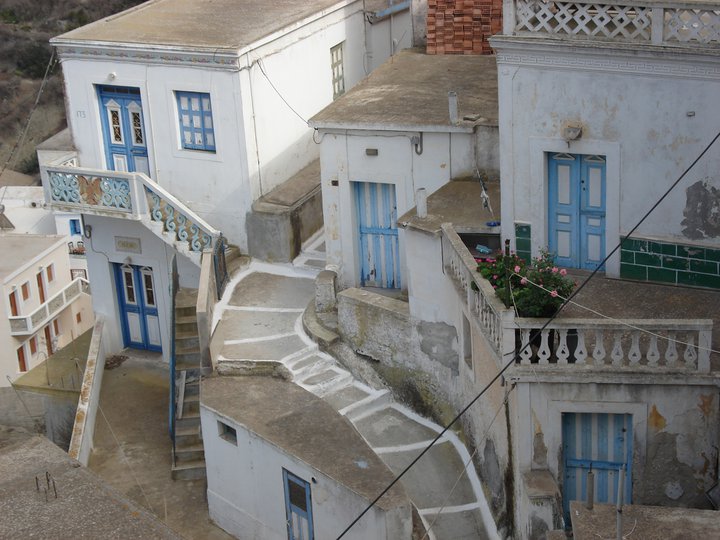
"And this is how our life goes by at the edge of the world. One day with laughter and joy, and the next day with tears". One more remarkable edition with field recordings of Greek folk music, which comes from France and which this time it takes us to a tour to the local repertoire of Olympos, a mountain village in the northern part of Karpathos. Olympos is one of the few places in Greece that preserves to a great extend up until the present day its largely traditional rural and pastoral social character. This is contributed to the isolation (the road and the electricity of the village is an event of recent years ...) and the persistence of traditional social structures and values. There would be no exaggeration to say that, until recently, Olympos was still a "living museum" where in spite of the passage of time, it kept ancient elements of speech, social organization and music. For this reason the village has many times been the object of study for sociologists, social anthropologists, musicologists and other scholars and has much to reveal to researchers ... This music edition thus seeks to give us an acquaintance with the music and dances of Olympos. A "dialogue" with mandinadhes (on the spot improvisation of rhymed distichs of 15 syllables), which took place in a coffee shop and transferred unchanged to the disc, gives us the stigma of this attempt for acquaintance. It could be an everyday dialogue in prose, but the music brings it out by serving it, distracts it from everyday life and projects it to a different-ritual level. Besides the music upon which the mandinadhes are matched, we have the opportunity to hear two very interesting "paraloges" (long narrative songs) that have survived in the music tradition of the island. The first is told on the "syrmatikos" music type, with which many old songs (Acritic and ballads) are rendered. It begins slowly to gradually accelerate and reach (after the end of the lyrics) to the lively "Pano Choros". "Last night I fell asleep in the arms of a young girl, in a powerful embrace I covered her with kisses..." The "syrmatikos" is followed by the Byzantine narrative ballad "The marbles of Galatas". This song is an example of very ancient Greek folk songs that have survived until today in conservative and isolated societies, such as Olympos. This is a direct connection to the distant past, which shows how the collective memory is preserved and disseminated through song and ritual. The old repertoire was accompanied by the "lyrotsambouna" a most unusual ensemble, which includes a lyra, a bagpipe and a lute and which today survives only in Olymbos. The disc also includes representitive dances of Karpathos such as "Pano Choros" and "Sousta". The first moves entirely within the capabilities of the tsambouna, while the second uses more melodic scale, thus exploiting the technical possibilities of the Dodecanese lyra. The publication is accompanied by a bilingual (French and English) insert booklet that includes a brief but very informative text about the music of Karpathos, the mandinadhes and folk musical instruments. It also contains the lyrics in Greek, English and French. It is worth noting that the writing of the verses in Greek is made with special care, something not always common in corresponding Greek editions. The articles are signed by Giuliano d 'Angiolini, who made the recordings in 1994 and 1995 and edited the recording.
Reviewed by: Charis Sarris. Translated from Greek by NOCTOC
 
thanks for the music, the words and the hint :)  
  
  
thank you manelaki for the photos

***

About the Music of Olymbos and the Region

1). The music of Karpathos

I.General

    Karpathos, as well as nearby Kassos form a unit that is extremely aligned in all forms of life including geography, culture, and music. Karpathos and Kassos are the southernmost islands of the Dodecanese and the closest to Crete.

Exploring the music of Karpathos, one has to only experience the music from the village of Olymbos which is located in the northern part of the island. The village, until recently somewhat isolated, remains highly important for the wealth of its cultural traditions and contains a mountain community still preserving the characteristics of an agro-pastoral economy.

Nonetheless, the reality of emigration has caused-and is still causing-substantial modifications in the social balance of the community life which affects the area of music as well.

II). Music and Musicians

    Musicians in Olymbos play a major role in the musical life of the village, and are the leaders in the island’s cultural life including those who live on the neighboring island of Rhodes. There is a great cultural continuity and integration between them, especially when time comes for all of them to perform together. This can be explained by the geographical proximity but also because the vast majority of the immigrants of Olymbos retain and exercise their traditions and cultural affairs anywhere they might live, and they return to the village for the holidays and the summer months.

Musicians have a status  which could be defined as "semi-professional"; recognized for their musical talents, they are called upon to play in other villages on the island. This activity can be a source of considerable income in addition to what they earn from their everyday professions.

    There are a number of players of the lyra, laouto, and tsambouna, the three main instruments of Karpathos, constructed by local craftsmen, most of the times the musicians themselves. The players span across all ages including young musicians which maintain a high level of interpretation and performance skills. From all the musicians, the tsambouna players, often specialized in the technique of this difficult instrument, are more rare, but still well represented. The kafeneio7, often constitutes the natural surroundings for the commencing of  festive occasions and popular musical and cultural events. When in the kafeneio, the musicians will start playing in the early afternoon, and from there the singers, most of the times being very good composers of mantinades6 will start gathering and at the end, they will form a diversified group of meraklides, able of arousing the whole village into a celebration which will last until the next morning.

    The content and form of mantinades is not specified in advance. Therefore, mantinades do not constitute a repertoire, but on the contrary, they vary and are generally conceived within the framework of a dialogue between several participants in certain tunes, or skopous, in clearly defined social functions and situations. In other words, the context of mantinades is generated by the situation at the moment and is incorporated within the music.
 
...read the whole thing here :)
  

20.9.11

Jazziza

  
Aziza Mustafa Zadeh
Aziza
1991/93

Tracks:

01. Chargah
02. My Ballad
03. Exprompt
04. Quiet Alone
05. Inspiritation
06. I Cannot Sleep
07. Oriental Fantasy
08. Moment [Short Variation, Based on a Theme by Michal Urbani]
09. Blue Day
10. Character
11. Tea on the Carpet
12. Cemetery
13. Reflection
14. Aziza's Dream
15. Two Candles

Aziza Mustafa Zadeh - Grand Piano / Vocal
 
♫☆`*♥¸¸.•*¨*•♫☆`*♥¸¸.•*¨*•♫
        
        
♫☆`*♥¸¸.•*¨*•☆♫`*♥¸¸.•*¨*•♫
 
   
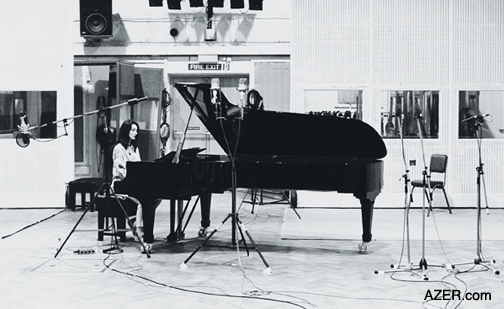
Aziza was born on December 19, 1969, in Baku, the capital of Azerbaijan, into an immensely musical family: Her father, Vagif Mustafa Zadeh, an established Jazz legend throughout the former USSR, of whom BB. King said "people call me the king of the blues, but if I could play the piano like you do, I would call myself God," was a pioneer in as much as he was the first musician to incorporate the traditional music of his homeland, known as "mugam" into popular Western Jazz music. Mugam, itself a highly improvisational style, refers to a modal system of music of which there exist over 70 types, all defined by their specific pattern of intervals, range, as well as direction of melodic movement and rhythm. With her father as architect of the Azerbaijani Mugam Jazz Movement, and her mother Eliza Mustafa Zadeh (in Soviet times known as Eliza Khanom), herself a professional singer and one of the first women to sing in the new Mugam Jazz style, it was only a question of when and how Aziza would express her musical heritage, never an if...
   
Still, she came a long way from the headstrong child fascinated by any kind of art-form (be it music, dance or painting, but bored and annoyed by her early musical teachers, who demanded more commitment to her practicing) to the disciplined professional pianist/singer/composer. Not that she would have lost any of her self-determination. She always liked to have things her way, a philosophy that did not necessarily go down well with her teachers at Baku conservatory where she received classical piano training. While her all to obvious talent was never under dispute, her handling of musical icons was: neither Aziza's trangressive "additions" to Beethoven Sonatas, nor her improvisations on Bach fugues were very much appreciated. "I'm sure Bach would have agreed with it," she said with a smirk at an interview. It was in this same self-confident fashion that she would later on recruit Jazz celebrities such as Al Di Meola, Stanley Clarke, Omar Hakim or Bill Evans as supporting guests on her CD Dance of Fire. The fact that they all came to play her music is not a small achievement for a then 25 year old, not exactly well-known musician. Asked whether she was in the least intimidated by the famous lot she replies: "No. Not at all. In fact, I think I intimidated them a little. It took a lot of time to record and the music was very different. We had to stay up long hours and even then we recorded for the best part of a month."

    Aziza started playing the piano when she was 3 years old, gave her first concerts with 14, and won her first international prizes with 17."It would have been a sin not to use this god-given gift," she muses. Next to God her parents are Aziza's most important musical leaders, especially her father. He tragically died at the early age of 39 of a heart attack after a performance in Uzbekistan, an event both devastating and strangely motivating for the ten-year old girl: With Vagif's death she not only lost her father but a source of inspiration and a gifted mentor for whose unceasing creativity Aziza continues to have the highest appreciation. "He was a genius. A true genius." Vagif continued to influence his daughter beyond his death it seems. Commenting on his death she muses: "For me, my father has never died. He simply has left this earth. I still feel his energy surrounding me. Sometimes, it's like his soul is flying around me, you know. There are times when I give concerts that I feel his presence so strongly, it's almost tangible. It's like I could reach out and touch him." Little surprise that her father is omnipresent in Aziza's work, be it in the form of one of his compositions or in a song dedicated to him.

After her husband's death Eliza Zadeh gave up her own career as a singer and invested her talent and professional knowledge into her daughter's musical education. In so doing she continued a tradition of musical collaboration that had formerly existed between herself and her husband. Eliza not only directed her daughter's vocal training but would later on become her manager, co-producer and confidante in all things regarding Aziza's own career.
In 1989 Aziza left her home Azerbaijan for Germany. At present she lives in Mainz...
 
   
The first CD bears as its title the name of the artist, as simple as that. Aziza presents 15 compositions of her own, where she distinguishes herself primarily as a pianist. These are 15 pearls on a string that need to be cherished one at a time. Although the tracks display an astonishing diversity of character and three of them incorporate her singing voice, the fact that these are all solo piano pieces, and not a small number at that, brings with it the danger of surfeit. The same thing happens if you listen to the entire Goldberg Variations in one go. One needs to give those tracks enough room to expand and display their nature.
Those are not easy-pleasy compositions: clearly, this CD is the most demanding for the listener, since we have become unaccustomed to listen to music that is not technically enhanced or digitally remastered, all the more if it is not "conventional" music.

But if we give it some time there is much to be discovered on this CD, and the more I listen to these tunes the better they get! The track called Inspiration for example shows us how Aziza uses her voice and how she "thinks" musically: her scat-like singing takes up the melody her right hand plays, which is--so typically for mugam--forever moving it seems. To every note there is attached a little trill, an ornament, so as to never let a note just be "plain". And she sings as fast as she plays! Her astonishing vocal abilities are amply displayed in the "Short variation," based on a theme by Jazz violinist Michal Urbaniak, Moment. (Given her singing technique I bet she would be a brilliant wind instrument player). The track Oriental Fantasy shows how Aziza plays with the cliché of Western conceptions of "oriental" music: well aware of the strangeness of some of her harmonies to Western ears and her Azerbaijani origins that make her prone to become the "exotic other," the "Oriental Princess of Jazz" as she has been called, she quickly lets go of supposedly typical oriental harmonies and takes us on a much more idiosyncratic and unconventional musical journey.
       

On the whole, one can say that the amount of "traditional" musical matter is much less prominent than in later productions, and that her compositions are much more avant-garde and jazz-induced. In fact, Aziza draws from the entire texture that the world of music provides for her, and her comment on the initial track Quiet Alone must be understood as a general practice for Aziza's musical understanding. She writes: "This piece was written by my father, interpreted through the prism of my soul. This is a dedication..." In this sense musical allusions are present everywhere and her play is as much a dedication as an exploration of her own personal universe. Tea on the Carpet and Exprompt bear Brackeenesque traits, pieces such as Aziza's Dream are reminiscent of Latin-American harmonies and rhythms, while Character seems to echo Bach, and in what has become the epitome of the art of Jazz improvisation, its variation on a simple, straightforward theme--in superior style--combines modernity with its classical musical heritage. On My Ballad, Aziza for the first time sings in Azeri, exhibiting the mysterious, enchanting beauty of her mother-tongue.


Aziza Mustafa Zadeh is certainly an impressive first work, giving us a pretty clear idea where the immense talent and creativity is going to take this young artist, versed in both technical and expressive skills, acting as composer, pianist as well as singer: straight to the top of the Mount Olympus of Jazz music!


listen,
listen,
listen.


18.9.11

Piano con Duende


Pedro Ricardo Miño
Piano con Duende

2003

Tracks:

1. Río Miño (bulerias) con Diego Carrasco
2. Casa "El Manteca" (tanguillos)
3. Gades Maestro
4. Fiesta en la plazuela
5. Soníos Negros (Seguiriya) con Fernando "Terremoto"
6. Vete y no vuelvas (Tangos)
7. Tío Beni (Alegrias)
8. Barranco (Rumba) con Paco Ortega
9. Ímpetu (Buleria)
10. Me dejaste el corazón (Malagueña) con Fernando "Terremoto"
11. Taberna "Altozano" (Soleá) con Ángela Bautista

Artists:

Pedro Ricardo Miño     Piano
Pepa Montes           Female flamenco dancer
Fernando Terremoto     Male flamenco singer
Paco Ortega           Composer / songwriter
Jorge Malú           Percussionist
Jesús Catalá           Percussionist
Tino di Geraldo     Percussionist
Manuel Nieto           Bass player
Tomasito           Rhythmic hand clapper
Diego Carrasco           Rhythmic hand clapper
Antxo Lorenzo           Gaita artist
Angela Bautista     Chorus

♫☆`*♥¸¸.•*¨*•♫☆`*♥¸¸.•*¨*•♫
        
        
♫☆`*♥¸¸.•*¨*•☆♫`*♥¸¸.•*¨*•♫
  
Name:Pedro Ricardo Miño Bastos
Birth: 1979 Sevilla

Son of dancer Pepa Montes and guitarist Ricardo Miño. He made his stage debut at the age of four. His training and formation took place in the family and at Seville’s conservatory of music. In 1990 he participated in the show "Criaturas" at the Bienal de Sevilla. In ’94 he gave a concert with his own material but has never stopped participating in his parents’ shows, with which he tours numerous cities throughout the world. He also performs live and solo. 
This first album as a soloist is a very personal aproximation to piano flamenco and instrumental music with a wide vision of his own traditions that lets other harmonies and melodies influence a music he has been playing since he was a child.
 
***
  
The first record by this young artist, who is incredibly mature and has a great personality as a pianist and composer. However, this record is more than just a youthful work. The artist, who is the son of the bailaora (female flamenco dancer) Pepa Montes and the guitarist Ricardo Miño, has studied and examined each of his compositions to draw us closer to the flamenco piano and to instrumental music. The album features eleven themes that will draw 'olés' from everyone. From the knowledgeable and demanding public, as well as from listeners who, without knowing much about flamenco, cannot avoid becoming emotional when they hear him, and become infected by the rhythm and simple melodies that characterise his themes, which are both flamenco and universal.
  
They're two types of music with two different inclinations, with two different ways of feeling. Maybe I understand flamenco better because I'm from Andalusia, from Seville and from Triana, know what I mean? And here the sunshine is something else, and you spend all day eating tapas, and I think they're factors you need to feel flamenco, just as to feel classical music you have to go to Austria, to Germany, to feel the cold.


17.9.11

Get up, stone, out of bed, roll, roll...

  
Musiques & Musiciens Du Monde
Musique Traditionelle Du Portugal
1988

Tracks:

Beira Baixa Province

1 The Rendez-vous / Le Rendez-vous (Cançao De Embalar) 2:05
Choir [Women], Tambourine [Adufe] - Unknown Artist
2 Lullaby / Berceuse 2:39
Vocals [Woman] - Unknown Artist
3 Macelada (Picking Camomile) 1:57
Vocals [Two Women], Tambourine [Adufe] - Unknown Artist
4 Christmas Carol / Chant De Noël 4:09
Vocals [Women, Children] - Unknown Artist
5 Sao Joao (Saint John) 2:47
Vocals [Woman], Tambourine [Adufe] - Unknown Artist
6 Desejos (Wishes) 2:17
Vocals - Unknown Artist
7 For The Souls In Purgatory / Pour Les Âmes Du Purgatoire 1:57
Vocals - Unknown Artist

Alentejo Province

8 Aurora Teve Un Menino (Aurora Has Given Birth To A Son) 5:45
Vocals - Unknown Artist
Lisbon Fados / Fados De Lisbonne
9 Os Teus Olhos (Your Eyes) 1:23
Guitar - Raul Nery
Lyrics By [Poem] - Graça Ferreira do Amaral
Music By - Carlos da Maia
Viola - Joaquim do Vale
Viola [Baixo] - Joel Pina
Vocals - Maria Teresa de Noronha
10 A Nossa Rua (Our Street) 2:27
Guitar [Guitarra] - Raul Nery
Lyrics By [Poem] - Antonio Callem
Music By - José Antonio Sabrosa
Viola - Joaquim do Vale
Viola [Baixo] - Joel Pina
Vocals - Maria Teresa de Noronha
11 Fado Corrido 3:25
Guitar [Guitarra] - Avelino do Carmo
Viola - Guilherme Carvalhais
Vocals - Manuel Vicente
Words By - Traditional
12 Meia Noite (Midnight) 3:05
Guitar [Guitarra] - Avelino do Carmo
Viola - Guilherme Carvalhais
Vocals - Manuel Vicente
13 Little Fado / Fado Mineur 4:08
Guitar [Guitarra] - Avelino do Carmo
Lyrics By [Verses] - Traditional
Viola - Guilherme Carvalhais
Vocals - Manuel Vicente
Douro Littoral Province
14 Tirana (The Wild Woman) 3:27
Vocals [Woman], Choir, Percussion, Violin, Guitar [Different Types] - Unknown Artist
15 Um Viva Para Toda A Gente (A Vivat For Everyone) 2:31
Vocals - Unknown Artist
16 Misericordia, Meu Deus (Have Mercy, O Lord) 1:23
Vocals - Unknown Artist
17 Stone-cutter's Song / Chant Des Teilleurs De Pierres 2:06
Vocals - Unknown Artist

Liner Notes: Alain Daniélou

Recorded By:

Hubert de Fraysseix (tracks: 1 to 6, 8 to 14) ,
Virgilio Pereira (tracks: 7, 15 to 17)
  
♫☆`*♥¸¸.•*¨*•♫☆`*♥¸¸.•*¨*•♫
        
        
♫☆`*♥¸¸.•*¨*•☆♫`*♥¸¸.•*¨*•♫
  
Now one of the comparatively less prosperous nations of Europe, Portugal was once a great maritime and imperial power, and that history has left linguistic and cultural traces in Africa, South America and the Far East; Madeira and the Azores are still Portuguese territory.  Continental Portugal's borders have been stable since the 13th Century, and although modernisation is making the country more uniform, and changing traditional lifestyles, there is still considerable cultural diversity among the different regions.  From 1926 to 1974, Portugal was governed by the longest enduring of all Fascist regimes; as the annotator and field recordist Salwa El-Shawan Castelo-Branco points out, the Estado Novo sought to promote an image of the country, to itself and the outside world alike, as "a predominantly rural community happily immersed in its traditions," and used folk music as one of its means to this end.  It is perhaps not surprising that for many years there was considerable hostility towards folclore among intellectuals and musicologists.

...

It will be obvious that Portugal sustains a rich variety of traditional music, some of it still an integral part of a traditional way of life, some of it the result of conscious processes of preservation, and some of it partaking of both attributes.  It also seems evident that, whatever dubious attempts at political co-option were made in the past, traditional music, revivalist and otherwise, is an important marker of both national and regional identities.  I'm well aware, of course that, in fulfilling those roles, Portuguese traditional music must have political dimensions and implications, which are doubtless of considerable importance to the democratic regimes that have happily succeeded the long rule of the military; but it seems likely that the mechanisms by which ideology interacts with folklore are considerably healthier and more respectful now than in former times.  It's also clear that, both for their variety and their quality, Portugal's folk musics are among the most interesting and enjoyable to be heard in Europe.
 
Chris Smith

source (about another good cd)

  
thanks for the music Lemmy :)


16.9.11

Saudade

   
Dona Rosa - Segredos
2003

Tracks:
       
1.      Green Corn (Milho Verde)       4:24        
2.      Gum Collector (Resineiro)       4:54        
3.      Lemon Balm (Erva-Cidreira)       3:57        
4.      Dream (Dona Rosa Talks About A Dream)       0:25        
5.      Laurindinha       4:01        
6.      Put Your Little Foot In Here (Ponha Aqui O Seu Pézinho)       3:14        
7.      Libon (Lisboa)       1:04        
8.      Mariquitas       3:16        
9.      Green Are The Fields (Verdes Sao Os Campos)       3:24        
10.      Kiss (Beijinho)       3:14        
11.      Trust (Dona Rosa Talks About Confidence)       0:48        
12.      The Girl Was In Tears / A Moça Chorava       6:09        
13.      Oh Branch, What A Beautiful Branch / O Rama O Que Linda Rama       3:59        
14.      I Was Baptized By Rose / De Rosa Fui Baptizada       1:26        
15.      Variations In Major's Dream / Variaçoes Em Sonho Maior       6:07
       
Accompanied by:

Enzo D'Aversa, accordion,
Raul Abreu, Portuguese guitar, bass, piano, and percussion
 
♫☆`*♥¸¸.•*¨*•♫☆`*♥¸¸.•*¨*•♫
        
        
♫☆`*♥¸¸.•*¨*•☆♫`*♥¸¸.•*¨*•♫
  
Besides Fados DONA ROSA sings traditional Portuguese songs that have been significant for her life.

Even today fairy tales still happen - tales that read as if they were straight out of the Arabian Nights. This is the miraculous story of the blind Fado singer DONA ROSA of Lisbon:

In 1999 a Portuguese production company was asked to find a Fado singer for an Austrian Television Company production to be recorded in Marrakesh. The programme..s musical director, the well-known Viennese artist and impresario Andr.. Heller, had a particular blind street singer in mind, a woman he had heard many years ago, whose voice had moved him deeply and haunted his memory ever since. The search proved to require quite some detective work but finally she was found - DONA ROSA.

With her live presentation at the World Music Fair WOMEX in Berlin in the year 2000, a whole new experience of life began for DONA ROSA. This was the first audience that was interested in her, as a person, for her own sake. She was confronted with all kinds of things that affected her life, disconcerted her, raised doubts in her mind: Her life changed dramatically. DONA ROSA was no longer accepted as a street singer in Lisbon. The other street and survival artists told her she was a star, expecting her to have lots of money now. Her story appeared on the front page of the Portuguese newspaper Publica (12/2000), Germany's Channel 1 (ARD) produced a documentary on her for its television programme "Kulturreport", concerts in Germany, France, Italy, England, Belgium, Denmark, Sweden, Finland, the Czech Republic, Austria and Switzerland followed. Since then, DONA ROSA has given 200 concerts in Europe and become familiar with things that were a total mystery to her in her previous life, things like airplanes.

Our understanding of the world is influenced strongly by what we see. DONA ROSA had to learn to trust things, people and situations that are taken as a matter of course for those with the power of sight. This over 40-year-old singer had to learn things other people are entirely familiar with - for example the strains of a life on tour, far from one's habitual surroun- dings.

Following one of her concerts, in the dressing room of the concert hall, the conversation once again revolved around her blindness. DONA ROSA said: "What I like to do best is dream; in my dreams I can see and I never want to wake up."
 
  
Who is Dona Rosa?

She was born on February 1, 1957 in poverty. At the age of four she contracted a severe case of meningitis to which she lost her eyesight. Her family, whose only means of livelihood was begging, could not easily accept the child’s handicap but managed to provide a basic education for her. She learned to read and write and carry out simple manual tasks ... and she became acquainted with the traditional songs of Portugal.
   
When she came of age she realised that she must leave her family for good: The day she arrived home in North Portugal she turned around and took the next train back to Lisbon.

There, with the help of other blind homeless persons, she quickly learned to master the art of survival on the street. What she didn’t earn by selling magazines and lottery tickets she earned by begging, until the day somebody suggested she use her beautiful voice as a means of livelihood.

And so there emerged on the streets of Lisbon a singer who sensitively translated her bitter fate into music. Gradually, Dona Rosa became an inseparable element of the cityscape.

Today, accompanied by a triangle once given her by a friend, she sings her own special brand of Fado. More so than traditional Fado, her song gives expression to all of the misery suffered by the poorest of the poor, and to their profound longing for the good life they will never call their own.


...my best wishes go to Jerez de la Frontera...
 
for you I will keep posting
 

15.9.11

Voices

   
Voix De Femmes Du Portugal
Women's Voices of Portugal

1995

Tracks:

1. O Senhora Do Alivio (Gary Cramolini)
2. Virgem da Concilação (Catarina Chitas)
3. Senhora Do Desterro (Rancho Folclorico De Vinhó)
4. São João (Catarina Chitas)
5. Misericordia (Gary Cramolini)
6. Alvissaras (Catarina Chitas)
7. Nossa Senhora Do Leite (Catarina Chitas)
8. Menina Do Bahlo (Gary Cramolini)
9. Vai Te Lavar Morena (Gary Cramolini)
10. Moreninha de Me Um Beijo (Grupo Chorale Feminino Flores Do Alentejo)
11. Galandrum (Albino Da Igreja; Isabel Da Igreja; Jose Ventura; Maria Da Igreja; Victor Alves)
12. Eu E de Mire Acentare (Grupo Chorale Feminino Flores Do Alentejo)
13. A A Pastorinha (Catarina Chitas)
14. Somos de Vila de Cuba (Grupo Chorale Feminino Do Alentejo)
15. So Portugues Immigrante (Grupo Chorale Feminino Do Alentejo)
16. A A Barragem (Grupo Chorale Feminino Do Alentejo)
17. Ligas Verdes (Albino Da Igreja; Isabel Da Igreja; Jose Ventura; Maria Da Igreja)
18. Homem Raro (Fado) (Fontes Rocha; Judite Pinto; Luis Gonçalves)
19. Cinta Vermelha (Fado) (Judite Pinto; Luis Gonçalves)
20. Calso Entorando (Desgarrada) (De Jesus, Sebastião; Judite Pinto; Luis Gonçalves)
21. Berceuse de Madère (Graca Serrao)
  
♫☆`*♥¸¸.•*¨*•♫☆`*♥¸¸.•*¨*•♫
        
        
♫☆`*♥¸¸.•*¨*•☆♫`*♥¸¸.•*¨*•♫
  
A collection of vocal works from the full spectrum of females in Portugal. There is much more here than simple fado to be heard, though fado is certainly represented. The quality of the album ranges from mildly grating to outstanding, touching most bases in between. There is a pair of choruses singing on the album, Cramol and the Flowers of Alentejo. Both provide some harmonic work that's appreciated in an otherwise barren-of-accompaniment album for the most part, but at the same time, the melodic work leaves something to be desired in general. More listenable perhaps are the solo singers. Catarina Chitas, an 80-year-old ex-shepherdess, performs a few numbers accompanied only by herself on a frame drum. The power left in her old voice is rather stunning as she wails through her songs. Even older is Judite Pinto, the primary fado singer on this album. Here is where the beauty of the album is truly shown. Pinto's vocals are still powerful and expressive, helped along by the outstanding guitar work of the Goncalves brothers. Unfortunately, the shining moments of fado are hardly enough to balance out the sometimes-rougher works. For a nice overview of some of the more overlooked folk forms of Portugal, this isn't a bad way to go...
says: Adam Greenberg

*****
 
Adufe

The adufe is one of the rare square double headed frame drums. A wooden structure is covered with rawhide from a sheep or goat and some rattling objects are thrown inside. The adufe is traditionally played by women in the interior provinces of Portugal, Beira Baixa and Trás-os-montes. In some regions it is simply called pandeiro (frame drum). Its sound invites meditation or even trance. To play it the adufe is held by the two hands with one corner pointing to the skies. The hands beat one of the skins and shake and hold the instrument.


3.9.11

Holy Cow


a cow is a cow
a rat is a rat
...
   

The Holy See (Latin: Sancta Sedes, "holy chair")


a chair is a chair
a nutcase is a nutcase


31.8.11

Flute & Satsuma-Biwa


Wil Offermans & Junko Ueda
Voice & Noise - How to Survive in Paradise
1992

Tracks:

1. Voice & Noise (1992)

    * Part 1 8'54"
    * Part 2 3'27"
    * Part 3 5'42"
    * Part 4 5'41"

Junko Ueda, voice, satsuma-biwa
Wil Offermans, flute, bass flute
recorded on April 11 & 12 1992 at the church of Chêne-Pâquier, Switzerland

2. How to Survive in Paradise II (1990) 31'22"

Junko Ueda, voice
Wil Offermans, flute, bass flute, live-electronics
recorded on May 6, 1992 at Haags Gemeentemuseum, The Hague, Holland

All compositions by Wil Offermans
 
♫☆`*♥¸¸.•*¨*•♫☆`*♥¸¸.•*¨*•♫
        
        
♫☆`*♥¸¸.•*¨*•☆♫`*♥¸¸.•*¨*•♫
  
     
 Japanese singer and performer of satsuma-biwa Junko Ueda has performed all around the globe with Wil Offermans - a Dutch flutist/composer - as the Duo Ueda-Offermans. Combining the seemingly opposite oriental and occidental circumstances, Junko Ueda & Wil Offermans gave their first duo concert in 1988. Out of this unique combination they have developed their compositions and improvisations, exploring the integral time-space between ancient and modern, oriental and occidental. During the last years, the duo has appeared at numerous music festivals (i.e. Musique Action Nancy, Singapore Festival of Arts, Quebec Summer Festival, New Music Festival Middelburg, Musica Contenporena Bogota) and has toured extensively all over the world. After various solo productions, their duo CD titled How to Survive in Paradise was released.

Junko

Wil
What sounds great live is not necessarily a good record. But it is interesting enough to share it. Especially since the flute got such an important feature on this blog. And watch out what they'll be doing next... And let's see where we are going next, it will be interesting at least...

Hasta la posta proxima!