Showing posts with label Domenican Republic. Show all posts

10.7.20

Padre e hija ... y música


Luis Kalaff Perez

This illustrious “maker of songs” was born on October 11, 1916 in Pimentel, Dominican Republic.

He first made his living as a carpenter and thus he made his first guitar, which soon led to his becoming an excellent guitarist, a talent he inherited from his mother who was a consummate guitar player. One day he fell deeply in love with his boss’ daughter and wrote for her his first song “Yo Vi Un Celaje” (I Saw A Sign).

He became so involved in singing and composing that his friends would worry: “He has a constant ‘heart to heart’ meeting with the muses”.

When his parents separated, together with his mother he moved to Bonao, where he pursued his musical passion and formed his first group. A second love led to his composing the now classical “Serenata De Amor” (Love Serenade). He loved to fall in love and compose beautiful songs for each new love. When juke boxes and 78 rpm disks became popular local musicians worried that the new technology would replace them, but Kalaff persisted in his art.

He formed the trio “Alegres Dominicanos” with Pablo Molina and Pedro Lapaix and soon signed a contract to perform in the radio stations “La Voz Del Tropico” and H.I.Z. When Lapaix left the trio Bienvenido Brens, another one of our great composers, took his place and together they created their best hits and performed in the historic radio station “La Voz del Yuna” where all the giants of the era played.

The trio then toured throughout the country charged with preserving their autochthonous rhythms. It is then that Don Luis composed “La Empaliza” one of his most emblematic works, which has been widely recorded, including a version by Julio Iglesias.

His creative genius is inexhaustible, he is always awake, in perpetual motion; his songs appear one after another and travel throughout the world carried by the best voices of the era, from Oscar de Leon to Celia Cruz among many, many of the biggest legendary names.

His tour of musical preservation through the inland small towns resulted in excellent works added to the country’s musical heritage, including the “mangulina” rhythm, with songs such as “Baitolin”, “Compay José”, “Compadre Cholo”, “Malao” and “Guayacanal”.

In 1956 the trio signed their first contract in Puerto Rico and in 1958 they moved to New York where he increased the size of his group and called it “Los Alegres Dominicanos” (The Happy Dominicans). Don Luis Kalaff’s artistic output is so vast that the list alone of his song titles, forms a splendid songbook: “Cuando vuelvas conmigo”, “Melancolía”, “Mi gloria”. “Acuérdate”, “Estoy a tu orden”, “Demasiado corazón”. “Olvídate de mí”, “Un corazón de acero”, “Amor sin esperanza”, “Voy a olvidarte”, “Aunque me cueste la vida”. “No tengo dinero”, “Al que me robó tu amor que le aproveche” and, of course, “Siempre hace falta una Mujer”.

Undoubtedly Don Luis Kalaff must have sworn eternal love to the love of his life: Music. At 93 he is still enveloped by the creative fire that only great artists have in their hearts. He has been a Peer composer since the early 50’s – probably one of the last surviving great composers. With over 700 songs to his credit, his works have been recorded by Julio Iglesias, La Lupe, Oscar d’Leon, Celia Cruz, Daniel Santos, Sergio Vargas, and Fernando Villalona among others – a living legend in his native Dominican Republic.


Lo ultimo de 
Luis Kalaff
1965

A1. El Merengue Del Cuentazo (Merengue)
A2. Yo Tranbajo En Eso (Merengue)
A3. Se Acabo Tu Juguetico (Bolero)
A4. La Viuda Cabrera (Merengue)
A5. Aunque Me Cueste La Vida (Bolero)
A6. La Pesadilla (Merengue)

B1. A La Orilla Del Rio (Merengue)
B2. l Telefono (Merengue)
B3. Acuerdate (Bolero)
B4. Ruque Que Te Ruque (Merengue)
B5. Yo Necesito Un Hombre (Bolero)
B6. Salve De Navidad (Merengue)

♫☆`*♥¸¸.•*¨*•♫☆`*♥¸¸.•*¨*•☆♫

.·.ღ•:*´♥`*:•ღ.·.

♫☆`*♥¸¸.•*¨*•☆♫`*♥¸¸.•*¨*•☆♫

*
*
*

26.3.14

A Mi Novia Linda... ♥

  
Bolivar Peralta
"La Novia Que Tengo"
1998

Tracks:

01 - La Novia Que Tengo
♥
 02 - Que Decida Ella
03 - Sin Tu Amor Soy Un Cobarde
04 - Asi Comenzo Nuestro Amor
05 - Tu Nuevo Calmante
06 - Dejate Querer
07 - Permitame Señora
08 - Nuestro Ayer
09 - Rico En Sentimiento
10 - Un Amor Que Ya Murio
11 - Nunca Se Sabe
12 - Asi Es El Amor (Merengue)
  
♫☆`*♥¸¸.•*¨*•♫☆`*♥¸¸.•*¨*•☆♫

.ღ•:*´♥`*:•ღ.

♫☆`*♥¸¸.•*¨*•☆♫`*♥¸¸.•*¨*•☆♫
 
   
Bolivar Antonio Peralta Camilo

Biografia por Rincon del Amargue

Este talentoso interprete de la bachata,nacio en 1948 en el municipio de tenares, salcedo. hijo de Jose Peralta y Eufemia Camilo.
Narra que su incursion en la musica nace de manera accidental,  aunque desde pequeño sintio inclinacion por la musica y el canto.
Bolivar Peralta compartia la agricultura en su tierra natal con el canto, dice, que en el conuco los muchachos me decian que no trabajara, sino que le animara cantando mientras ellos trabajaban.
En la epoca que el cantautor de amargue decide lanzarse al ambiente musical, ya nombres como: Luis Segura, Miguelito Cuevas,
Julio Jaramillo, Jose M Calderon, Rafael Encarnacion, entre otros ya se dejaban escuchar.
En 1974 Bolivar Peralta logra vender su primera composicion "Historia de Amor" al señor Francisco Flores por el precio de150 pesos y para 1977 grabo el sencillo "Samaritana" al Señor Jesus Lopez, (el compa).
Hace su llegada a Santo Domingo en 1988 motivada por la continuacion de la carrera bachatera, ya que para ese tiempo la agricultura no representaba ningun sutento.
En 1989 Peralta inicia su carrera musical, junto a Manolito de la Cruz  con un pequeño grupo para tocar en lugares publicos, un año despues formo parte del conjunto "los melodicos".
En 1992 formo su primer conjunto llamado "Los Inigualables" la Historia musical de este cultivador de la bachata, esta contenida en una 11 producciones detacandose otros exitos como: el caballo blanco, me gusta esa hembra entre otras.
En la nueva estapa de su carrera  el artista lanza una nueva produccion bajo el sello R&L del Señor Roque Cruz, titulada Mujer de mis sueños, popularizando mas su carrera con los exitos: se que volveras, la vida es una tombola y mujer de mis sueños.
Peralta  esta convencido que gracias  al tratamiento mas depurado en la letras de las composiciones de bachata, este ritmo se ha catapulado a niveles de popularidad insospechados por el.
Es por ello que siempre se ha preocupado por imprimirle a sus canciones una lirica romantica y si doble sentido, por tal razon, este artista es reconocido hoy por  sus compañeros de arte como uno de los mejores compositores de todos los tiempos.
Bolivar, mas adelante lanza otra producion titulada la novia que tengo considerando este trabajo musical, como uno de los mas importante en su carrera.
En esta ultima entrega musical, el cantautor expresa su fino sentimiento y no abandona el romantisismo que lo ha caracterizado a lo largo de su exitosa trayectoria musical. "la novia que tengo" fue la segunda producion que el artista lanzo bajo el sello R&L.
Bolivar Peralta se define como un fiel seguidor de las composiciones romanticas, por esto a su composiciones le imprime su estilo y su voz depurada.


"La Novia Que Tengo"
 
Tengo la novia mas linda
la mas concentida
que sone tener

Ella me quiere, me entiende
me envuelve me lleva
y me vuelve a traer

Y como un loco quiza
cada dia mas
mas la quiero yo

Estoy viviendo locuras
por esa criatura
que dios me mando

Estoy viviendo locuras
por esa criatura
que dios me mando

CORO
La novia que tengo
es una dulzura

Es una manzana
no es una alma dura

Es todo mi sueno
es mi alegria
asi la deseaba
asi la queria

La novia que tengo
es una dulzura

Es una manzana
no es una alma dura

Que novia mas linda
(Tengo yo)

Que novia mas buena
(tengo yo)

Que novia mas linda
(tengo yo)

Mi novia es perfecta
(tengo yo) 
 
 ♥

1.1.14

A Happy New (Y)ear : )

  
Cuco Valoy
Sonero Y Valor
2007

Tracks:

01 - Los Soneros De Ayer
02 - Juliana
03 - El Murmulleo (Nueve Noches)
04 - Mendigo De Amor
05 - Hoy Te Maldigo
06 - El Golpe De Bibijagua
07 - Amor Para Mi
08 - Salsa Caliente
09 - Mentirosa
10 - Celitos Baratos
11 - Quejas De Mi Barrio
12 - El Borracho
13 - La Vida A Mi Modo
14 - Valle Arriba, Mare Abajo
  
♫☆`*♥¸¸.•*¨*•♫☆`*♥¸¸.•*¨*•☆♫

.ღ•:*´♥`*:•ღ.

♫☆`*♥¸¸.•*¨*•☆♫`*♥¸¸.•*¨*•☆♫

 "THE WITCH MASTER" Cuco Valoy (singer, composer, arranger, producer) and his guitarist brother Martín began working as a duo (Los Ahijados, the Godsons) in the late '50s based on popular Cuban voice and guitar duos and trios of the time, many songs written by Cuco. 'Páginas Gloriosas' '65 ('Pages Of Glory'; available on Páginas Gloriosas, Adelante Soldados '94) was Cuco's patriotic hymn and the anthem of the short-lived 'constitutional revolution', suppressed by a military government helped by US Marines.

Listen to the music of Los Ahijados : )

'I was young,' he says (now describing himself as apolitical); 'I identified with the impoverished and marginalized against the wealthy establishment in power ... but it was a long time ago.' (interviewed by Philip Sweeney in the Independent '93). They met leaders of the budding salsa boom in New York '71; Cuco formed a twelve-piece band '75 which he named both Los Virtuosos (the Virtuous) and La Tribu (the Tribe), changed to Nueva Tribu (New Tribe) when new members were added mid-'80s. The lineup included lead and chorus voices, rhythm section and a changing front line of one or two saxophones, two or three trumpets and frequently one trombone; personnel including the splendid vocalist Henry García (mid-'70s to mid-'80s), Martín on bass, and two of Cuco's 14 sons: Marcos Antonio Valoy (sometimes on trombone) and Ramón Orlando (Valoy, piano, musical director, arranger, composer, chorus singer). Ramón left mid-'80s and became a major Dominican star. Until then, Valoy featured a variety of salsa and merengue (the DR's predominate dance form) but then deviated from this rule on albums that were largely or totally merengue. Lots of his best material was scattered through albums on the Discolor and Kubaney labels '75-83, later compiled on the Kubaney CD collections: Sonero, El Brujo (Volumen 2), 20 Exitos De Los Ahijados (with Los Ahijados), La Salsa De Cuco Valoy -- 15 Exitos, Salsa Con Coco, Bien Sobao, Sonero Mayor and Cuco y Martín Valoy (with Los Ahijados) '87-94; annoyingly, just to confuse things, the '92 compilations Salsa Con Coco and Bien Sobao have the same titles and cover artwork as Valoy's '78 and '82 releases. His key albums on Discolor were Salsa Con Coco '78, Tremenda Salsa '78 (aka Cuco Valoy y su Tribu en Curazao), Arrollando '79 and Tiza! '80, the latter including what Sweeney described as the 'superbly melodramatic salsa thriller' 'Mendigo de Amor' ('Beggar Of Love'). Cuco recorded for small firms '83-7, returning to Kubaney '88; treasures lurking among the mid-'80s albums include Cuco Valoy y su Tribu '84 on his own CVR label, Mejor Que Nunca '85 and Con Sabor del Tropico '86, both on Team. He made a substantial return to salsa on A Petición Popular Salsa '89, which was entirely arranged by Isidro Infante. Cuco reunited with Ramón on La Gran Obra Musical De Cuco Valoy '91 on J&N/Fuga Records; Infante was co-musical director, co-arranger and keyboardist on Valoy's last album on J&N, El Que Sabe! '92 and as co-arranger on Sabroso '93, his first on AVL. On Sabroso he returned to his first love, old Cuban songs; he told Sweeney it was the music he felt most deeply. Cuco settled in New Jersey '91, and with his Nueva Tribu was doing three to four gigs a week across North and South America in '93. Many of Cuco's more than 300 songs are about women, such as his monster hit 'Juliana' from Salsa Con Coco '78; 'I find it easy to write songs on the bitterness of love gone wrong because it's a part of the everyday life of ordinary people -- everybody recognizes it.' He acquired a nickname and an association with the Afro-Christian voodoo cult of santería with his merengue hit 'El Brujo' '77 ('The Wizard' from El Brujo '76, aka Corre, Policia, Corre!): a woman with a wayward husband uses a potion to bring him back. UK disc jockey Tomek decided '91 that Cuco really was a wizard, in 'his mastery of all elements of the Cuban-Dominican expression, ''merensalsa''. The immaculate swing of his band is informed by arrangements which never sacrifice the bittersweet diasporic tradition for specious modernism...' Further albums: Las Mujeres Calientes: Bachata, Merengue y Son '94 and Selección de Merengues '95 on AVL, Merengues Bombon '95 and Salsa Con Valoy '96 (compiles salsa tracks from '91-3 albums) on Mr Imperio.In 1997 DE VUELTA AL SON in 1998 A DOS TIEMPOS with Rmm in 2005 with kubaney INCTACTOand his new hit La Piedra and "Merengues Clasicos" is on digital store 2009. 


Cuco Valoy

In a career beginning in the 1950s and continuing into the present day, Cuco Valoy has known success singing son, salsa, merengue, bachata and bolero, in addition to playing and singing Afro-Dominican folk styles like palo. Not only has Valoy’s career run the gamut of Dominican musical forms, he has also seen the music from the vantage point of singer, percussionist, guitarist, producer, and even on-air disc jockey. Known chiefly as a vocalist, Valoy recorded both the rhythm guitar and the bongo for the son duo Los Ahijados which he fronted with his brother Martin, and often played piano or bass on his later merengue recordings. Many of the early merengues de guitarra recorded by bachateros like Edilio Paredes and Ramon Cordero featured Valoy on tambora. As a producer he worked with pioneering musicians like Bernardo Ortiz and Antonio Gomez Salcedo, and he was recognized by no less a figure than Radio Guarachita founder Radhames Aracena as having been the first radio disc jockey in the Dominican Republic to play bachata on the air.

Valoy was born in 1937 in Mano Guayabo, near the capital of Santo Domingo.
The Dominican Republic is home to a thriving culture of soneros, from Santiago to the capital, and Valoy grew up in the middle of it. Cuco’s father wanted his sons to be professional musicians, and though only a carpenter of humble means, he had Cuco study music at El Conservatorio Nacional de Música de la República .

Cuco’s professional career started in the late 1950s with Los Ahijados ( The god-children), a traditional son group he formed with his brother Martin and named in response to the great Cuban duo Los Compadres (The Godfathers). Without a doubt the most commercially successful Dominican soneros ever, Los Ahijados enjoyed hit after hit until Valoy turned to salsa and orchestra merengue in the early 1970s.

Cuban music exports dried up after the arrival of Fidel Castro in 1959. Inversely, in 1961, three decades of restrictions on Dominican music were lifted with the demise of dictator Rafael Trujillo. For Dominican son lovers, Los Ahijados filled the vacuum left by the silence from Cuba. Valoy was conscious of this, and in many of his songs he makes references to the great Cuban soneros of the past, artists like Miguel Matamoros and Antonio Machín. Some of the duo’s most memorable songs, like “Vaiven” and “El paso de la jaiva” have become standards in the international son repertoire.

The success of Los Ahijados left Valoy with the resources to invest in his own record label and radio station. Soon after the death of Trujillo, a wave of migration took place from the countryside to the city, and the capital’s new residents brought with them their love of guitar music; the result was the Dominican variant of bolero which has come to be known as bachata. It was in the midst of this wave that Valoy began to work as a producer, and some of the best loved of early bachatas were sung by his artists, songs like “Dos rosas” by Bernardo Ortiz and “El interno” by Antonio Gomez Salcedo. Apart from these singers Valoy’s studio was the first to employ legendary guitarist Edilio Paredes, who Valoy calls “A musician of extraordinary importance.”

...


 ♥

20.3.13

¡Baila!

 
El Chaval 
De La Bachata
Para Siempre

Tracks:

01. De Hoy Pa Delante
02. No Trates De Mentir
03. Bohemio De Aficion
04. El Chancletu
05. Me La Voy A Llevar
06. El Jefe
07. Fruta Venenosa
08. Planchame
09. Me Falta Valor
10. Mal Agradecida
11. Como Olvidarla
 
♫☆`*♥¸¸.•*¨*•♫☆`*♥¸¸.•*¨*•☆♫

.ღ•:*´♥`*:•ღ.

♫☆`*♥¸¸.•*¨*•☆♫`*♥¸¸.•*¨*•☆♫
 
 Dominican singer El Chaval -- often referred to as El Chaval de la Bachata -- was an active recording artist for over a decade before breaking into the Latin music mainstream in 2007. Born Linar Espinal on April 12, 1978, in Juncalito Jánico, Dominican Republic, he moved with his family to the city of Santiago in 1985. He began his singing career as a teenager in 1993 with the album Si Te Vas, credited to El Chaval & Los Infantiles del Amargue; another early album with the same group, Amor de Mis Sueños... Ahora Si Mas Mambo, followed in 1994. After a few years away from the marketplace, El Chaval returned to recording with a series of increasingly mature albums, including Sentimiento Unico (1997), Enfermo de Amor (1998), Para Toda la Vida (1999), Para Siempre (2000), Volvere (2002), Ayer y Hoy (2003), Devuelveme Todo (2004), No Te Llamo Más (2005), ¡En Vivo! (2007), and Ya Me Cansé (2007). The latter -- like many of these albums, released by Mas Music -- was his breakthrough, featuring the popular song "Dónde Están Mis Amigos." A greatest-hits collection, Su Mejors Exitos (2007), was compiled and released by Mas Music not long thereafter. ~by Jason Birchmeier
 
***
 
 NOMBRE ARTÍSTICO: El Chaval de la Bachata

NOMBRE REAL: Elinar Espinal

NACIÓ EN: Juncalito Jánico (RD) el día 04/12/1978
GÉNERO: Bachata

BIOGRAFÍA:
Linar Espinal mejor conocido en el campo artístico como El Chaval de la Bachata. Nace en Juncalito Jánico el 4 de diciembre 1978, rodeado del cariño de sus padres y hermanos es el menor de 4 hijos que procrearan Maria su madre y Chucho su padre, desde pequeño tocaba el acordeón, pero fue cuando en el año 1985 la familia se traslada a la ciudad de Santiago RD precisamente en el sector de Pekín, ahí es cuando se inclina por el ritmo de la bachata, escuchando en ese entonces al bachatero Blas Duran con la producción “Mujeres Hembras”, desde muy pequeño su trabajo era la búsqueda de aluminio, cobre y bronce para luego venderlo.

Para el año 1993 conoce a Zenón Marte quien le presento a Juan Tavarez el cual tenía un grupo de bachata acompañado de su hijo Joel Tavarez de 8 años de edad, un chico esplendido tocando su guitarra con el cual forman el grupo “LOS INFANTILES DEL AMARGUE” con la voz líder de Linar Espinal. En 1994 conocen a Nepo Nuñez Records el cual le grabo su primera producción discográfica para ese mismo año.

En 1997 sale la primera producción como El Chaval de la Bachata titulada “Sentimiento Unico” la cual contiene el hit “cuando el amor se va”. En 1998 “Enferno de Amor”, 1999 “Para toda la vida”, en el 2000 “Para Siempre”, 2002 “Volvere”, 2003 “Ayer y Hoy”, 2004 “Devuelveme Todo”, 2005 “No te llamo Más”, 2007 “Ya me canse” esta última conteniendo el más reciente hit “Donde están esos amigos”

El chaval recibió un disco de oro 1998, ha sido nominado a los premios Ases de New York 1999, en los premios Casandra 2005 y muchas nominaciones más.

Actualmente esta con la compañía disquera MAS MUSIC y sigue trabajando duro para hacer buenas producciones para seguir en el gusto popular…

El Chaval de la Bachata ha llevado su ritmo a lugares como Estados Unidos, Ameria del Sur, Europa, America Central y otros.

Bachata is a genre of music that originated in the Dominican Republic in the early parts of the 20th century and spread to other parts of Latin America and Mediterranean Europe. It became popular in the countryside and the rural neighborhoods of the Dominican Republic. Its subjects are often romantic; especially prevalent are tales of heartbreak and sadness. In fact, the original term used to name the genre was amargue ("bitterness," or "bitter music"), until the rather ambiguous (and mood-neutral) term bachata became popular. The form of dance, Bachata, also developed with the music.


♥
 

9.11.10

¡Baila!

  
JOSSIE ESTEBAN
tropical
2000

Tracks:

01. El baile del pato
02. De fin de semana
03. Borracho y sigo para'o
04. Esto si esta bueno
05. Gzando
06. Nadie
07. Nena
08. Carino mio
09. Te sigo queriendo
10. Solo, solo
11. Historia de amor
12. Ron compai
13. Me gustan to'a las mujeres
  
♫☆`*♥¸¸.•*¨*•♫☆`*♥¸¸.•*¨*•♫
        
        
♫☆`*♥¸¸.•*¨*•♫☆`*♥¸¸.•*¨*•♫
 
This release from Jossie Esteban is one my favorites from this exceptionally talented merengue artist. Formally the lead singer of La Patrulla 15, as a soloist artist for many years now Jossie is in his element. This album follows his classic high energy, upbeat and extremely rhythmic merengue. The lyrics are hilarious as usual which will inspire you to dance and enjoy every inch of each song. This album has plenty of hits to choose from. My personal favorites are: "El baile del Pato", "Borrachao y Sigo Para'o", "Gozando", "Nadie" and "Solo,Solo'. If you like Jossie Esteban then you know what to expect. He does not disappoint. Therefore don't miss out on this wonderful album.
~Marianopolita2005 
 
***
  
Jossie Esteban y la Patrulla 15 is a leading merengue band from Dominican Republic, formed by Jossie Esteban (born Esteban Grullón) and Alberto Martínez (known as Ringo).
The group was formed by these Dominican childhood friends in May 1979, and included musicians from Puerto Rico, but mostly Dominican Republic. Their debut album El Cuchu Cu Cha was a hit, and since then they have recorded more than 20 records, winning awards such as “the gold congo” in Colombia, “orchestra of the year” in New York, and a number of platinum discs. Some of their hit songs are "Agua de Coco" (Coconut Water), "Pirulo", "El Can" (The Party), "Un hombre busca una mujer" (a man looks for a woman), "Enamoraito" (love-struck) etc.
Since 1992 Jossie Esteban has also been part of the successful merengue threesome Zona Roja.
Mr. Esteban got strange beliefs about being born... but no trouble with music.


El Baile Del Pato

El baile del pato, Cuá, Cuá, Cuá

Un pato salió de fiesta, pa' lla pa' la capital

Se llevó muchas mujeres, para poder disfrutar

El pato bailand mucho, le ha dado mucho calor

Lo meto entre mi laguna, el paso media mejor

El baile del pato, Cuá, Cuá, Cuá
 
 ...
 
♥

8.10.10

Hands in Motion

  
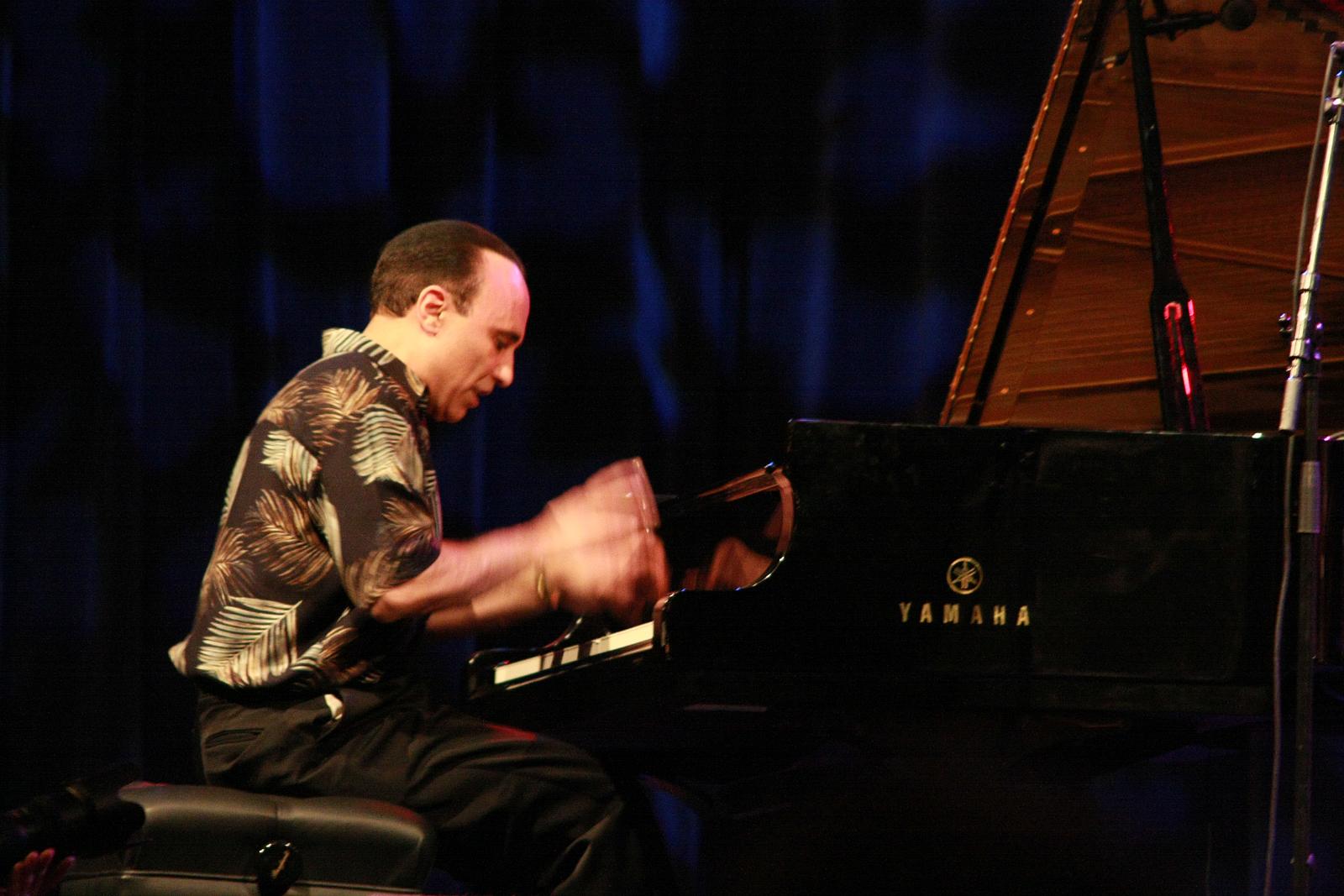
Giovanni Hidalgo & Michel Camilo
Hands of Rhythm

1997

Tracks:
  
1. And Sammy Walked In - Camilo    5:53
2. Footprints - Shorter    5:07
3. Amo Esta Isla - Milanes    4:22
4. Softly, As in a Morning Sunrise - Romberg, Hammerstein    4:15
5. My Soul Beat - Hidalgo    4:10
6. Papa Boco - Acosta, Chapuseaux, Chapuseaux    4:50
7. Blue Monk - Monk    3:47
8. If You Knew... - Camilo    5:14
9. En Mi Viejo San Juan - Estrada    4:05
10. Hello and Goodbye - Camilo    6:17
11. Hands in Motion - Hidalgo    3:02

Personnel:

Giovanni Hidalgo 
(floor tom, bongoes, congas, timbales, wood blocks, cymbals, chimes, cricket guiro, cowbell, goat nails, jawbone, tambourine, shakers, shekere, vibratone, cascaras, maracas, sound effects);
Michel Camilo 
(piano)
♫☆`*♥¸¸.•*¨*•♫☆`*♥¸¸.•*¨*•♫
        
        
♫☆`*♥¸¸.•*¨*•♫☆`*♥¸¸.•*¨*•♫
Could a collaborative effort between piano virtuoso Michel Camilo and Giovanni Hidalgo, who is commonly known as the finest living conguero, possibly live up to the expectations? The answer Hands of Rhythm offers is nothing short of "All that and them some, baby." The beautiful thing about hearing both Camilo and Hidalgo in a rare duo format is that unlike larger band contexts, their genius does not compete for sonic space with anyone. Every note, every stroke is clearly audible, and crystal clear. Almost as fantastic as the instrumental performance was the repertoire chosen. In fact, the overall flavor is not what one might expect from two players known well for blistering speed. A haunting, sensitive rendition of "Footprints" and the reminiscent "En Mi Viejo San Juan" are welcome surprises from a percussion lead duo. "Softly as in the Morning" and "Blue Monk" are swinging from start to finish. With these jazzy selections, the bossa nova-at-its-best "If You Knew," and the merengue "Papa Boco," Hands of Rhythm shies away from the clave-driven music that made these two men famous. And yet, they prove themselves as adept in any one idiom as the other. Hidalgo and Camilo make up for their small numbers with both taste and sheer brilliance. Hands of Rhythm is required listening for both these musician's loyal fan bases, and the Latin jazz listening public alike. 
~ Evan C. Gutierrez, All Music Guide
  
Widely acknowledged among the greatest congueros of his generation, Giovanni Hidalgo was born in San Juan, Puerto Rico, in 1963, first taking up the drums five years later; the son of the noted percussionist Jose "Manengue" Hidalgo, he was educated in Latin rhythms from childhood onward, and as a teen regularly walked to local gigs with his congas strapped to his back. He soon caught the attention of the legendary Dizzy Gillespie, touring in his United Nations All-Star Orchestra for four years; Hidalgo also became a noted session player, recording with Freddie Hubbard, Paul Simon, and Mickey Hart's Planet Drum project.
In 1992, he recorded his debut solo LP, Villa Hidalgo; Worldwide followed a year later, and for 1997's Hands of Rhythm, a collaboration with pianist Michel Camilo, Hidalgo earned a Grammy nomination in the Best Latin Jazz Album category. His Greatest Hits collection followed the next year. 
~ Jason Ankeny, Rovi 
 
An exciting and high-powered virtuoso pianist, Michel Camilo came from a very musical family (with all nine of his uncles being musicians). Originally playing accordion, he switched to piano when he was 16. After moving to New York in 1979, his song "Why Not?" became a hit for the Manhattan Transfer and caught on as a standard, and "Caribe" entered the repertoire of Dizzy Gillespie. Camilo, who worked with Paquito d'Rivera's band for three years (cutting an album with "Why Not?" as the title cut), recorded for Electric Bird (sessions reissued by Evidence) and Columbia, and worked as a leader beginning in the mid-'80s. He has released numerous albums under his own name, including Spirit of the Moment in 2007.
~ Scott Yanow, Rovi
♫

22.7.10

Bachata


Edilio Paredes
1980

Tracks:

01. Porque Me Busca
02. Muchachita Misteriosa
03. Mujer Perdida
04. No Me Olvides
05. Se Cambiaron Los Papeles
06. Del Cielo Cayo Una Rosa
07. La Mujer Completa
08. La Tinajita
09. Dos Amantes
10. Yo La Recuerdo

♫☆`*♥¸¸.•*¨*•♫☆`*♥¸¸.•*¨*•♫
        
         
♫☆`*♥¸¸.•*¨*•♫☆`*♥¸¸.•*¨*•♫
Edilio Paredes and The Birth of Bachata
David C. Wayne

In the annals of popular music throughout the world, it is difficult to find a single figure who has had as much influence in the forging of a style as Edilio Paredes has in the creation of bachata. Recording the lead guitar on “many more than a thousand” tracks over three decades, Edilio shaped a new genre; his arrangements distinguished bachata from the bolero out of which it emerged, and set the framework within which bachateros continue to operate even today. From bachata’s seminal days until the early 1990’s, Edilio Paredes directed and recorded the most important work of the music’s most important artists, and along the way inspired three generations of Dominican guitarists.

From infancy, Edilio has always been a prodigiously talented musician. He is a native of the small country town of La Galana, near San Francisco de Macoris, and was the first person in his family to sing or play an instrument (although his brother and his three sons have since become well known musicians in their own right). Nothing in his family history or background augured for the appearance of a musical genius. Nevertheless, Edilio relates that the first time he played a guitar was when he was four years old. “The owner of the colmado had a tres, and he put it up on the counter. I remember having to stand up on my tiptoes to be able to reach it. I’d never played any kind of instrument before, but I was able to pick up three merengues that were popular at the time.” Perhaps seeing a young child play the instrument that he was unable to play incited jealousy in the owner of the colmado - he became infuriated one day after Edilio broke a string. This left quite an impression on the gentle Edilio, and at the tender age of four the great master of the Dominican guitar swore off music forever!

By the time he was eight he had seen more of the world (he reports crossing the river to nearby San Felipe), and he repented of his decision. He formed a group with his brother, Nelson, and Ramón Cordero, who would go on to be a major figure in bachata as well. They began to play at parties in the area with a guitar that an uncle of Ramón’s gave to Edilio along with some basic instruction (Edilio is largely self-taught). Edilio recalls playing the music of Odilio Gonzalez, Julio Jaramillo and Blanca Iris Villafañe, and dreaming of one day being able to play as well as Puerto Rican legend Yomo Toro.

When he was 13, Edilio decided to go to the capital, Santo Domingo. He went to work at Casa Alegre, which was a music store owned by singer Cuco Valoy. Valoy also owned a record label, and Edilio went to work recording for him. He recorded songs with singers Bernardo Ortiz, Rafael Encarnación and Mélida Pérez, and his reputation began to grow. He quickly supplanted a number of older musicians as the most sought after guitarist to record “bolero campesino”—what would later become known as bachata.

Soon after Edilio began to record for Radhames Aracena, the proprietor of Radio Guarachita. Aracena’s station was the only national radio station which featured guitar music, and the music the station played was all recorded under one of the various labels which Aracena himself owned. It was during the years of Radio Guarachita’s predominance that bachata properly began to coalesce as a genre. Every bachatero in the country at one time or another probably recorded for Radhames Aracena. Since he was Guarachita’s premier “requinto”, or lead guitar player, all of those artists except for the few who, like Luis Segura, played their own lead guitar, worked with Edilio Paredes.

As the years went by bachata changed markedly. Whereas it began in the early 1960s as a music which was barely distinguishable from the bolero that came before it, by the mid-1970s bachata was beginning to become much more rhythmic and danceable. The güira replaced the maracas, a change which Edilio was party to, and elements of other more upbeat musics like son and merengue could be heard in the guitar lines. The one person who most influenced these changes was unarguably the one who was making the arrangements—Edilio Paredes. During this period his name was most closely linked with that of his childhood friend, Ramón Cordero, but he did important work with almost all of the major bachateros of the 1960s, 1970s and 1980s. Besides the substantial ouvre of classic songs he recorded with Marino Pérez, Bolívar Peralta, Leonardo Paniagua, and José Manuel Calderón, among others, Edilio also released a good deal of his own work.

To have a conversation with Edilio Paredes about those days is to take a glimpse into bachata’s history through the eyes of an intelligent, critical and uniquely well informed observer. And the story we see is at times a difficult one to look at. As the genre developed, it became increasingly marginalized by Dominican society, until bachata’s creators and their audience became, for a time, a despised group of people. The reasons behind this are complex and best dealt with in another context. They certainly included, however, the active efforts of the merengue industry to eliminate bachata as effective musical competition; an elitist and modernist tendency which associated guitar music with the “backwardness” of the countryside; and, later, a puritan reaction against the double entendres which became a staple of the music during the 1980s.

Happily the situation has changed. As a result of a variety of factors, bachata’s popularity grew steadily during the 1990s, and it has become arguably the most important Dominican musical export, threatening to eclipse the much longer established merengue. Bachata’s audience extends throughout Mexico, Central and South America, Europe and the United States. Young groups have pioneered a fusion of bachata with rock and R&B, while a more traditional style continues to thrive. Among those who are driving the success of the music are Edilio’s three sons, David, Samuel and Nano, all of whom are themselves tremendous musicians.
 
In spite of the current bachata vogue, Edilio Paredes still does not enjoy the esteem in his own country that one would expect. Whereas cuatrista Yomo Toro of Puerto Rico, Edilio’s childhood idol, and tresero Francisco Repilado (Compay Segundo) of Cuba are cultural icons in their respective nations, the complicated relationship of bachata with Dominican culture has relegated its greatest virtuoso to the margins of society. The musicians who have benefited from bachata’s recently achieved popularity readily acknowledge their debt to Edilio, and on any given night his audience might include some of the genre’s marquee names. Likewise, those who were aficionados of the music when it was being actively denigrated by the Dominican media know and recognize Edilio Paredes as the master musician he is.

With the entry of bachata onto the international stage, Edilio has found an audience that can objectively appreciate his great artistry. Touring with singers like Super Uba and Puerto Plata, Edilio is introducing authentic bachata to a new group of listeners. Far from the bordellos and cabarets where this music once took refuge, Edilio's pioneering style is being enthusiastically embraced the world over.


♥♥♥
  

25.6.10

Pero con Coco!


Pochi Y Su Cocoband 
Los Cocotuces
Pero con Coco!
1991

Tracks:

1. Bala Bala
2. Ana Victoria
3. La Seca
4. Detente
5. La Negra Pola
6. El Cacu
7. Vete Vete
8. La Sopa
9. A ti Mujer
10. Los Palmaritos
11. Dos Personas
12. El Bombillo

♫☆`*♥¸¸.•*¨*•♫☆`*♥¸¸.•*¨*•♫
        
        
♫☆`*♥¸¸.•*¨*•♫☆`*♥¸¸.•*¨*•♫

These guys ride the joyousness of few horn-band popular musics left to us, and whenever the bounce starts to fall they freshen it with a touch of bachata guitar, a trombone solo, whatever. ~ Carl Hoyt and John Storm Roberts, Original Music, All Music Guide

...the year that this album came out (time frame) was around the time that the cocoband were blueprinted as one of the best merengue bands around (those days) man, sometimes i do wonder about whatever happened to those good old days with the cocoband...

...Pochy (Alfonso Vásquez) is a very talented artist who not only stands out for his merengue but has incredible salsa and cha cha talent.

I was introduced to the music of Cocoband in the early 1990's and I was immediately hooked. The rhythms are infectious and the horns lift your spirit and the enthusiasm with which the lyrics are delivered make you feel like you know what they are saying, even if you don't. I have a collection of several genres of music, but it is the latin music styles that I never tire of. Maybe it is partly because I long to understand the words, but it is also because of it's unique feel. It has no equivalent in other genres. I dare you to try and sit still while listening. Even the slower rhythms make you tap your feet.
I can think of no better reason to recommend Pochi & His Cocoband than it is just musical heaven!
~ Todd A. Johnson
  
One of the premier merengue acts of the early to mid-'90s, Pochy y Su Cocoband were a group from the Dominican Republic led by Alfonso "Pochi" Vásquez. The group recorded roughly a dozen albums over a ten-year period for the renowned Kubaney label and billed themselves under a variety of names -- originally just Cocoband, then Pochi y Su Cocoband or Pochy y Su Cocoband, also Los Cocotuces. Founded in 1988 by Vásquez, the original Cocoband  were notably also comprised of Kinito Méndez and Bobby Rafael. Along with Vásquez, Méndez -- who would split from the Cocoband during the early '90s and find success elsewhere with Rikarena  and Rokabanda, plus as a solo artist -- wrote many of the group's songs. The Cocoband made their full-length album debut on Kubaney  with Cocoband  (1989), followed by numerous other albums including La Faldita (1990), Llegaron los Cocotuces (1991), Pero con Coco! (1991), El Arrollador (1992), Canciones Cocomanticas (1993), La Coco Es la Coco (1994), El Hombre Llegó Parao (1995), Temible  (1995), and El Ombliguito (1996). In addition, Kubaney compiled a few greatest-hits collections: Grandes Exitos de la Cocoband, Vol. 1 (1994), Grandes Exitos de la Cocoband, Vol. 2 (1994), and the double-disc Coco Mixes (1998).
  
By the time of the latter collection -- a compilation of extended merenhouse remixes reflecting the changing times -- Vásquez had left Kubaney and associated himself with a new label, Fonovisa Records. Changing his billing from Pochy y Su Cocoband to Pochy Familia y Su Cocoband, he released a few albums that found him moving away from purely merengue and adopting other tropical styles such as salsa and bachata: Ponle Sazon (1998), Tu Sabes...No Te Hagas (1999), and Con Más Sabor a Coco (2001). This trio of Fonovisa releases marked a downturn in popularity for Vásquez, and after a one-off independent release, Pochy Familia y Su Cocoband (2004), he essentially entered a state of retirement. A few years later, the label Emusica purchased the Kubaney back catalog and reissued some of the best Pochy y Su Cocoband recordings of the early '90s: there were two compilations in 2007 -- the single-disc Coco de Oro and the double-disc A Man and His Music...¡Pero con Coco! -- plus a few select albums. Then in 2008 Vásquez reunited with original Cocoband members Kinito Méndez and Bobby Rafael for a 20th anniversary celebration performance at the United Palace in New York City. ~ Jason Birchmeier, All Music Guide

  ♥