Showing posts with label Dances. Show all posts

2.4.18

Linđo


"Moj je dragi najbolji, njega svaka cura voli, jer on plese Lindjo"
...or in rough translation - My beloved is the best, every girl likes him because he dances Lindjo
- is a 1994 song by a Croatian pop-rock band called Gracia. - even today it truly is so!

Linđo

Linđo is a popular dance of Dubrovnik and the Dubrovnik region. It is danced to the accompaniment of lijerica (an old Southern Dalmatian instrument with three strings), which came from the Eastern Mediterranean in the late 18th century and spread on the Adriatic coast in the 19th century.


**
 **
 *

16.11.16

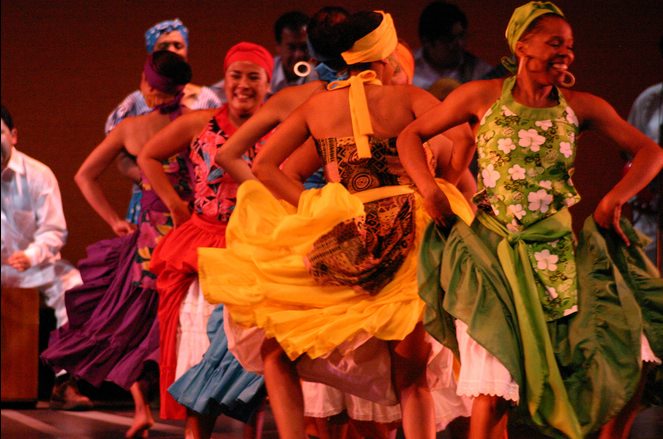
¡Asi Baila Mi Perú!


Perou 
Huayno, Valse Créole Et Marinera
1994

Tracks:

01. Pot-Pourri De Huaynos
02. Lo Cholito
03. Hermitana
04. Le Charangiste Solitaire
05. Adios Pueblo De Ayacucho
06. Tocucha
07. Inti Raymi
08. Bajo El Cielo De Los Incas
09. Huayno De La Merced
10. Mi Peru
11. Como Quisiera Tenerte En Mis Brazos
12. Cantenito De Mis Amores
13. Villancicos De Ayacucho
14. Nube Gris
15. Festejo
16. Marinera
17. Danzas Andinas
18. Las Virgenes Del Sol

♫☆`*♥¸¸.•*¨*•♫☆`*♥¸¸.•*¨*•☆♫

·.ღ•:*´♥`*:•ღ.·

♫☆`*♥¸¸.•*¨*•☆♫`*♥¸¸.•*¨*•☆♫

 Field recordings by Gérard Krémer in "Black" Peru.

Huayno - The Fingerprint of the Incas

Since Huayno lyrics are sung in Quechua, many consider it to be one of the most authentic Peruvian dances. Huayno has been a vessel carrying the essence of Inca culture throughout various generations.

The first references of Huayno appeared in 1586. The book “Vocabulary of the Indians of Peru” mentioned the “Huayñucuni”, a music indigenous people danced behind closed doors. “Huayñucuni” translates as “dancing with a partner, with arms folded.” Under colonial rule, Huayñucuni was rarely danced in public. Its successor, the Huayno, is the root of most Andean dances.

Huaynos are danced in most Andean festivities. They could be classified by the region of origin. Northern Huayno is characterized by joyful steps. Southern Huayno, instead, has cadent rhythms. Central Huayno has animated swings but very tragic lyrics. Why tragic lyrics? Quechuas lived under the despotic rule of mining corporations. Quechuas sang to vent off their sorrows and seek consolation through Huayno.

Vals - The Symbol of Peruvian Criollismo

Vals is the most valuable cultural expression of Peruvian criollismo. Due to its multiple cultural influences, Vals is an iconic dance encompassing our vast Peruvian diversity.

Dancing is not an activity disassociated with the world. Every dance is a living entity shaped by both historical and daily events. A minor change in the flow of events can provoke repercussions in the fate of any particular dance. This is how dances are developed, grow or simply decay.

In the late 1890’s, the fusion of African tunes, the French Minuet, the Polish Mazurka, the Viennese waltz and the Spanish jota produced the Peruvian Vals. Most Limeños, who loved Opera, didn’t pay attention to it. Gradually, fabulous performers as Felipe Pinglo and Chabuca Granda brought Vals to great acclaim. If a Limeño from Colonial times would materialize today, he would be astonished to see that Vals, a music generally despised then, is now the main symbol of Peruvian criollismo.

Vals, with slight steps and cadent tempo, is the most conventional of Peruvian dances.

Marinera Norteña - A Romantic Coastal Dance

Hands down, Marinera is the most iconic of Peruvian coastal dances. Along with Vals, Marinera also imbibed a manifold of cultural currents. Therefore, any serious exhibition of Peruvian dances would be incomplete without Marinera.

Despite multiple theories, Marinera probably arose from Zamacueca. There is a striking resemblance in the steps of both typical dances.

While men danced Marinera wearing shoes, women did so barefooted. Proud of their fortitude, women even sought coarser grounds to dance on. Hence, they created the motto: “the coarser the ground, the greater the dancer.” Women then exhibited their calloused soles to earn the respect of skillful dancers. Some women also danced Marinera holding a Chicha bottle on their heads.

Although we also have ‘Marinera Limeña’, ‘Marinera Norteña’ surpassed the former in popularity. The Norteño dance exudes joy, energy and speed. “La Concheperla” is the most popular Marinera song.

Why was it named Marinera (Sea dance)? Nobody knows. The swings and swirls of ‘Marinera’ assimilate those of sea waves. And some say Trujillano seamen may have baptized it so. Others assert that Trujillano writer Abelardo Gamarra picked that term in 1879.


**

12.10.14

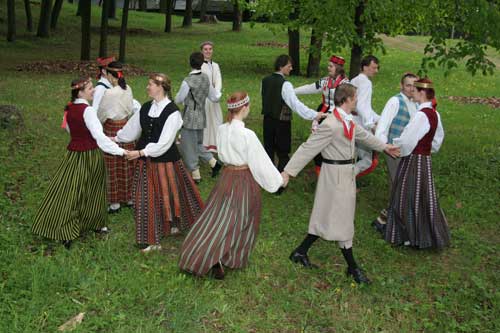
¡Baila, Baila Latvia!

  
Latviešu danči
Latvian Folk Music Collection
1999

Tracks:

01. Makaidū  
02. Cūkas driķos     
03. Eilanders
04. Enģelits  
05. Mugurdancis
06. Kurzemes mugurdancis 
07. Dzīsme
08. Skroders 
09. Diždancis  
10. Tūdaliņ tagadiņ 
11. Šaine
12. Žīga 
13. Padespaņs   
14. Lielā Jūle 
15. Garais dancis

♫☆`*♥¸¸.•*¨*•♫☆`*♥¸¸.•*¨*•☆♫

.ღ•:*´♥`*:•ღ. 

♫☆`*♥¸¸.•*¨*•☆♫`*♥¸¸.•*¨*•☆♫


Latvian music for happy feet

by Daina Bolšteins

It makes me feel happy.” A British executive of a prestigious international company said this when he heard the new Latvian Folk Music Collection’s Latviešu danči (Latvian Dances) playing as telephone on-hold music at his company. Overall, that is quite an accurate assessment of this disc.

To put it another way, the music on this album is, in two words, quintessentially Latvian. As ethnomusicologist Valdis Muktupāvels writes in the liner notes (in both Latvian and English, although a few of the English phrases are a bit awkward), Latvians love to dance. This love is truly evident in the joyous music on this disc.

The music was performed by a number of people, including Māris Muktupāvels (producer of this album) and Ilga Reizniece, both of whom are well known and highly respected in Latvian folk music circles. Other notable performers include Gints Sola, guitarist for the pop-rock group Jauns Mēness, and Mikus Čavarts, like Reizniece and Māris Muktupāvels a member of the folklore ensemble Iļģi. One surprise addition is Ilmārs Mežs and his family. Mežs, known in part for his research into Latvian demographics, also is lead singer for the folklore ensemble Eilenders.

Included in the liner notes are instructions (in Latvian only), written by Sniedze Grīnberga, for dancing the dances. It’s a wonderful idea, but does not work all that well. The directions particularly would not work well for two groups of people (other than those who do not read Latvian): those who are highly visually oriented and those who have no Latvian dance knowledge or experience. These people might be able to figure out only the simplest dances. I am quite visually oriented when it comes to dancing, never having been a big fan of written dance instructions with no illustrations because I have a very difficult time picturing the steps and formations. As for the dances on this disc, I was able to follow along the instructions mostly only to the dances that I have danced before.

However, on a purely musical level, this is absolutely fantastic music. The second track, “Cūkas driķos” is one of the more rousing versions I’ve heard and I had an almost irrepressible urge to begin dancing down the hallways of my office when I heard it. The tracks with vocals make you want to sing along at the top of your voice. The 15 dances chosen for inclusion on this disc offer a nice variety: some are fast, others are slower, some have vocals, others are instrumental. Most Latvians will be familiar with at least a couple of dances, such as “Tūdaliņ, tagadiņ” and “Mugurdancis,” which are classics that children learn at very young ages. Yet there also are tracks that will be new to many listeners.

Another enjoyable aspect of this disc is that dancers were a part of the recording. Not only does the listener hear the wonderful music, but also the actual dancing. In other words, it is very much a live recording. For those of us living outside of Latvia, at times this disc is as close as many of us will come to an authentic evening of Latvian dancing, singing and merrymaking.

This disc will make Latvians feel Latvian to the depths of their souls (and to tips of their toes) and it will give non-Latvians a greater appreciation of Latvian culture. Naturally, this is the somewhat biased opinion of a former dancer who is crazy about both Latvian dance and music, but if a half dozen co-workers from around the world at my office enjoyed Latviešu danči, I am certain all readers will as well.


3.8.10

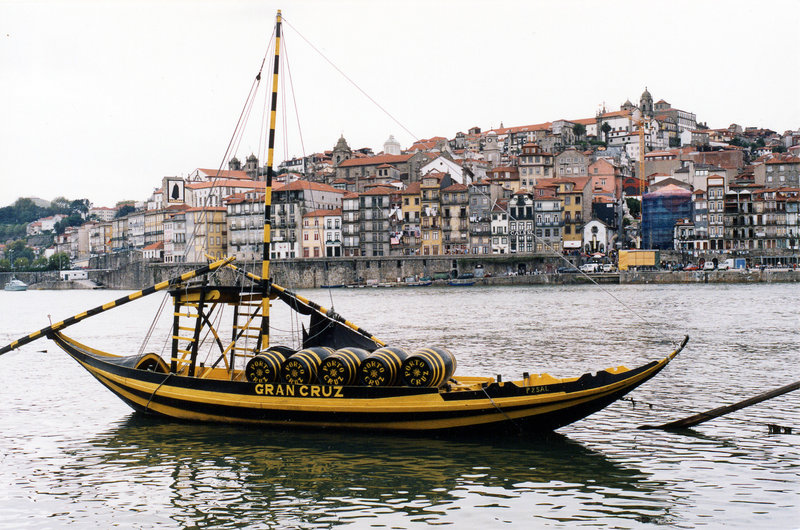
Minho & Douro

  
Danças tradicionais do Portugal
Minho e Douro
1983

Tracks:

1. Santa Marta de Portuzelo: Rosinha
2. Santa Marta de Portuzelo: Chula Picada
3. Santa Marta de Portuzelo: Rusga
4. Vila Nova de Famalicão: Chula Velha
5. Vila Nova de Famalicão: O Regadinho
6. Vila Nova de Famalicão: Malhão das Palmas
7. Vila Nova de Famalicão: Chulita
8. Meadela: Vira das Palmas
9. Meadela: Gota de Meadela
10. Moreira da Maia: Verdegar
11. Moreira da Maia: Malhão de Noite
12. Moreira da Maia: Vira das Lavradeiras
13. Gulpilhares: Regadinho
14. Gulpilhares: Tirana
15. Moldes: Cana Verde de Oito
16. Moldes: Vira Valseado
17. Barqueiros Do Douro: Chula
18. Barcelinhos: Vareira
19. Barcelinhos: Lima de Góio
20. Barcelinhos: Sapatinho
21. Areosa: Vira das Palmas
22. Malhão
23. Ponte da Barca: Gota Dos Novios
24. Ponte da Barca: Caninha Verde
25. Ponte da Barca: Vira Do Salto
26. Ponte da Barca: Chula Trocada
27. Ponte da Barca: Serrinha
  
♫☆`*♥¸¸.•*¨*•♫☆`*♥¸¸.•*¨*•♫
        
        
♫☆`*♥¸¸.•*¨*•♫☆`*♥¸¸.•*¨*•♫
  
In "Danças tradicionais do Minho e Douro," we can find songs from the musical heritage of the Minho and Douro regions in northern Portugal. Still performed today.
Entre Douro e Minho is a historical province of Portugal which encompassed the country's northern Atlantic seaboard between the Douro and Minho  rivers. Contemporaries often referred to the province as simply "Minho". It was one of six provinces Portugal was commonly divided into since the early modern period until 1936, although these provinces were not recognized as official units of government.