31.8.11
Flute & Satsuma-Biwa

Wil Offermans & Junko Ueda
Voice & Noise - How to Survive in Paradise
Voice & Noise - How to Survive in Paradise
1992
Tracks:
1. Voice & Noise (1992)
* Part 1 8'54"
* Part 2 3'27"
* Part 3 5'42"
* Part 4 5'41"
Junko Ueda, voice, satsuma-biwa
Wil Offermans, flute, bass flute
recorded on April 11 & 12 1992 at the church of Chêne-Pâquier, Switzerland
2. How to Survive in Paradise II (1990) 31'22"
Junko Ueda, voice
Wil Offermans, flute, bass flute, live-electronics
recorded on May 6, 1992 at Haags Gemeentemuseum, The Hague, Holland
All compositions by Wil Offermans
♫☆`*♥¸¸.•*¨*•♫☆`*♥¸¸.•*¨*•♫
♫☆`*♥¸¸.•*¨*•☆♫`*♥¸¸.•*¨*•♫

Japanese singer and performer of satsuma-biwa Junko Ueda has performed all around the globe with Wil Offermans - a Dutch flutist/composer - as the Duo Ueda-Offermans. Combining the seemingly opposite oriental and occidental circumstances, Junko Ueda & Wil Offermans gave their first duo concert in 1988. Out of this unique combination they have developed their compositions and improvisations, exploring the integral time-space between ancient and modern, oriental and occidental. During the last years, the duo has appeared at numerous music festivals (i.e. Musique Action Nancy, Singapore Festival of Arts, Quebec Summer Festival, New Music Festival Middelburg, Musica Contenporena Bogota) and has toured extensively all over the world. After various solo productions, their duo CD titled How to Survive in Paradise was released.
Junko
Wil
Junko
Wil
What sounds great live is not necessarily a good record. But it is interesting enough to share it. Especially since the flute got such an important feature on this blog. And watch out what they'll be doing next... And let's see where we are going next, it will be interesting at least...
Hasta la posta proxima!
♥
27.8.11
Voice & Gasba

Houria Aïchi
Chants de l'Aurès
1990
Tracks:
01. Louange au Prophète (Praise to the Prophet)
02. Elle Sort du Bain (She Emerges from the Bath)
03. Chants de Partisans (Partisans Songs)
04. Salah
05. La Fille des Aïth-Abdi (The Girl of the Aïth-Abdi)
06. Fontaine Dis-Moi (Fountain, Tell Me)
07. Gloire aux Chaouis (Glory to the Chaouis)
08. Soussem
09. La Médisance (The Scandal)
10. Berceuse (Lullaby)
11. La Fuite (The Fight)
12. Les Amants (The Lovers)
13. Mes Frères (My Brothers)
Personnel:
Houria Aïchi: Vocals, Abendaïr
Saïd Nissia: Gasba, Jawaq
Houria Aïchi was born in the center of the Aurès, and she's still here to bring the musical algerian history to people all over the world. Patiently, she collects the last vestiges in the forgotten villages and interprets them by trying to remain so faithful as possible for the tradition.
Of its native mountain, Houria Aïchi kept a shape of sourness. And it is doubtless this purified aspect which seduced Bernardo Bertollucci to accompany a passage of its film " A tea in Sahara ". The first evidence for Houria Aïchi was to go towards the music. She is endowed with a very beautiful voice, powerful, at once pure and guttural impression especially due to her phrasing, both in Arabic and chaoui.
And then she arises from a family - and of a culture where the music is omnipresent. " To sing fact left the life, the education of the girls, it flows in source. To learn the directory is obvious " she explains in the interviews today. From the age of 7 years, Houria escorted her grandmother who was a renowned azriate. Sort of troubadours in the feminine, azriates went of feast to feast, agents of vocal techniques and directories which could so be passed on through valleys and generations.
Listenning to Houria Aïchi is like listenning to 300 years of history, tradition & feelings...

Houria Aichi was born in the Aures region of northeast Algeria and studied psychology in Paris, France, during the 1970s. Her music career only got started around 1985 when she started to perform on stage. At the time she was a sociology teacher. Whenever she took to the stage, audiences found her voice enchanting while the musical accompaniment of the GaSb (reed flute) and bender gave her performances a very unique edge. It wasn’t too long before she was able to record two albums, working mainly with only these two instruments and her own brilliant voice. ‘Songs Of the Aures’ was released in 1990 and ‘Hawa’ was released in 1993. After that Aichi was busy promoting her music so it was quite a bit later, in 2001, that she recorded her third album ‘Khalwa’. It is the third album, which is perhaps most special to the people of Algeria, since it is filled entirely with songs that are largely considered to be sacred to the people of Algeria.
Yet that was certainly not the end of her brilliant music career. In 2007 Houria Aichi met up with the music group Hijaz Car. Their passion for traditional Algerian music and song matched and it wasn’t long before a collaboration was formed. The final result was the release of the album ‘Aures the Cavaliers’. The music performed through this collaboration is a powerful mix of western Mediterranean lyricism, trance, story-telling and dark or melancholy images.
Yet that was certainly not the end of her brilliant music career. In 2007 Houria Aichi met up with the music group Hijaz Car. Their passion for traditional Algerian music and song matched and it wasn’t long before a collaboration was formed. The final result was the release of the album ‘Aures the Cavaliers’. The music performed through this collaboration is a powerful mix of western Mediterranean lyricism, trance, story-telling and dark or melancholy images.

The gasba or qasaba (end-blown flute)
by Myriem LAKHOUA
I have chosen to tell you about the gasba because it tells me a story... the goat skin tent has been erected in the plain. The night sky is a constellation of stars. Red tea boils on the embers of the fire. The members of the douar have assembled and are listening to the storyteller who recounts stories of ancient and unchanging times. From one generation to another, the storyteller is the link that hands down experience and tradition. The best ones are poets. Their language idealizes a hard rugged life, in rhythm with the seasons.
Their song, the ghna, is accompanied by an instrument so simple that it expresses the genius of the simple life. The gasba, a flute of very dry reed without any reed or mouthpiece, has nine finger holes to produce its ancient melodies. It is decorated with Berber motifs in red and black. The flute supports the singer, called a ghannay, and urges him on. Sometimes, the flute prompts him. Fill up the silence and express the inexpressible! Their dialogue is proof of their complicity. Flute and singer become one to hand down their musical language.
*
The gasba (from the Arab "qasba" meaning "reed" and, in general sense, "reed flute") is a flute with a simple mouth hole. When accompanying a singer, flautists get as close as possible to his voice and melodic formulas. The bendir is intimately linked to the gasba, as it is its sole accompanying instrument. This frame-drum is approximately 50 centimeters in diameter and tensed with goatskind.

♥
26.8.11

25.8.11

22.8.11

18.8.11

15.8.11
Dizi and Xiao

Chinese Di and Xiao Solos
by Luo Shou-Cheng
Pastoral Song
1995
Tracks:
01. Autumn Night 03:14
02. Trip to Suzhou 04:45
03. A Love Song in Autumn Night 05:12
04. Flight of Partridge 05:54
05. Meditation on the Past 04:40
06. Mountain Song 04:09
07. Pastoral Song 03:30
08. Autumn Recollection 04:20
09. Autumn Moon on a Placid Lake 06:00
10. Rainbow Dress 05:11
11. Melody of Waves 05:13
Di and Xiao, Chinese woodwind instruments, interweave their sounds to display magic in full. The Chinese di is a bamboo woodwind instrument consisting of a a tube with six tone holes. The performance of this instrument depends on complex techniques of the tongue. The xiao is also a woodwind instrument. It can be made from bamboo, jade or porcelain. It creates soft tender sounds. Luo Shou-cheng is a famous performer of the Chinese di and xiao. After Luo graduated from the Shanghai Music Conservatory, he became a solo performer of the Shanghai Film Symphony Orchestra.
At a very old church in California, the skillful performance of Luo Shou-Cheng and the professional recording technique of Kavichandran Alexander interwaved a world where di and xiao display their magic in full.
At a very old church in California, the skillful performance of Luo Shou-Cheng and the professional recording technique of Kavichandran Alexander interwaved a world where di and xiao display their magic in full.

The dizi
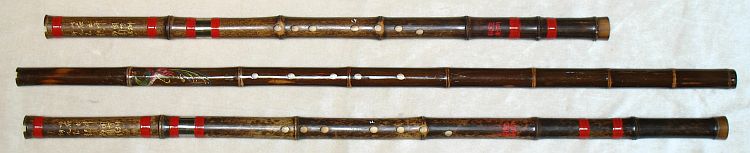
The generic term for the transverse flute in China today is "di". The most popular traditional type, a bamboo flute with six finger holes and a special hole for a "membrane" between the embouchure and first finger hole, is the dizi. In my understanding, dizi is pronounced vaguely like "dee-tsu", with only a quick touch of an unaccented vowel sound at the end; sometimes it sounds like "dee-tzzz". (The "zi" in "dizi" is a diminutive ending, so that dizi literally means "small di".)
wiki

wiki
wiki
The xiao
The xiao (pronounced somewhat like "showh", to rhyme with "cow", or "shyow") is an end-blown bamboo flute that is pitched lower than dizi.wiki
♥
Did I make fun of "wind" music yesterday? Well this they call Solar wind.... and it is quite nice... no new age, but no old age either and they went all the way to a very old (ha ha) church in California, as if they did not have any very old temples in China... so the quest goes on.. : )
14.8.11
Chinese Flute

Tseng Yung-Ching
Magic of the Chinese Flute
2002
Tracks:
01. Bird in the Shadows - 3:15
02. The Little Cowherd - 5:52
03. Joyous Meeting - 3:12
04. Song of Yimeng Mountain - 4:07
05. Spring Morning on Yangming Mountain - 6:23
06. Li-chu's Dream (Beijing Opera) - 4:12
07. Wheat Harvest - 4:33
08. "Pa-pan" - 4:50
09. View of a Mountain Village - 6:40
10. The Oriole Spreads his Wing - 3:33
11. Liu Ching - 2:01
12. Plum Blossom Triplet - 5:13
13. Ferry at Hsiao Yao (Beijing Opera) - 11:28

Beautiful and atmospheric Chinese flute music played by world-famous flute virtuoso Tseng Yung-ching. Accompanied on traditional Chinese instruments (yang qin – dulcimer, er-hu – Chinese fiddle, kong-hou – harp, various percussion, etc.).
Yes, and this is the closest we came in our quest for the Dizi so far, forget all these Chinese new age records, they call themselves Wind records, gone with the wind I guess, while ARC has become a serious record company you can almost trust... and that is a lot!

While very ancient, single-tube Chinese flutes with finger holes have been found—made from the bones of birds or animals, stone, and jade—it seems that the earliest depictions of flutes in China show panpipes (now called paixiao). Pottery figurines of players of end-blown flutes (today called xiao, also spelled hsiao) survive from the Han Dynasty (206 BC–220 AD). Transverse flutes (today called di or dizi) became common later, though some sources state that they, along with the xiao, arrived in China from the western regions during the Han Dynasty.
read it all here here :)

♥
9.8.11
100 gaidas ; )

Bulgaria: Gaida Orchestra
Bagpipe Music from the Rhodope
1995
Tracks:
01. Rodopi Gaida Suita (Large Ensemble)
02. Kapa Gaida Duo Contest
03. Shirokalaka Gaida Suita (Veteran Ensemble)
04. Rodopi Posadnitsa (Gaida Solo)
05. Dospat Gaida Suita (Veteran Ensemble)
06. Ovnyolyo Vakal Ramatan
07. Rodopi Gaida Suita (Veteran Ensemble)
08. Rodopi Suita (Gaida Solo)
09. Rodopi Suita (Gaida Duet)
10. Grashikovo Gaida Suita (Large Ensemble)
11. Chereshko Chorna Vishnichko
12. Rodopi Gaida Suita (Young Ensemble)
13. Ovcheri Moi, Ovcheri
14. Dospat Gaida Suita (Young Ensemble)
♫☆`*♥¸¸.•*¨*•♫☆`*♥¸¸.•*¨*•♫
♫☆`*♥¸¸.•*¨*•☆♫`*♥¸¸.•*¨*•♫

This CD is a collection of one specific type of gaida music, that of the kaba (low) ga-ida from the Rhodope mountains in Western Bulgaria. Tuned lower than its smaller brother the Thracian gaida which if often used to accompany dancing, the kaba gaida is occasionally featured in mass unison ensemble playing ( the so-called sto gaidi, or 100 gaidas-though no more than 18 kaba gaidas are heard performing in ensemble on this recording) or used as a single instrument in accompanying singers.
The fourteen tracks on this CD were recorded for Japanese JVC by members of youth and a "veteran"' ensembles from villages in the region around Smolyen in the Rhodopes. Presented are examples of the various performance forms in which kaba gaida is found, the solo (two examples), duo (two examples), solo accompaniment of a singer (three examples) and mass performance (seven examples). One tune is presented by both the youth and veteran ensembles.
Lynn Maners
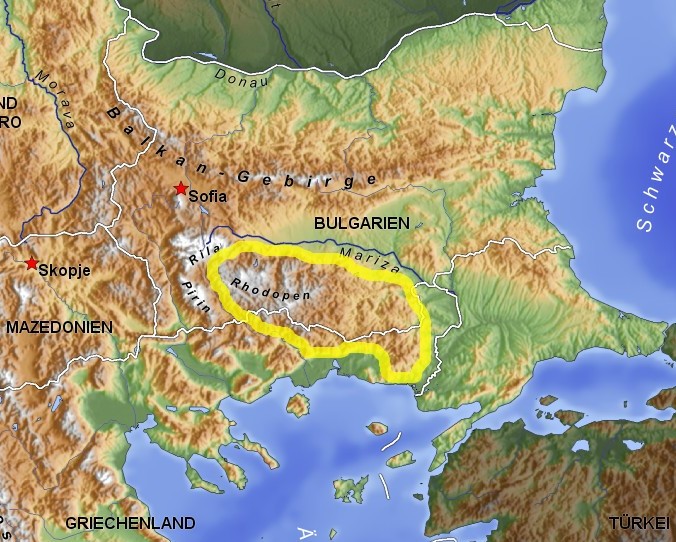
Rhodope Mountains

Gaida
The GAIDA (bagpipe) has two sounding parts: the Gaidounitsa and the drone. The Gaidunitsa is the most important part of the Gaida on which the performer plays the tune, and the drone accompanies the melody with a constant buzzing sound. There are two main types of Gaidas in Bulgaria: lower (“kaba”) and high (”djura”). The low (“kaba”) Gaida is spread in the Rhodope Moutain Region and the remaining types in the remaining parts of the country.
♥
some
?!
Subscribe to:
Posts (Atom)